A rapid, international observing campaign has documented the opening act of a supernova as a star about 20 times the mass of the Sun came apart in a catastrophic explosion. The event was first flagged by China’s Einstein Probe space telescope as a brief X‑ray flash in March, sparking an urgent response from ground‑based facilities that mobilised within the hour.
Fast alerts, fast follow-up
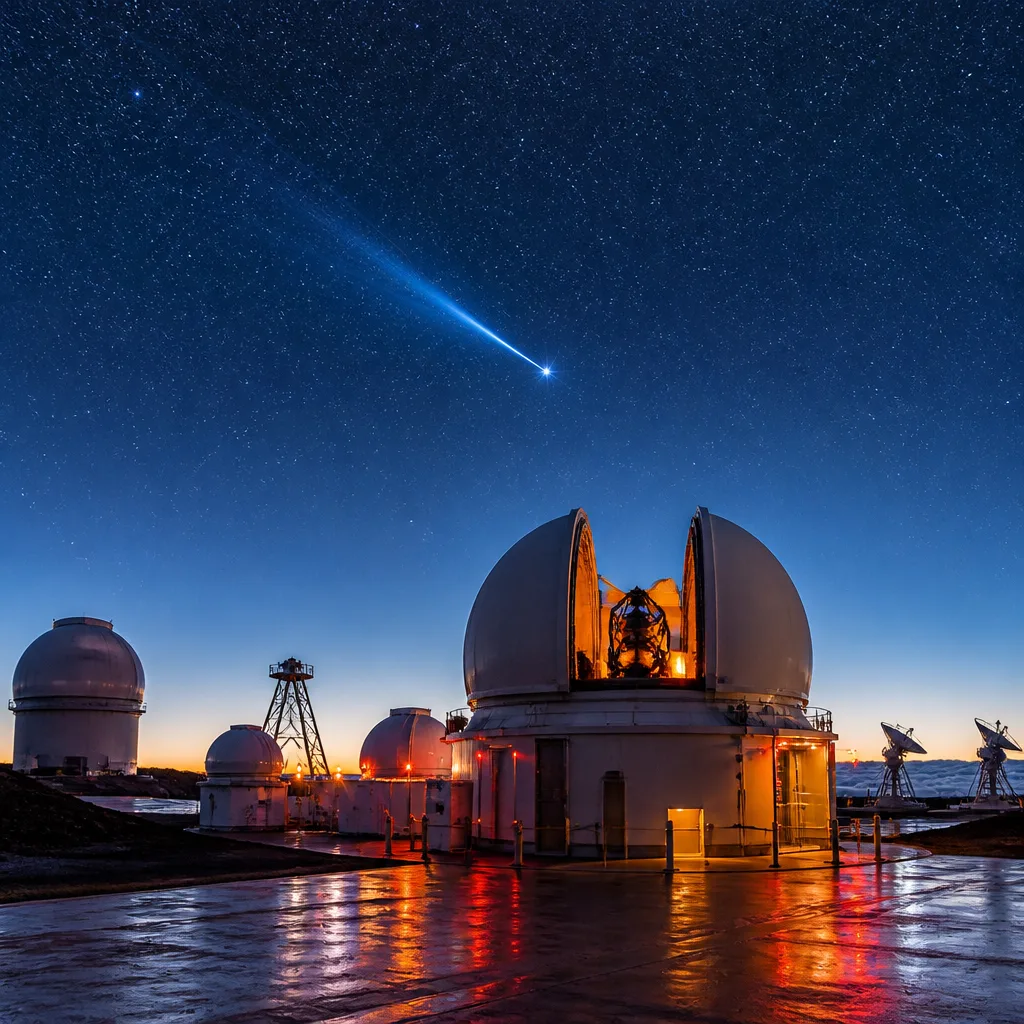
The initial X‑ray detection prompted a network of telescopes around the world to swing into action. Observatories cooperating in the effort included wide‑field survey instruments and pointed cameras able to track the transient as it evolved. Notably, the Vera C. Rubin Observatory — which began its planned 10‑year sky survey in late June — contributed early optical observations, marking one of the first science returns from the new facility.
Images from the Dark Energy Camera (DECam) chart the object’s rapid changes: a bright, blue source visible before the explosion, the initial luminous blast itself and a later phase of further brightening as the debris expanded and heated. These multi‑wavelength data provide a highly resolved timeline of the explosion’s early physics.
What the sequence reveals
By combining X‑ray and optical measurements taken within hours of the X‑ray flash, astronomers were able to witness stages of the supernova that are usually missed. Early emission can carry information about the star’s final hours, the distribution of material immediately surrounding it, and the shock physics that power the first radiative display. Capturing the event so promptly and across different bands gives researchers a rare chance to test models of massive star death.
- Trigger: X‑ray flash detected by China’s Einstein Probe (March).
- Rapid response: Ground telescopes began observations within an hour of the alert.
- Key facilities: Dark Energy Camera provided detailed optical evolution; Vera C. Rubin Observatory joined the campaign after starting its survey in late June.
The global approach — space‑based X‑ray discovery followed by near‑real‑time optical follow up — demonstrates the growing maturity of time‑domain astronomy. Large survey instruments that repeatedly scan wide swathes of sky are increasingly effective at delivering transient alerts that can be chased up by networks of specialist telescopes.
Implications for future discoveries
Events like this underline the scientific value of rapid coordination between facilities and the importance of new observatories coming online. The Rubin Observatory, designed to map the dynamic sky over a decade, is expected to issue thousands of transient alerts each night once fully operational. The success of this campaign shows how such alerts can be turned into immediate, high‑impact science when the community responds quickly.
| Milestone | Date / detail |
|---|---|
| X‑ray discovery | March — Einstein Probe detected a brief X‑ray flash |
| Ground follow‑up | Within an hour — telescopes identified the flash as a supernova |
| Rubin Observatory involvement | Late June — Rubin began its 10‑year survey and joined observations |
Future work will focus on detailed analysis of the multi‑wavelength datasets to constrain properties such as the progenitor star’s envelope, any nearby circumstellar material and the mechanisms that produce early X‑ray and optical emission. Such constraints are crucial for understanding how the most massive stars end their lives, and for refining predictive models used across astrophysics.
For now, the campaign stands as a clear demonstration that rapid, international cooperation — combining space‑based monitors with powerful ground observatories — can reveal the fleeting dawn of one of nature’s most energetic explosions in unprecedented detail.