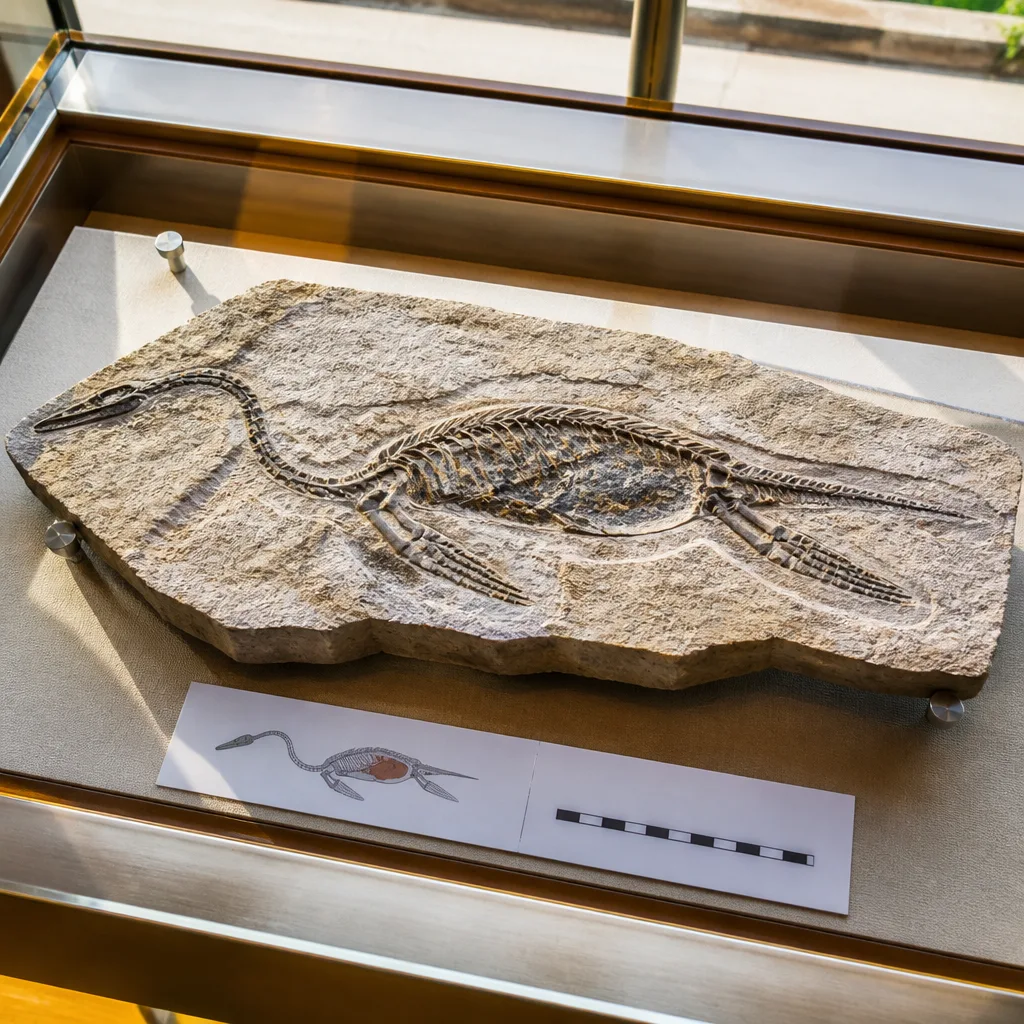
An international team of researchers has described an almost complete fossil of a small, long‑necked marine reptile that lived about 245 million years ago and, unusually, retains much of its digestive tract. The specimen, assigned to Austronaga minuta, contains identifiable remains of the stomach, liver and intestines, representing the oldest largely complete digestive system recorded in a reptile, the authors report in Science Advances.
Rare preservation gives new window on Triassic marine life
The fossil was analysed by scientists from China, across Europe and in the United States using modern analytical techniques. It measures roughly 60 centimetres in length and preserves not only a near‑complete skeleton but also soft tissues that are very rarely seen in reptiles of this age. The preserved organs allow direct comparison between skeletal anatomy and internal anatomy in a marine reptile that was already specialised for life in the water.
Austronaga has an unusual combination of proportions: an especially long neck and tail, elongated, fin‑like forelimbs and greatly reduced hind limbs. Examination of the specimen suggests the tail provided the primary propulsive force while the modified front limbs aided steering and stability. This swimming style resembles that of several unrelated marine reptiles that evolved later or independently, despite Austronaga’s evolutionary position.
“The archosaurs and their ancestors were the most diverse group of reptiles on land during the time of the dinosaurs, but we always thought that their adaptation to life in the sea was limited. However, the
The fossil’s evolutionary significance stems from Austronaga’s affinities. Although it shows convergent adaptations to an aquatic lifestyle, it is not closely related to ichthyosaurs or to the mosasaur lineage. Instead, the species sits closer to the land‑dwelling archosaur branch — the wider group that includes dinosaurs and crocodilians. The find therefore expands understanding of how and how frequently archosaur relatives invaded marine environments during the Triassic.
What the specimen reveals
- Soft tissues identified: stomach, liver and intestines — the oldest largely complete digestive system known in a reptile.
- Body plan: long neck and tail, fin‑like forelimbs, reduced hind limbs; tail-driven propulsion with forelimb stability control.
- Phylogeny: descended from land reptiles related to the archosaur lineage, demonstrating unexpected marine specialisation.
The research team includes scientists such as Dr Stephan Spiekman of the State Museum of Natural History Stuttgart and the University of Hohenheim. Credit for specimen imagery is given to Wei Wang and artistic reconstruction to Gabriel Ugueto.
| Feature | Observation |
|---|---|
| Age | ~245 million years |
| Species | Austronaga minuta |
| Length | 60 cm |
| Preserved organs | Stomach, liver, intestines |
Soft‑tissue preservation of this quality is exceptionally uncommon in Triassic reptiles, making the specimen valuable beyond its novelty. The anatomical data permit inferences about feeding, digestion and locomotion that are usually speculative for animals known only from bones.
Beyond the specimen itself, the find prompts broader questions about marine colonisation by terrestrial reptile groups. Convergent evolution — where distant lineages independently evolve similar solutions to aquatic life — appears to have been at work in the Triassic seas overlying what is now China. Austronaga’s mix of traits demonstrates that archosaur‑related reptiles experimented with aquatic niches earlier and perhaps more widely than previously appreciated.
As the authors note, combining skeletal and soft‑tissue evidence sharpens reconstructions of paleobiology in ways that isolated bones cannot. Continued study of this and related specimens, using advancing imaging and geochemical methods, should refine our picture of how these animals lived, moved and digested their food in prehistoric oceans.