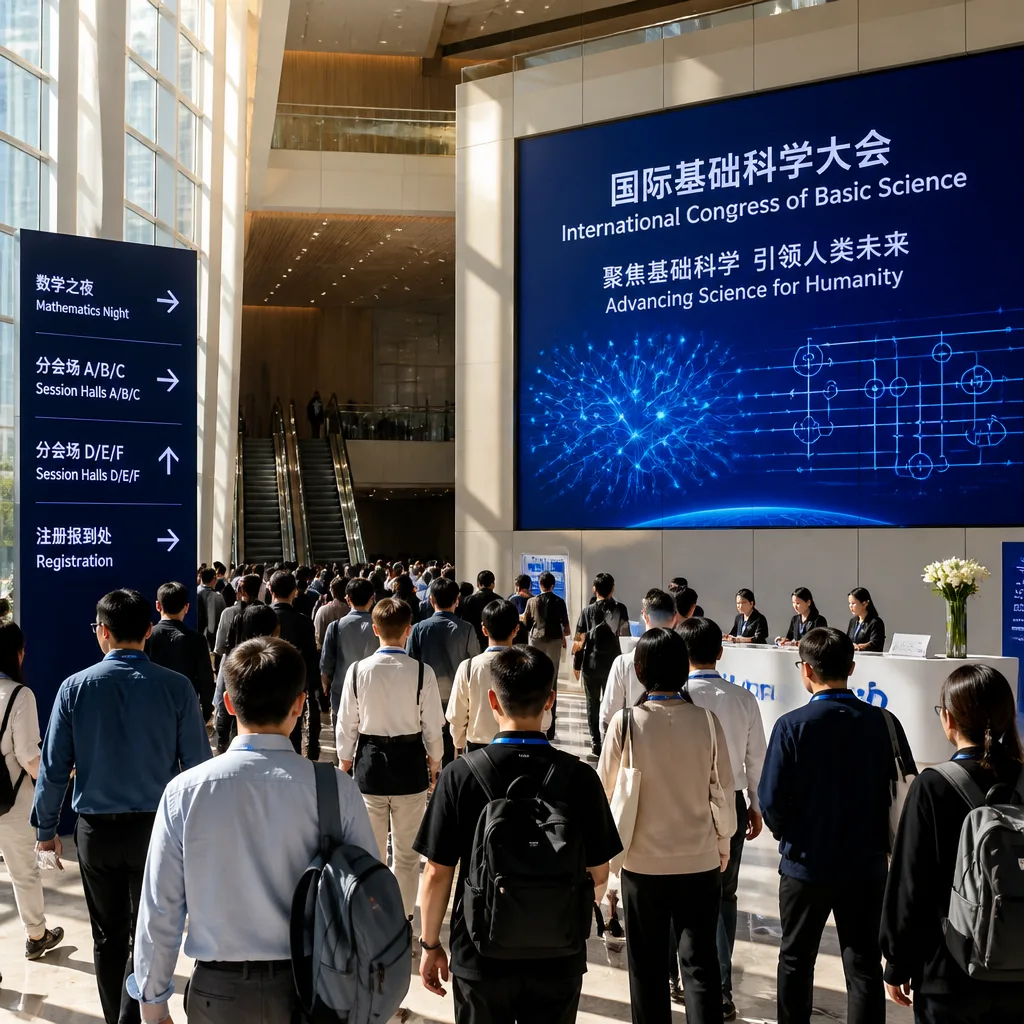
The 2026 International Congress of Basic Science opened in Beijing on Sunday, bringing together more than 1,000 participants from China and overseas for a two‑week programme designed to spotlight foundational research and foster multidisciplinary collaboration.
Broad agenda spanning disciplines and frontier topics
Organisers say the congress will run in excess of 500 academic sessions covering all branches of basic science, with particular attention to fast‑moving frontiers such as generative large‑model reasoning, computer vision, human–computer interaction and quantum information. The event aims to connect established researchers with younger scholars to share breakthroughs and discuss future directions.
A range of high‑level activities is scheduled, including discipline‑focused dialogues labelled as “Mathematics Night,” “Physics Night” and “Engineering Night.” These sessions are billed to feature lectures and discussions by internationally renowned scientists, with organisers highlighting participation by recipients of major international awards.
"Advancing Basic Science for Humanity," the organisers said, was the theme of the congress.
Forums on AI and diversity
Among the new elements of the programme is a Basic Science and AI Forum, intended to probe theoretical bottlenecks and potential routes to future breakthroughs in artificial intelligence, as well as to examine industry trends. A Women Scientists Forum will also convene, offering a platform for female researchers to discuss career trajectories, obstacles and opportunities in scientific research.
Delegates will be able to take part in a varied complement of activities beyond formal sessions: high‑level academic dialogues, youth engagement measures and cultural exchange programmes are on the calendar, underlining the organisers’ aim of combining scholarly exchange with science outreach.
Local engagement and international exchange
The congress also incorporates a series of locally focused events under banners such as “Tsinghua Day” and an “Explore Huairou” programme. These will bring visiting experts to Tsinghua University and to sites within Huairou Science City, as well as to cultural and innovation hubs — a schedule intended to offer international scholars a view of China’s research facilities and regional innovation landscape.
Delegates are expected to benefit from a mix of formal lectures, award reports and informal dialogue aimed at stimulating multidisciplinary research. The organisers say the congress will showcase recent global advances in basic science while encouraging greater collaboration across fields.
What the congress offers the research community
For the international research community, the congress presents several practical opportunities:
- Networking between established award‑winning scientists and early‑career researchers.
- Exposure to frontier topics linking theoretical research with rapidly developing AI and quantum technologies.
- Forums addressing diversity in science and the future direction of basic research.
With its size and breadth, the event aims both to disseminate recent discoveries and to shape conversations about where basic science should focus next. For policy‑makers and funders, the congress offers a vantage point on priorities in fields that underpin long‑term technological and economic competitiveness.
As the two‑week meeting progresses, the international science community will be watching for reports of new collaborations, consensus on theoretical challenges — particularly in AI and quantum theory — and indications of how basic research agendas may shift in response to the discussions held in Beijing.
| Detail | Figure |
|---|---|
| Duration | Two weeks |
| Participants | More than 1,000 |
| Sessions | Over 500 |