
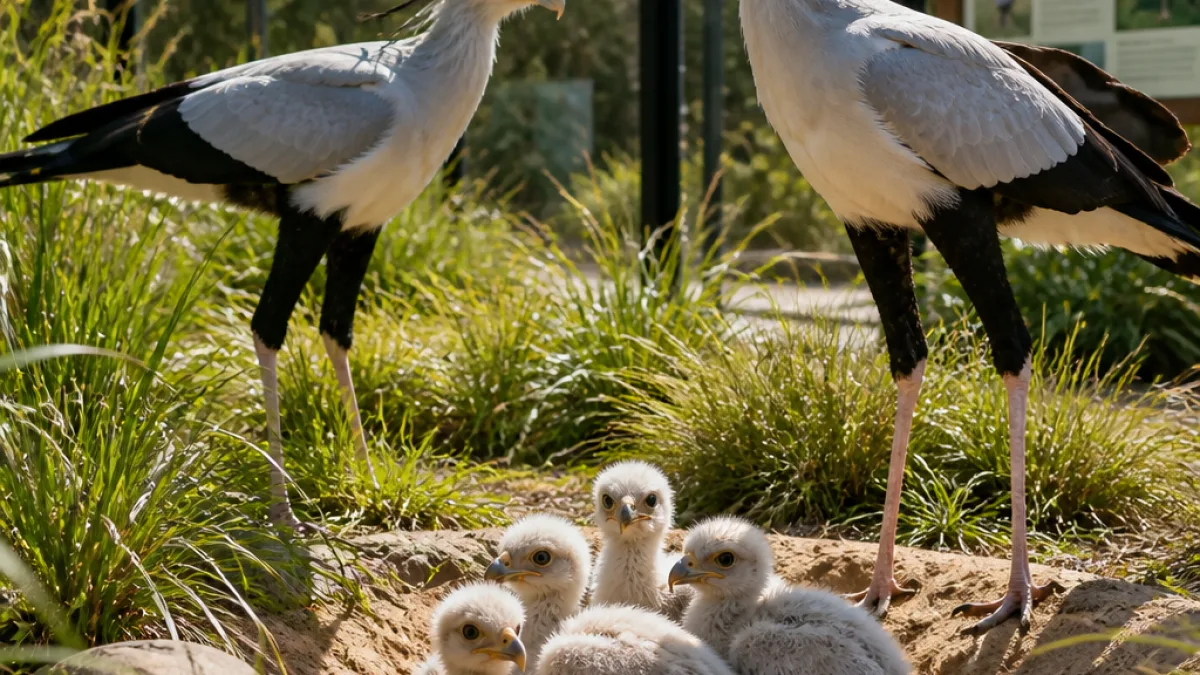
Historic hatch at Chester Zoo bolsters conservation efforts for endangered secretarybirds
Chester Zoo has announced the successful hatching of five secretarybird chicks, the first time the species has bred at the site in its 95-year history. The births were described by zoo staff as a significant breakthrough that could inform captive-breeding approaches for the species elsewhere in Europe.
The chicks hatched to a pair that arrived at the zoo as part of international conservation efforts to support the secretarybird, a striking bird of prey native to African grasslands. Unlike many raptors, secretarybirds hunt extensively on foot, using their long legs to pursue prey and to dispatch venomous snakes by stomping on them — an adaptation reflected in their scientific name, Sagittarius serpentarius, often translated as "the archer of snakes."
Conservationists say the species has suffered steep declines in recent decades, principally through loss of grassland habitat to agriculture and urban expansion, which has reduced available prey and nesting areas. Today, estimates suggest there may be as few as 6,700 birds left in the wild, and the International Union for Conservation of Nature (IUCN) raised the species to endangered on its Red List in 2020.
The zoo believes the husbandry and breeding techniques developed during this successful rearing could benefit other institutions participating in coordinated conservation programmes. Staff emphasised that methods refined at Chester may help improve breeding outcomes for the species across conservation collections in Europe.
- Number of chicks: 5
- Zoo history: 95 years since founding
- Estimated wild population: around 6,700
- IUCN status change: uplisted to endangered in 2020
For Chester residents, the event underlines the zoo’s continuing role as a centre for species conservation as well as public education. Chester Zoo has long attracted visitors from across the region and beyond; successful breeding of a high-profile endangered species is likely to strengthen its reputation for scientific expertise and wildlife care.
Beyond immediate local pride, the breakthrough carries practical conservation implications. If the husbandry techniques applied in Chester can be replicated elsewhere, captive-breeding programmes may see improved success rates, allowing zoos and conservation partners to better manage the genetic diversity and long-term viability of secretarybird populations held in human care.
Staff at the zoo have stressed that captive breeding is only one component of a broader conservation strategy. Long-term survival of secretarybirds in the wild depends on securing and restoring grassland habitats and addressing the threats posed by agricultural expansion and human development — challenges that require international co-ordination and investment.
The hatchlings also present an educational opportunity for visitors and schools. Chester Zoo’s public-facing work frequently aims to raise awareness of species declines and foster support for conservation measures. The presence of these chicks may be used to illustrate the complexities of species protection, from habitat preservation to the technical aspects of breeding rare birds under human care.
| Fact | Detail |
|---|---|
| Chicks hatched | 5 |
| Zoo age | 95 years |
| Estimated wild population | ~6,700 |
| IUCN status | Uplisted to endangered (2020) |
As the chicks grow, staff will continue to monitor their development closely and share findings with international partners. For the people of Chester, the successful hatching is a reminder of the zoo’s global conservation reach and its local value as a hub for scientific expertise and wildlife engagement.