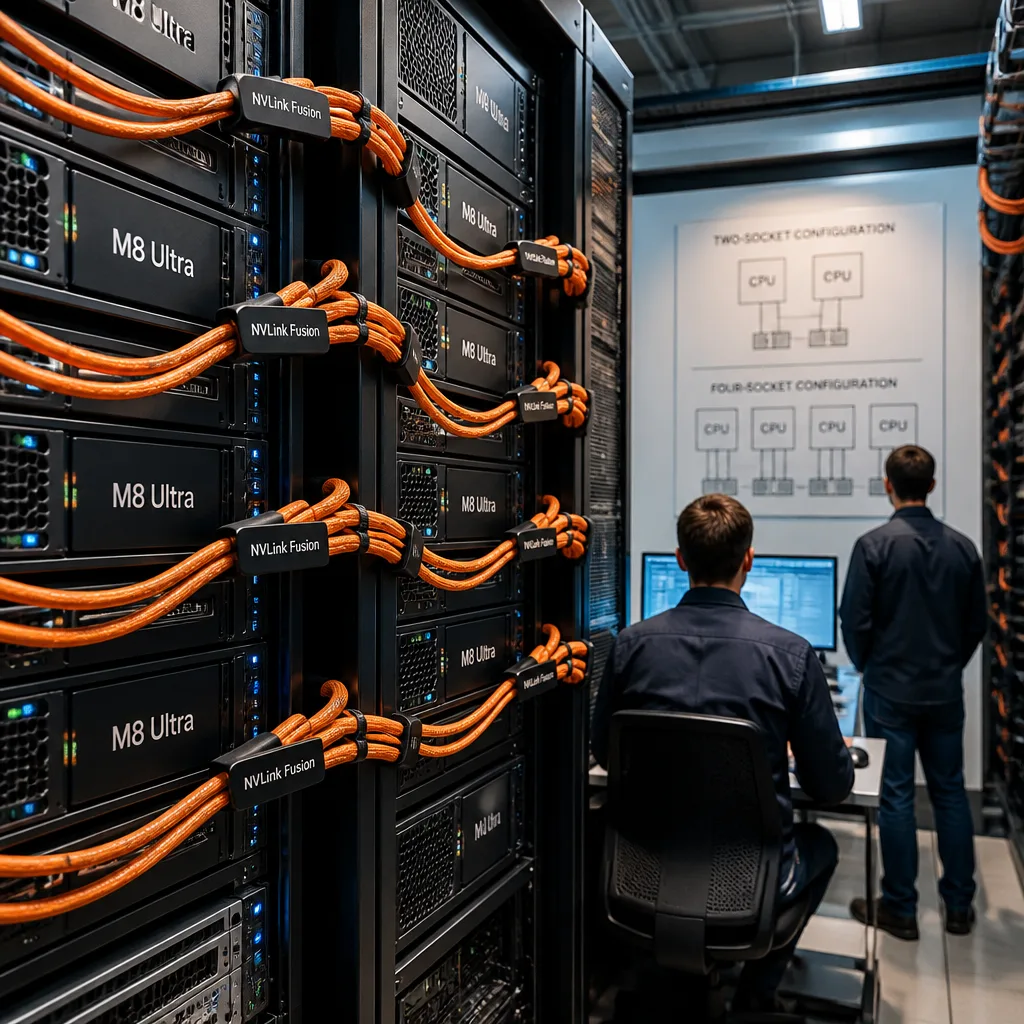
Apple is reportedly preparing a return to the server market by designing racks built around new, AI-orientated M-series system-on-chips that could use NVIDIA's NVLink Fusion technology for high-speed interconnection.
What is being proposed
According to reporting by The Information, Apple is considering server-class hardware that would permit socket-to-socket links between two or four future M8 Ultra chips using NVIDIA's NVLink, with NVLink-C2C handling die-to-die communication. The project, aimed at enterprises and government customers, is tentatively timed for a 2029 product launch.
If realised, the move would mark Apple’s first formally marketed server offering since it sold Xserve rack units from 2002 until discontinuing them in 2011. In place of designing its own interconnect stack, the company would reportedly lean on NVIDIA's IP while concentrating on the system-on-chip itself.
Why Apple might be drawn back
Three factors appear to be in play:
- AI demand — Apple has been expanding efforts on generative AI and runs its own Apple Foundation Models; local inference hardware is increasingly attractive to enterprises.
- Mac sales momentum — The Mac product line posted a record quarter with $10.4 billion in revenue, with the company said to be seeing particular interest from AI developers.
- Developer practices — Some organisations are already mounting multiple Mac Studio units in custom racks to run local AI inference, suggesting a market for more integrated server solutions.
Apple is also working on an internal custom inference accelerator in partnership with Broadcom, codenamed:
"Baltra"
That accelerator reportedly targets TSMC's 3 nm process options (N3E or N3P) and is scheduled to reach the market in late 2026 or early 2027, according to the same reporting. It is not clear how Baltra and any future M8 Ultra server racks would coexist or be positioned relative to each other.
Technical and commercial questions
Relying on NVLink Fusion would be a notable departure from Apple’s historical tendency to own more of the stack. The NVLink portfolio is designed to enable high-bandwidth, low-latency links between chips and dies, which matters for partitioning large AI models and moving data quickly between compute elements.
Key unknowns remain. The publicly reported timeline targets 2029 for M8 Ultra-based racks, but Apple’s famously secretive product planning and prior shifts in schedule mean those dates could change. It is also unclear whether the company would sell complete rack systems, supply modules to third parties, or offer chips and interconnect technology in different combinations.
There are strategic trade-offs: offering servers could help Apple keep more of its AI stack on-premises for enterprise customers and governments, but it would also place the company in direct competition with established server vendors and hyperscalers whose ecosystems and software stacks differ markedly from macOS and Apple silicon's current markets.
Context and consequences
For enterprises running local AI workloads, a tightly integrated Apple hardware stack could simplify deployments if software and management tools follow. For the chip and IP supply chain, collaboration with NVIDIA and Broadcom highlights how modern server designs increasingly blend partners' strengths — compute, specialised accelerators and high-speed interconnects.
Whether Apple will follow through and how customers would adopt such systems are open questions. The reported plan reflects wider pressure on major tech companies to deliver performant, on-premise AI inference at scale while balancing cost, power and control.
| Milestone | Date (reported) |
|---|---|
| Apple Xserve availability | 2002–2011 |
| Broadcom "Baltra" AI accelerator | Late 2026 / early 2027 |
| M8 Ultra server racks (NVLink Fusion) | Planned 2029 |
For now, the report is a reminder that hardware roadmaps remain in flux as companies chase generative AI workloads. With a new chief executive in hardware, John Ternus, Apple’s future product mix could broaden considerably — but the details, and market reception, will determine whether a return to the server rack is a strategic expansion or a niche play.