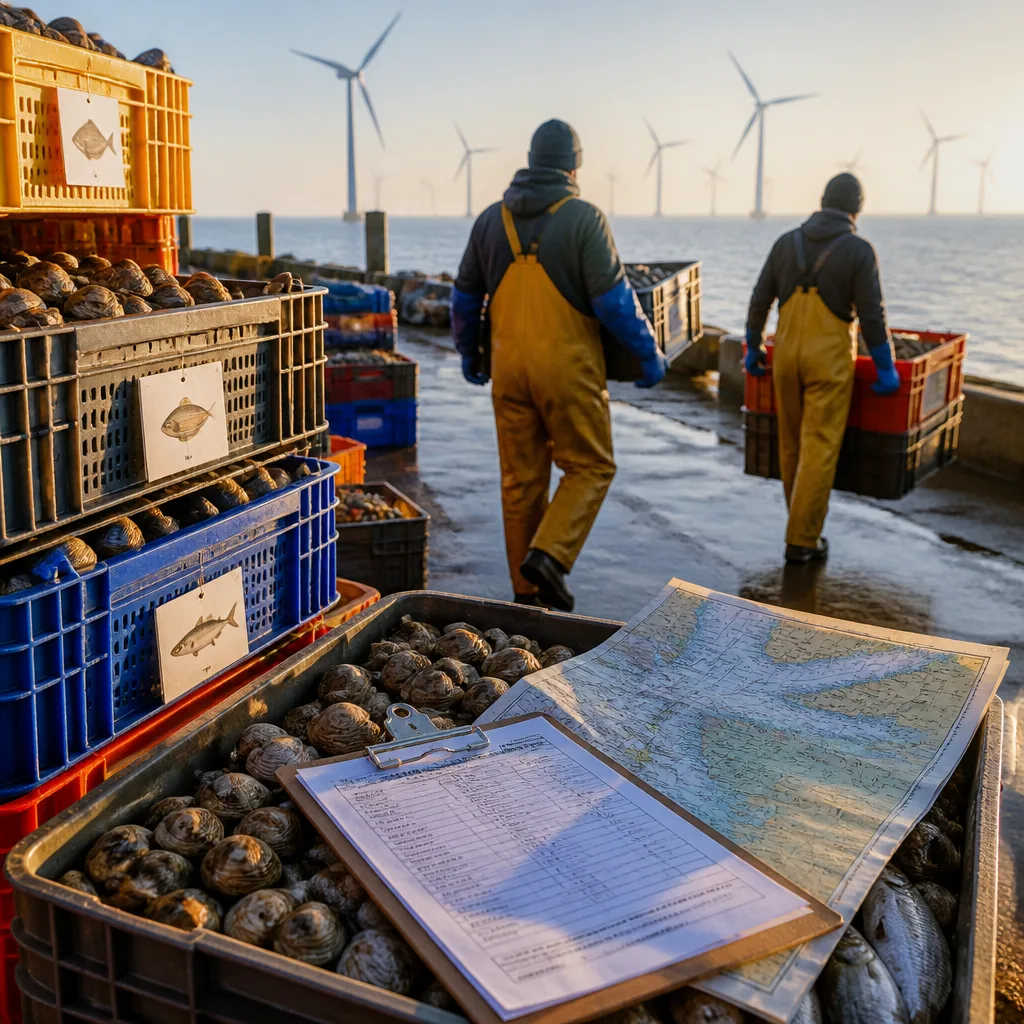
The Virginia Institute of Marine Science (VIMS) has appealed to the seafood sector to take part in a new survey designed to clarify how offshore wind development could affect the wider commercial fishing economy. The exercise, called the Seafood First Sale Value Added Survey, is intended to capture the economic roles and business operations of shoreside companies that handle seafood in the Mid-Atlantic and Northeast United States.
Survey aims to map shore-based economic links
Funded by a grant from the Science Center for Marine Fisheries (SCEMFIS), the questionnaire is meant to fill information gaps that advocates say are essential to designing fair compensation for communities that might lose revenue if regional landings fall because of offshore wind installations.
According to VIMS, the survey will document how seafood moves from the vessel through the other businesses that support the commercial fishing economy and will quantify the economic contribution of those enterprises. Officials hope that better data on processing, distribution and other shore-based activity will allow policymakers to weigh how changes at sea could ripple ashore.
“Compensation programmes cannot fairly account for shoreside losses unless decision-makers understand how seafood moves from the vessel through the other businesses that support the commercial fishing economy,”
— Peter Hughs, director of sustainability for Atlantic Cape Fisheries and an advisor to the multistate Fisheries Compensation Program, urged businesses to use the survey to record their economic roles and to explain how reduced regional landings would affect operations, staff and local communities.
Context: strained relations between fisheries and wind developers
The request for broad industry participation comes against a backdrop of friction between commercial fishing interests and the offshore wind sector. Fisheries groups have expressed concern about the potential impact of turbine developments on fishing grounds and operations, with some seeking legal remedies to halt projects.
Notably, the Responsible Offshore Development Alliance pursued litigation challenging wind leases off the East Coast but ultimately lost when the US Supreme Court declined to hear an appeal. Political intervention has also occurred: the presidency of Donald Trump produced multiple executive orders seeking to impede offshore wind expansion; court action struck down the first such order in December 2025, and a subsequent order issued in January 2026 also failed to achieve its aims.
VIMS frames the survey as a practical step to ensure that compensation discussions and planning reflect the complexity of the seafood supply chain rather than focusing solely on losses at sea.
- Who is being asked: Shoreside seafood businesses in the Mid-Atlantic and Northeast US
- Purpose: Document business operations, economic contributions and the value added along the seafood chain
- Funding: Grant from the Science Center for Marine Fisheries (SCEMFIS)
| Item | Detail |
|---|---|
| Survey name | Seafood First Sale Value Added Survey |
| Lead institution | Virginia Institute of Marine Science (VIMS) |
| Funder | Science Center for Marine Fisheries (SCEMFIS) |
| Geographic focus | Mid-Atlantic and Northeast United States |
Researchers and industry advisors say comprehensive shore-side data are crucial because losses from reduced fishing opportunity do not stop at the harbour: processors, transporters, wholesalers and ancillary service providers all face potential impacts. Without such evidence, compensation schemes risk undervaluing the full economic effect of disruptions to regional landings.
The VIMS initiative underlines a central tension in the rapid expansion of offshore wind: how to reconcile national energy targets and climate goals with the livelihoods and economic ecosystems tied to working seas. By inviting seafood businesses to set out their roles in detail, the institute aims to provide a clearer basis for policy discussions about mitigation and compensation as the offshore landscape changes.
VIMS has urged eligible businesses to participate so that planners and regulators can make decisions informed by a fuller picture of economic interdependencies.