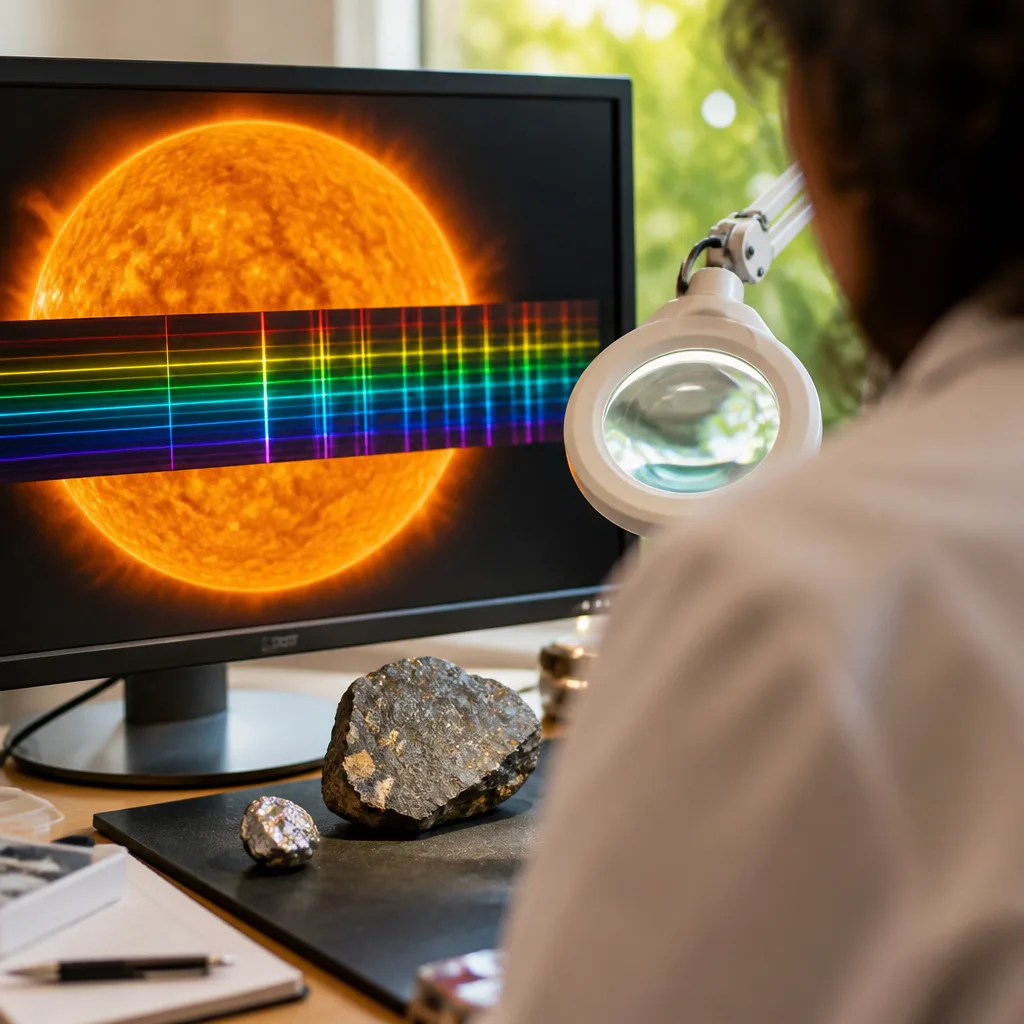
Scientists at Uppsala University report that the Sun contains about 55% more silver than previous estimates, following a new analysis that uses a more realistic model of the solar atmosphere and updated atomic physics calculations. The result brings the star's measured composition into closer agreement with values inferred from ancient meteorites and offers a sharper benchmark for studies of stellar and galactic chemical evolution.
Improved models, revised abundance
The Sun is overwhelmingly hydrogen and helium; heavier elements such as carbon, iron and silver together make up a small fraction of its mass. Despite their scarcity, these elements act as vital tracers of the history of stars and galaxies. The Uppsala team combined a dynamic, three-dimensional description of the Sun’s outer layers with better treatments of how silver atoms absorb and scatter light. This produced an updated silver abundance around 55% higher than earlier figures derived from simpler models.
"The new knowledge about the Sun's composition is important for the understanding of other stars, planets and cosmic material, because the Sun is one of astronomy's key reference points," said Sema Caliskan, who carried out the work during her PhD studies at Uppsala University's Department of Physics and Astronomy.
Why silver in sunlight matters
A wealth of astrophysical inference depends on accurate solar abundances. Elements heavier than helium are produced in stars and in stellar explosions and are incorporated into subsequent generations of planets, meteorites and stars. By measuring how much of each element is present in the Sun, astronomers calibrate models of nucleosynthesis and the chemical enrichment history of the Milky Way.
Spectroscopy — the study of the Sun’s light broken into its constituent wavelengths — is the primary tool for these measurements. Different elements imprint unique dark lines, or spectral features, where atoms absorb specific wavelengths. The strength and shape of those features depend not only on the number of absorbing atoms but also on the physical conditions in the layers of the solar atmosphere where they form. The Uppsala analysis used a more realistic atmospheric representation and refined atomic interaction data to reinterpret the silver lines.
Consequences and context
The upward revision of the solar silver abundance helps resolve a long-standing mismatch between solar measurements and the composition of some meteorites, which preserve material from the early solar system. Bringing those two records into better alignment strengthens confidence in using the Sun as a chemical yardstick for other astronomical objects.
Practical consequences include:
- Improved calibration for models of stellar and galactic chemical evolution.
- More reliable comparisons between solar and meteoritic material when reconstructing the early solar system.
- Potential adjustments to elemental ratios used in studies of planet formation and stellar archaeology.
| Quantity | Relative value |
|---|---|
| Previous silver estimate | 1.00 (baseline) |
| Revised silver estimate | 1.55 (≈55% higher) |
The team’s approach emphasises that deriving accurate elemental abundances requires both precise atomic data and realistic modelling of the medium where light-matter interactions occur. Earlier studies often used simplified, static atmospheric descriptions; accounting for the Sun’s dynamic outer layers changes how spectral lines are interpreted.
While the revised silver figure is significant, it concerns one element among many that are measured to build a comprehensive picture of solar composition. The study demonstrates how advanced physical modelling can shift inferred abundances and suggests similar re-evaluations may be needed for other elements where discrepancies persist.
The finding is particularly valuable because the Sun is a cornerstone for astrophysical comparison: it serves as the nearest, best-studied star and a reference against which distant stars and solar-system materials are measured. Any change to its chemical inventory ripples through multiple areas of astronomy, from models of how stars produce heavy elements to the interpretation of exoplanet host-star signatures.
Further work will examine whether comparable revisions are required for other elements and how updated abundances alter current stellar and galactic chemical models. For now, the Uppsala result narrows a long-standing mismatch and highlights the continuing importance of combining detailed atomic physics with realistic stellar atmosphere modelling.