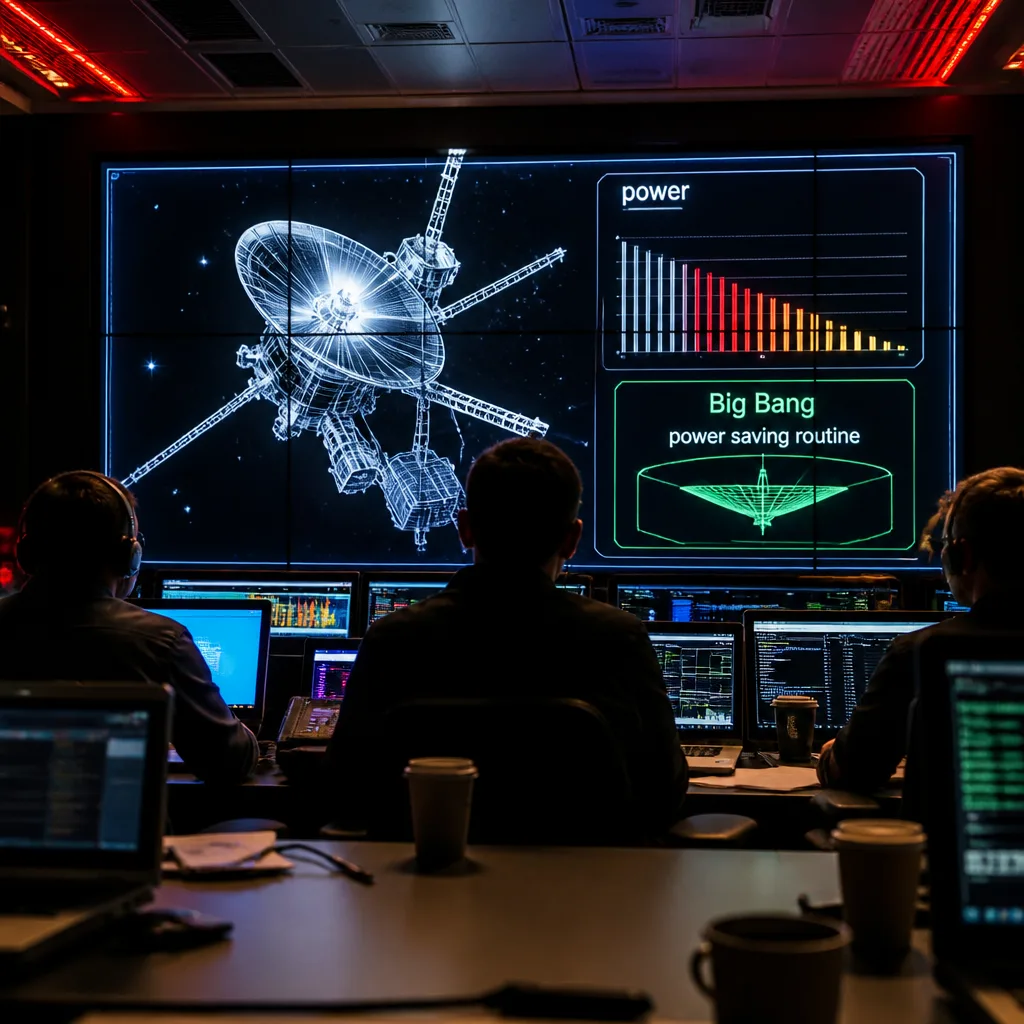
NASA engineers have found a way to keep the Voyager 2 spacecraft conducting science in interstellar space for longer than previously expected by reducing the probe’s electrical demand. The manoeuvre, dubbed the “Big Bang” by the mission team, substitutes higher-power devices with lower-consumption alternatives and powers down non-essential systems to preserve energy for instruments.
How the team bought more science
Launched almost half a century ago, Voyager 2 relies on a pair of radioisotope thermoelectric generators (RTGs) that convert heat from decaying plutonium into electricity. As the plutonium decays the available electrical output falls; the mission team estimates the probes lose around 4 watts of power each year. With margins slim after decades in space, engineers have progressively shut down non-critical equipment to prioritise scientific instruments.
The recent effort involved simultaneously switching off certain powered devices and replacing others with lower-power substitutes while ensuring essential thermal control remained sufficient for operations. According to the mission update, the measures should permit three science instruments to continue gathering data for at least an additional year beyond prior expectations.
- Mission platform: Voyager 2
- Power source: Radioisotope thermoelectric generators (decaying plutonium)
- Power decline rate: ~4 watts per year
- Outcome of manoeuvre: Three instruments preserved for at least one extra year
Why this matters
Voyager 2 remains one of humanity’s few emissaries beyond the heliosphere, sending measurements from plasma, magnetic fields and charged particles in a region of space never routinely sampled. With no way to refuel the RTGs, each watt saved translates directly into more time for scientific observation. The latest conservation step therefore sustains a unique stream of data about interstellar space and how the sun’s influence fades into the environment between the stars.
The approach taken underlines the operational creativity required for long-duration missions. Engineers must balance electrical consumption, thermal management and communications needs: reduce power in one subsystem and the thermal environment can change, potentially affecting instruments or electronics. The team’s plan apparently maintained temperature margins while freeing enough power for the selected instruments to continue functioning.
| Parameter | Value |
|---|---|
| Annual power decline | ~4 watts/year |
| Additional science operations expected | At least 1 year |
These incremental engineering solutions have been a recurring theme for the Voyager missions as their power budgets have tightened over decades. Mission teams have previously shut down heaters, instruments and auxiliary systems in a staged fashion to protect core scientific capability. The latest manoeuvre — labelled the Big Bang — bundles multiple such actions together to produce a larger immediate saving.
While the announcement does not list which three instruments will remain active, sustaining any set of instruments aboard a vehicle launched in 1977 is testament to meticulous systems management and extensive ground-side analysis. Continued returns from Voyager 2 are valuable not only for heliophysics but also as a benchmark for designing and operating future probes that must function for many years in deep space.
Credit for imagery and mission details was provided by NASA/JPL‑Caltech.
As the Voyagers continue their slow outward trek, each additional year of data helps refine models of the boundary between our solar environment and interstellar space. Engineers say further conservation steps will likely be necessary in coming years as the RTGs’ output continues to diminish.