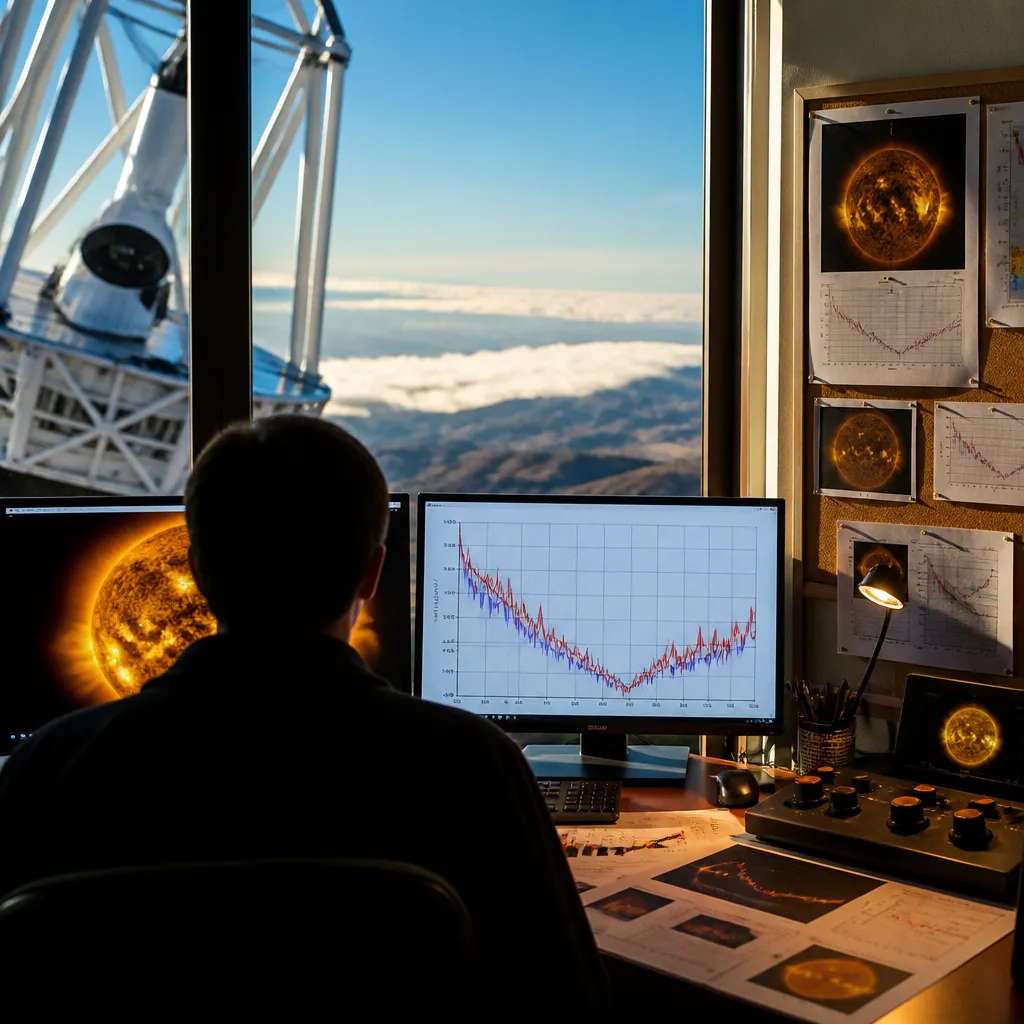
The long-term weakening of the Sun that began in the late 20th century appears to have reversed around 2008, with underlying solar activity rising in the years since, researchers report. The findings, published in The Astrophysical Journal Letters in September 2025 and summarised by NASA, reshape expectations about whether the Sun was entering an extended quiet phase.
What changed after 2008
Across multiple measurements of the solar wind and magnetic properties near Earth, the downward trend that characterised several decades up to 2008 stopped and has been trending upward on average. The reversal does not mean the Sun has abandoned its normal cyclical behaviour; rather, scientists say the baseline on which the familiar 11-year sunspot cycles ride has shifted.
“The Sun is slowly waking up.”
The brief remark, attributed to Jamie Jasinski in NASA’s account of the study by Jasinski and Marco Velli, captures the essence of the result: cycles continue, but the background state that defines how active those cycles appear has altered.
Context: cycles and the 2008 minimum
The Sun’s magnetic activity swings on roughly an 11-year rhythm, punctuated by a larger 22-year magnetic reversal during which the solar poles swap and then return. Near cycle peaks, tangled magnetic fields produce more sunspots, flares and coronal mass ejections; at minima, visible sunspots can be scarce for extended periods.
Solar Cycle 23 ended in a minimum that was notable even among minima. During 2008 and into early 2009 the Sun spent long stretches without visible sunspots and spacecraft-era measurements recorded an unusually weak solar wind. Prior to that minimum, several solar-wind indicators had been falling across more than one cycle, prompting speculation the Sun might be entering a prolonged quiet interval akin to historical grand minima.
What the new analysis shows
The new study examined a range of solar-wind and magnetic datasets and concluded the multi-decade decline bottomed in 2008. Since then the trends in those parameters have pointed upward, indicating an increase in the Sun’s baseline activity even as its recurrent 11-year oscillations continue.
The distinction is important: researchers stress the Sun has not grown steadily more violent year after year, nor has it abandoned cyclical variation. Instead, the background level upon which cycles are superimposed appears to have recovered some strength after the extreme quiet observed in the late 2000s.
- 1980s–2008: Several solar-wind parameters trended downward across multiple cycles.
- 2008–2009: Exceptional solar minimum with lengthy spotless intervals and weakened solar wind.
- Post-2008: Underlying trend reverses; baseline activity increases whilst 11-year cycles persist.
Implications and next steps
Understanding the long-term baseline of solar activity matters for forecasting space weather that affects satellites, communication systems and electrical infrastructure. A rise in the background level could influence the frequency or intensity of space-weather events at future cycle peaks, even if year-to-year variability remains governed by the familiar cycle.
Researchers will continue to monitor solar-wind and magnetic measurements to see whether the upward trend endures and how it interacts with forthcoming cycles. The paper by Jasinski and Velli, and NASA’s summary of it, provide a crucial recalibration of where the Sun stands after the exceptionally quiet period around 2008.
| Period | Characteristic |
|---|---|
| 1980s–2008 | Multi-decade decline in several solar-wind parameters |
| 2008–2009 | Notable solar minimum; long spotless stretches and weak solar wind |
| Post-2008 | Underlying trend reverses; baseline activity rises |