Researchers have detected signs that a substantial magma reservoir beneath Japan's mainly submerged Kikai caldera is being replenished, offering rare observational evidence of how enormous volcanic systems rebuild themselves after catastrophic eruptions.
Seismic imaging reveals renewed magma input
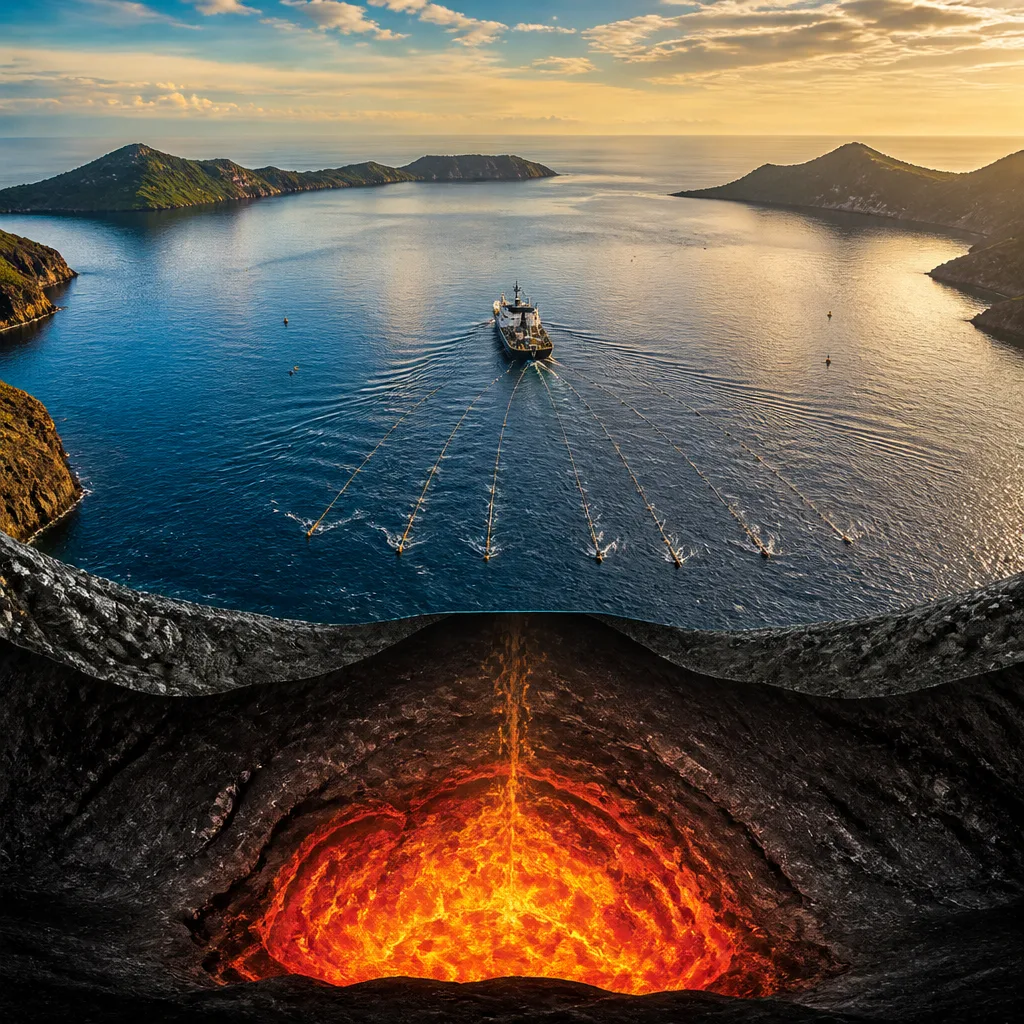
The work, led by geophysicists at Kobe University in collaboration with the Japan Agency for Marine-Earth Science and Technology (JAMSTEC), used systematic seismic surveys across the caldera to probe its crustal plumbing. Controlled energy sources — deployed at sea where much of the caldera lies — let the team map deep structures beneath the seafloor and infer that fresh magma has likely entered an existing underground reservoir.
Kikai is notable because about 7,300 years ago it produced what is regarded as the largest volcanic eruption of the Holocene epoch, the geological period that began roughly 11,700 years ago. Such eruptions evacuate enormous volumes of magma and often leave behind broad collapse features known as calderas rather than a single cone-shaped mountain.
"We must understand how such large quantities of magma can accumulate to understand how giant caldera eruptions occur,"
— Nobukazu Seama, Kobe University geophysicist.
Why underwater setting helped the study
The caldera's partly submerged position, while challenging in some respects, allowed the researchers to carry out wide-ranging, systematic surveys that are harder to execute on complex terrestrial terrains. The controlled seismic sources — commonly referred to as airgun arrays — enabled consistent imaging across the structure and supplied data to characterise the size and state of the magmatic reservoir beneath the caldera.
- Observation: Seismic signatures consistent with renewed magma accumulation beneath the caldera.
- Method: Large-scale underwater seismic surveys using controlled sources.
- Collaboration: Kobe University and JAMSTEC conducted the work.
Implications for giant calderas worldwide
The finding is important because caldera systems such as Kikai, Yellowstone (United States) and Toba (Indonesia) can erupt more than once, but the processes by which they amass the vast quantities of magma needed for repeated colossal eruptions are not well understood. Observations that capture a reservoir in the act of recharging provide empirical constraints on those processes and may ultimately help scientists recognise the subsurface changes that precede major eruptive activity.
Because direct observations of large caldera recharge are rare, the Kikai study offers a valuable natural experiment. Improved imaging of how melt accumulates, pools and evolves at depth can be integrated with geochemical and petrological studies elsewhere to refine models of caldera behaviour.
| Feature | Detail |
|---|---|
| Volcano | Kikai caldera |
| Epoch | Holocene |
| Notable event | Largest known Holocene eruption (~7,300 years ago) |
| Method | Broad underwater seismic surveys with airgun arrays |
While the presence of fresh magma beneath Kikai does not mean an eruption is imminent, the work adds to a growing body of evidence about the lifecycles of the planet's largest volcanic systems. The team emphasise that understanding the mechanics of magma accumulation is essential to any attempt to forecast the timing and scale of potential future eruptions.
Future research building on these observations could combine longer-term seismic monitoring, petrological analyses of erupted materials (where available) and geodetic measurements to detect any surface deformation tied to deep recharge. Together, such approaches would improve the ability to distinguish routine magmatic processes from the signals that might presage extraordinarily large eruptions.
The study underlines the scientific value of systematic, large-scale surveys in volcanic regions and demonstrates how marine environments can afford a unique vantage point for peering into the deep plumbing of calderas.