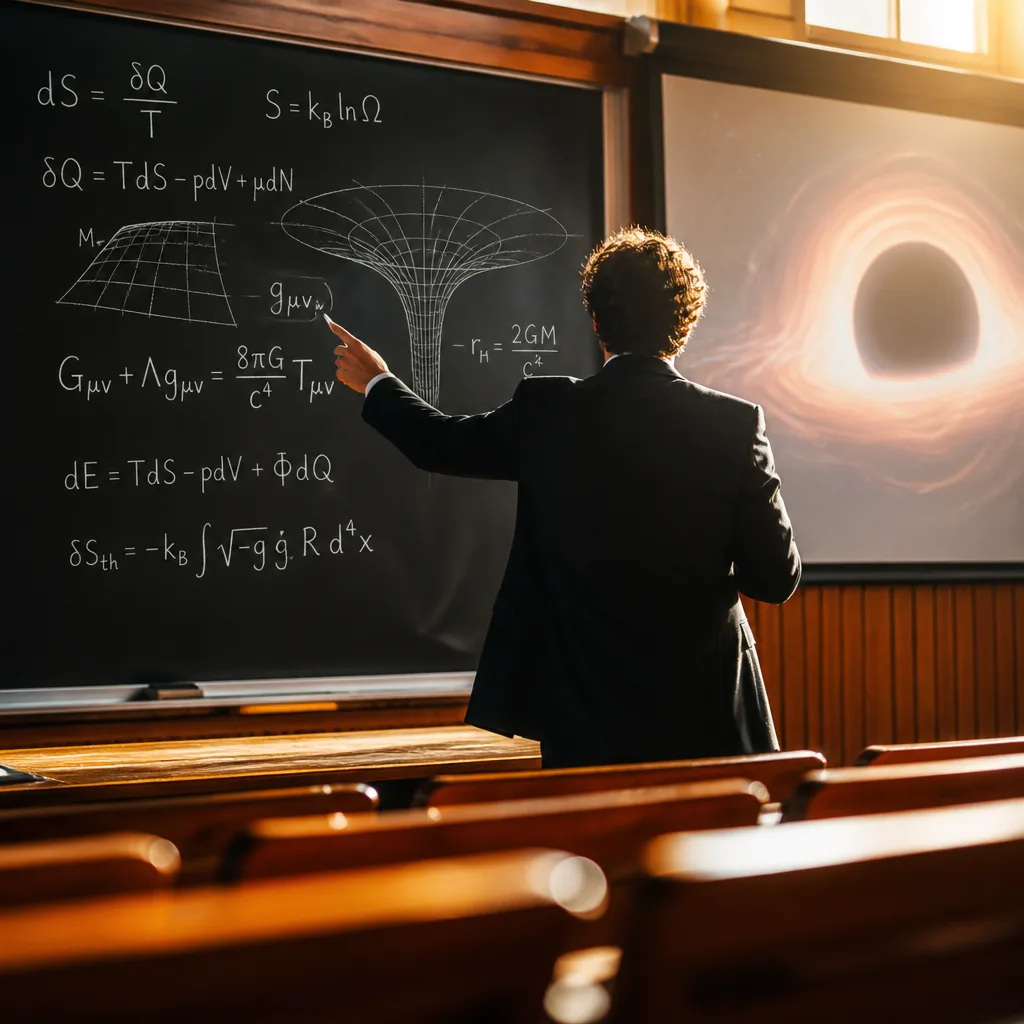
Physicists have reported an unexpected and potentially profound link between the laws of thermodynamics — the theory that governs heat, energy and entropy — and Einstein’s general relativity, the framework for gravity. The finding builds on decades of work showing that black holes are not merely regions of warped spacetime but also thermodynamic systems with temperature and entropy.
From steam engines to spacetime
The conceptual thread that now appears to weave heat and gravity together began in the 19th century with studies of heat engines. The French engineer Sadi Carnot’s investigations into the performance limits of steam engines exposed fundamental constraints on how heat can be converted into work, and helped establish what became the second law of thermodynamics.
In the 20th century physicists extended thermodynamic thinking into the realm of gravity. Jacob Bekenstein proposed that black holes possess entropy — a measure of disorder or hidden information — and Stephen Hawking later showed they emit radiation, giving black holes a temperature. Those discoveries transformed how scientists view the intersections of quantum theory, statistical mechanics and spacetime geometry.
What is new
According to reporting, contemporary researchers have now uncovered another, distinct connection linking thermodynamic quantities such as entropy (S), heat Q and usable work W with Einstein’s equations for gravity. While the precise technical details are sparing in the initial account, the development is presented as an extension of the conceptual bridge that Bekenstein and Hawking first revealed.
The announcement has prompted interest because any robust demonstration that thermodynamic relations are embedded in the structure of spacetime could change how physicists approach some of the field’s deepest problems, including the relationship between gravity and quantum mechanics.
- Carnot: established limits on heat-to-work conversion that led to the second law of thermodynamics.
- Bekenstein: argued black holes carry entropy proportional to surface area.
- Hawking: showed black holes emit radiation, giving them a temperature and making them thermodynamic objects.
Why it matters
Researchers and theorists have long suspected that thermodynamic reasoning might be more than an analogy when applied to gravity. If heat, entropy and information can be mapped onto geometrical features of spacetime in a rigorous way, that mapping may provide new avenues to resolve tensions between general relativity and quantum theory.
Possible consequences include fresh insights into the microscopic origin of gravitational dynamics, alternative formulations of Einstein’s equations, or constraints on how information behaves in extreme gravitational settings. However, the report itself is cautious: it frames the result as an intriguing link rather than a finalised unifying theory.
Next steps and scrutiny
New theoretical claims of this kind require careful vetting through peer review, replication by independent groups and clarification of their assumptions and domain of validity. The history of physics demonstrates that apparent bridges between disciplines can either open transformative paths or narrow to more limited, though still valuable, results once probed in detail.
Observers will watch for formal publications, technical exposition of the methods used, and follow-up work that tests whether the connection holds in a range of scenarios — from classical spacetimes to regimes where quantum gravitational effects become significant.
| Milestone | Contribution |
|---|---|
| Sadi Carnot (19th century) | Framed limits on converting heat to work; foundation of the second law |
| Jacob Bekenstein (20th century) | Proposed black hole entropy linked to horizon area |
| Stephen Hawking (20th century) | Demonstrated black holes radiate and have a temperature |
| Current work (reported 2026) | Claims a new thermodynamics–gravity relation; details pending formal publication |
For the scientific community, the announcement revives central philosophical and technical questions about whether gravity is fundamental or emergent from more basic degrees of freedom — potentially thermodynamic or informational in nature. Until the underlying calculations and assumptions are published and assessed, the claim should be treated as a stimulating development rather than settled science.
The interplay between heat and geometry has repeatedly reshaped theoretical physics across two centuries. This latest reported link, if sustained and clarified, could be another step toward a deeper understanding of the universe’s most basic laws.