The impact of university-based technical expertise on Westminster policymaking was thrust into the spotlight after a scientist from Northumbria University completed a Royal Society placement with a leading MP and subsequently hosted her on campus. The placement — part of the Royal Society Pairing Scheme 2026 — linked Dr Cecil Cherian Lukose, Scientific Officer for Thin Film Laboratories at Northumbria, with Dame Chi Onwurah, MP for Newcastle upon Tyne Central and West and Chair of the Science, Innovation and Technology Select Committee.
Shadowing at Westminster, demonstration in the lab
Dr Lukose spent a week at the House of Commons where he shadowed Dame Chi and observed a range of parliamentary activities, including committee meetings, policy briefings, stakeholder engagements and debates. The scheme is designed to improve the dialogue between researchers and policymakers by offering scientists first-hand experience of parliamentary processes and MPs exposure to research environments.
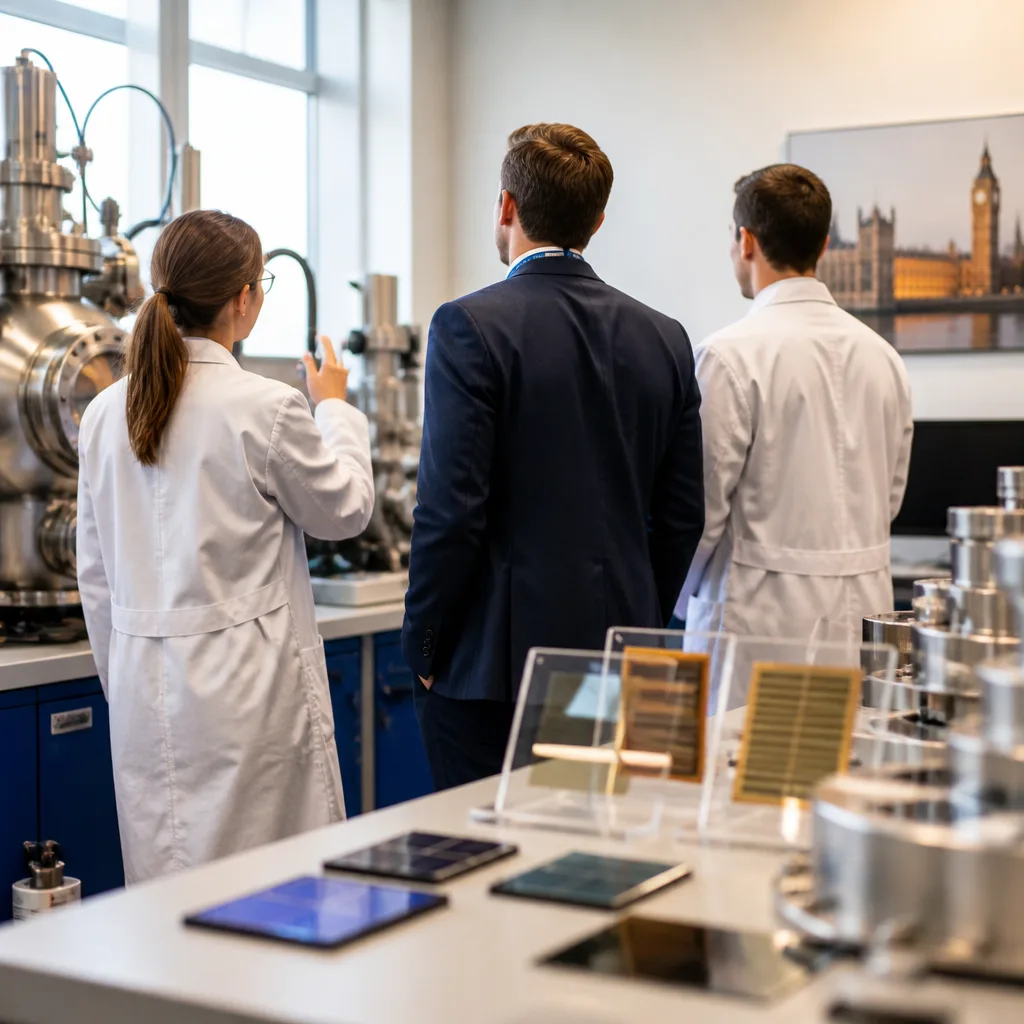
As part of the reciprocal element of the scheme, Dame Chi visited Northumbria’s campus to see facilities funded by the Engineering and Physical Sciences Research Council (EPSRC), notably the Advanced Thin Film Sputtering Fabrication Facility (TF-FAB) and the Northumbria Material Characterisation Laboratory (NMCL).
Research areas underlined
During the visit, the MP was shown work spanning solar photovoltaics, biomedical implants and other advanced materials developed using thin-film technologies. The university’s material characterisation capabilities — including high-resolution scanning electron microscope imaging — featured strongly in demonstrations to illustrate how skilled technical teams underpin applied research.
The visit was subsequently referenced by Dame Chi at a parliamentary event in the House of Lords marking the three-year impact of the Institute for Technical Skills and Strategy. She cited the Northumbria visit as a flagship example in discussions about the importance of technical skills and the technical workforce.
- Participant: Dr Cecil Cherian Lukose, Scientific Officer, Thin Film Laboratories, Northumbria University
- Parliamentary partner: Dame Chi Onwurah MP, Chair, Science, Innovation and Technology Select Committee
- Programme: Royal Society Pairing Scheme 2026
- Facilities visited: TF-FAB and NMCL (EPSRC-funded)
Context and consequences
The exchange highlights several policy-relevant themes. First, it demonstrates a practical route for MPs to observe technical work directly rather than relying solely on briefings — a channel that may influence policy thinking on skills, research funding and industrial application. Second, it showcases the role of laboratory-based expertise in areas where the UK seeks to maintain or expand strategic capability, such as renewable energy technologies and medical device materials.
For universities, such pairings offer a platform to translate laboratory practice into narratives that are visible at the highest levels of government. For parliamentarians, they provide empirical insight into the workforce and equipment required to deliver the UK’s science and innovation ambitions.
| Element | Details |
|---|---|
| Duration of Westminster placement | One week |
| Reciprocal campus visit | Demonstrations at TF-FAB and NMCL |
| Research areas highlighted | Solar photovoltaics, biomedical implants, advanced thin-film materials |
While the immediate outcome is largely reputational — the university’s laboratories received prominent acknowledgement in a parliamentary forum — the longer-term implications concern how such exchanges shape funding priorities and skills policy. The Institute for Technical Skills and Strategy, whose work was celebrated at the House of Lords event, seeks to bolster the UK’s technical workforce; examples showcased by MPs can feed into public discussion and political support for training and capital investment.
The Royal Society Pairing Scheme has been used in recent years as a bridge between science and policy. By enabling scientists to experience parliamentary life and MPs to engage with research settings, the scheme encourages mutual understanding that could prove influential when ministers, select committees and the civil service consider measures to strengthen the technical and research base.
For Northumbria, the episode provides national visibility for its thin-film research and characterisation capabilities. For policymakers, the visit offered a concrete impression of the people, equipment and training that underpin cutting-edge materials research — the sort of detail that can inform debates on how best to support the UK’s science and innovation ecosystem.