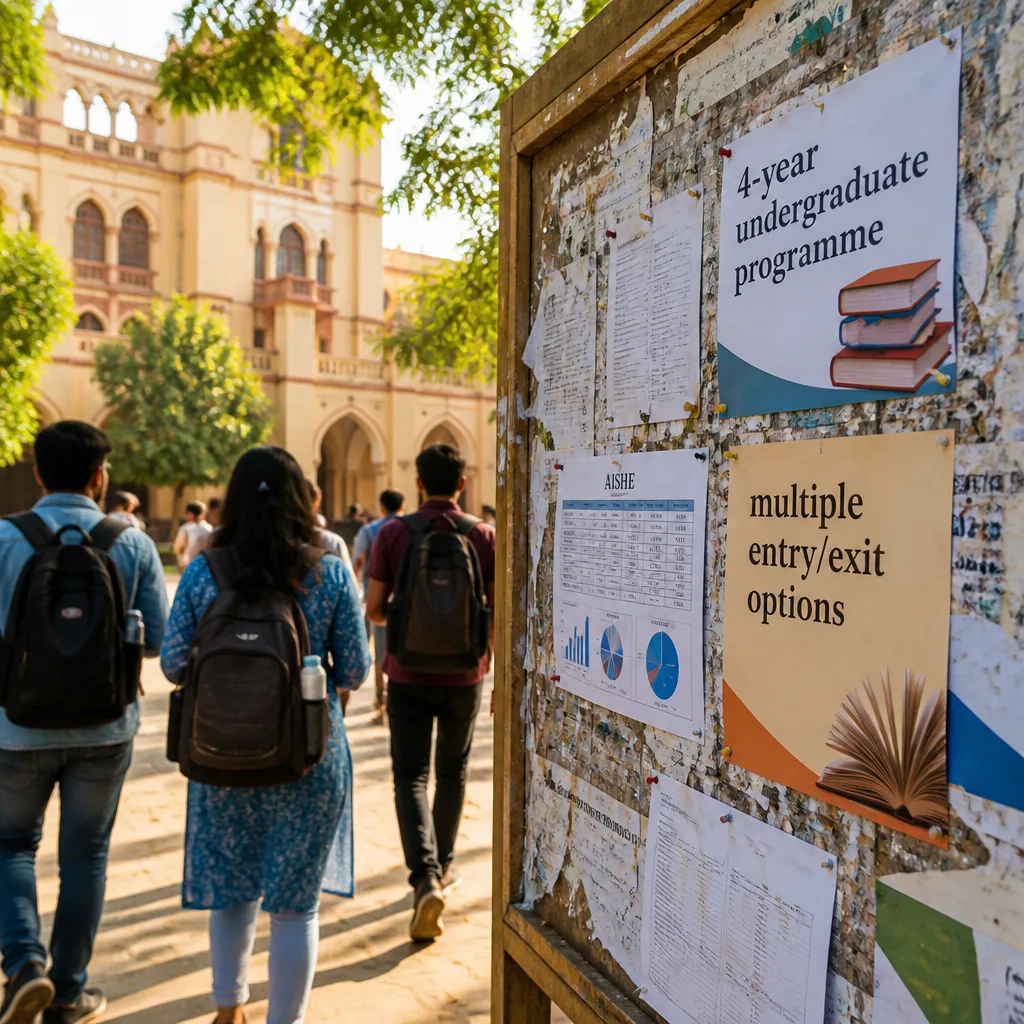
India’s higher education landscape is undergoing a major restructure as universities move from a traditional three-year bachelor model to four-year undergraduate programmes promoted under the National Education Policy (NEP) 2020. The change is being presented as a route to broaden learning, deepen disciplinary training and improve international comparability for Indian graduates.
Numbers and uneven adoption
Data from the All India Survey on Higher Education (AISHE) for 2023–24 shows that 56% of the country’s 1,278 universities have introduced four-year degrees, while 49% now provide multiple entry and exit options within academic programmes. However, adoption has not been uniform across regions or institutions, leaving a patchwork system during the transition.
| Indicator | Figure |
|---|---|
| Universities with 4-year programmes | 56% of 1,278 |
| Universities offering multiple entry/exit | 49% |
Why four years?
Proponents argue that a four-year model provides space for both disciplinary depth and broader learning experiences — including research exposure, internships and interdisciplinary content — that three-year programmes traditionally struggle to accommodate. The NEP frames the extended degree as a response to growing complexity in knowledge creation and the demand for graduates who can combine specialist skills with adaptability.
- Alignment with many global systems: the four-year bachelor is standard in the United States and common in China, where it supports technical mastery and early research engagement.
- Addressing international recognition: longer undergraduate programmes aim to ease credit equivalence and mobility challenges that three-year graduates have faced abroad.
- Flexibility via multiple entry and exit: students can potentially leave with a recognised credential after shorter durations or continue to a full honours-level award.
International context and trade-offs
Internationally, there is no single model that suits every context. European systems under the Bologna Process commonly use a three-year bachelor plus two-year master pathway, while the United States has long used a four-year bachelor's as the standard. The policy shift in India is not an attempt to mirror any one system exactly, but to create parity where needed and to give students greater scope for both breadth and depth in their undergraduate years.
The consequences of the shift are practical as well as academic. For students it could mean stronger preparation for research or professional roles; for institutions it requires curriculum redesign, investment in teaching and assessment, and new arrangements for credit and progression. Employers’ signals about the kinds of skills they want from graduates have been cited as part of the rationale for the change.
Challenges ahead
Despite momentum, the uneven rollout raises immediate challenges. Students and employers will face a mixed landscape of degree lengths and exit options for several years, complicating comparisons and mobility. Universities that have not yet adopted the four-year structure will need guidance and resources to redesign programmes without compromising quality.
Implementation will test the capacity of regulators, institutions and employers to translate policy intent into consistent practice. Monitoring outcomes — on employability, further study, and research engagement — will be essential to judge whether the extended undergraduate model delivers the promised benefits for India’s large and diverse student population.
As the reform progresses, the critical question will be whether a longer undergraduate degree system brings tangible improvements in student learning and international parity, or whether gaps in rollout and resourcing limit its potential.