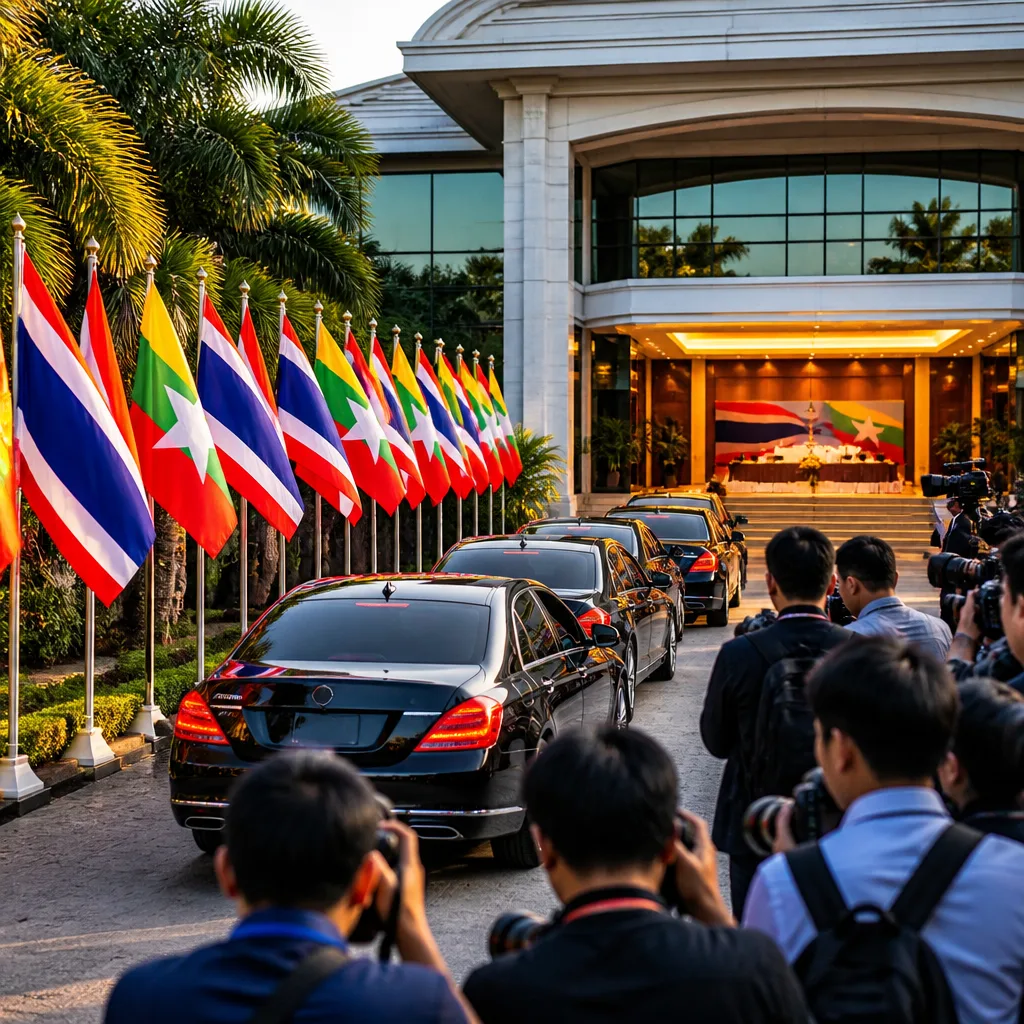
President Min Aung Hlaing, the head of Myanmar’s military-backed administration, arrived in Thailand on Thursday for a two-day official visit widely regarded as an attempt to strengthen his international standing more than five years after seizing power from an elected civilian government.
Meetings, memorandums and business diplomacy
During the visit, Min Aung Hlaing is scheduled to meet Thai Prime Minister Anutin Charnvirakul and other officials at Government House, where the two sides are expected to sign a number of memorandums of understanding. The leaders will also attend a Thailand–Myanmar Business Forum.
The trip follows a pattern of diplomatic outreach by the Myanmar leader since he was sworn in as president in April after elections held in phases in December and January. Those polls were dismissed by critics as a sham intended to consolidate the military’s control while giving an appearance of civilian rule.
Justice For Myanmar said the trip lends “false legitimacy” to Min Aung Hlaing and the ruling generals.
Regional re-engagement amid western isolation
Western governments have largely shunned and sanctioned Min Aung Hlaing and his associates for the February 2021 overthrow of Aung San Suu Kyi’s government. The coup was followed by a deadly military crackdown on protests, the emergence of a nationwide armed resistance and what outside observers describe as a bloody civil war and serious rights violations.
Despite that international isolation, Min Aung Hlaing has embarked on a series of visits to neighbouring countries as he seeks to rebuild ties across the region. The Thailand trip is one of his most significant diplomatic engagements since assuming the presidency.
- Meetings with senior Thai officials at Government House.
- Signing of memorandums of understanding between Thailand and Myanmar.
- Attendance at a Thailand–Myanmar Business Forum to showcase bilateral economic ties.
Previous travels have included visits to China, India and Laos, and Myanmar maintains close relations with Russia. Even so, the president remains largely isolated on the world stage because of condemnation and sanctions from many Western states.
Implications and contention
For Min Aung Hlaing, the Thailand visit offers both diplomatic and economic symbolism: official bilateral meetings and business engagement can be presented domestically and regionally as signs of normalisation. For critics and activist groups, however, any official hospitality extended to the Myanmar leader risks conferring a degree of legitimacy on a regime held responsible for widely documented abuses.
Observers note the visit will be closely watched for what it reveals about Thailand’s approach to engagement with Myanmar — whether emphasis is placed on practical cooperation and economic ties or whether political and human rights concerns are foregrounded.
| Recent foreign visits (selected) | Purpose/context |
|---|---|
| China | Regional diplomacy |
| India | Regional diplomacy |
| Laos | Regional diplomacy |
| Thailand | Official visit, memorandums, business forum |
How Thailand balances its own diplomatic and commercial interests with calls from activists and Western governments for continued pressure on Myanmar will be an immediate test of regional dynamics. For Min Aung Hlaing, such visits form part of a sustained effort to reduce isolation and shore up the military’s grip on power through external recognition and economic engagement.
The wider consequences remain uncertain: while renewed ties with neighbours may deliver short-term benefits, they are unlikely to dissolve the deeper international sanctions or address the underlying political and humanitarian crisis inside Myanmar that followed the 2021 coup.