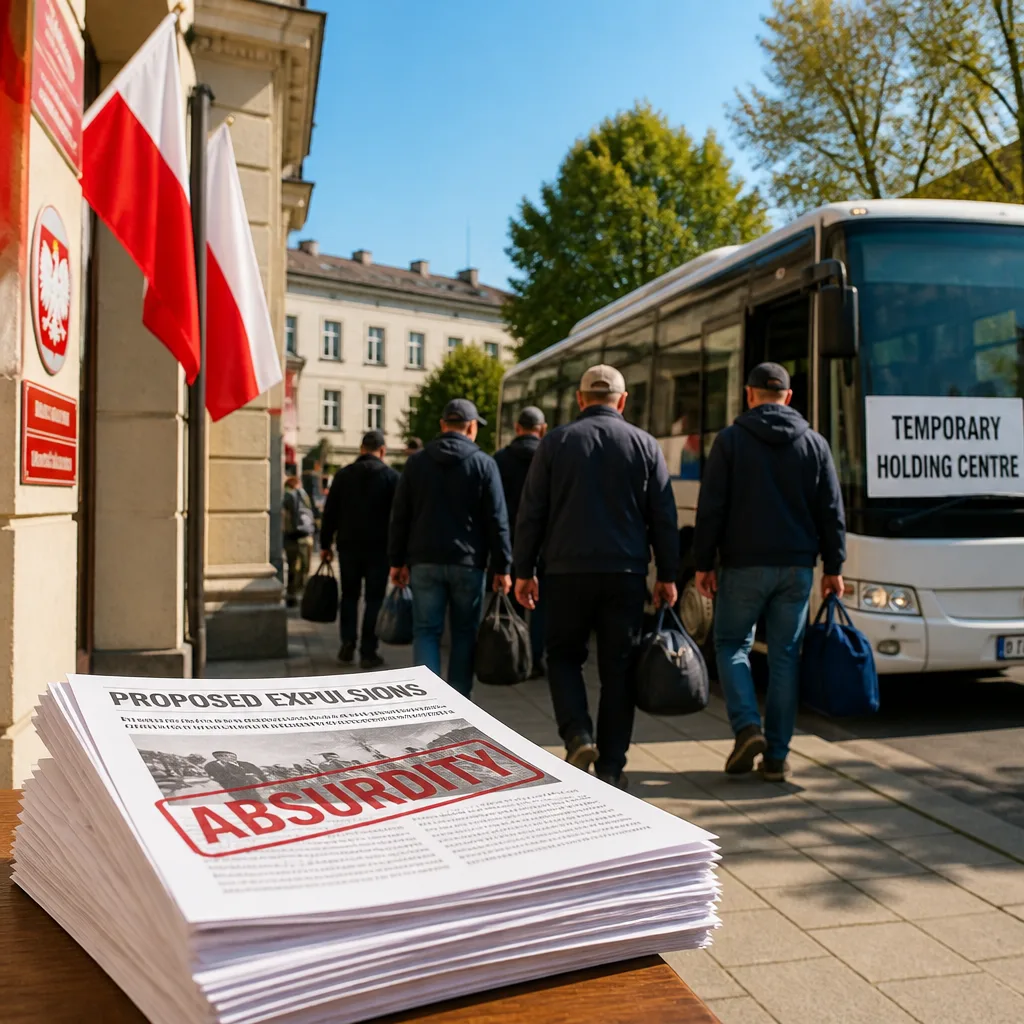
Poland’s government has publicly dismissed a proposal from the opposition Law and Justice party (PiS) to deport military‑age Ukrainian men who are not legally employed, calling the plan unworkable and a bid to win far‑right support ahead of next year’s parliamentary election.
Government response and statistics
An interior ministry spokesperson described the proposal as “pure absurdity and populism.” Deputy Interior Minister Maciej Duszczyk told reporters that more than 90% of military‑age Ukrainian men living in Poland are employed, and that many of those not in the labour market include wounded soldiers undergoing rehabilitation and parents caring for disabled children.
“These plans are pure absurdity and populism,” an interior ministry spokesperson said on Saturday.
The PiS plan, unveiled at a party conference, would see Ukrainian men aged 25–60 who lack legal employment deported if the party returns to power. PiS deputy leader and MEP Tobiasz Bocheński said those deported would “have the opportunity to fight for their homeland”, according to local media reports.
Details of the PiS proposal
PiS has outlined several measures intended to enforce the policy, including:
- establishing dedicated deportation centres for the identified group;
- creating a central register of foreign nationals to track administrative compliance;
- targeting Ukrainians working in the informal economy as well as those without legal employment.
Party sources framed the plan as a priority for a potential new PiS government, declaring it among their “first major decisions”.
Political context and wider implications
The proposal comes against a backdrop of internal strains within PiS. The party, which is part of the European Conservatives and Reformists group in the European Parliament, has suffered recent defections and divisions. Former prime minister Mateusz Morawiecki left PiS to form a new movement, Rozwój Plus, and tensions intensified after PiS leadership selected a Eurosceptic candidate for next year’s election.
Observers note the policy has a dual edge: domestically it aims to placate hardline voters sceptical of continued migration, while externally it risks friction with EU institutions and humanitarian norms. The European Union is already tightening rules for Ukrainians: Brussels plans to refuse temporary protection to newly arriving military‑age Ukrainian men (who are prohibited from leaving Ukraine under Ukrainian law), while extending the temporary protection scheme for other Ukrainians until March 2028.
| Element | PiS proposal | Government response |
|---|---|---|
| Target group | Ukrainian men aged 25–60 without legal employment | Rejected as unworkable; most are employed |
| Measures | Deportation centres; central register; enforcement on informal work | Described as populist and absurd |
| EU context | Not addressed by PiS in detail | EU tightening: new arrivals of military‑age men to be denied temporary protection; scheme extended to others until March 2028 |
Deputy Interior Minister Duszczyk’s figure that over 90% of military‑age Ukrainian men in Poland are employed undercuts the PiS narrative of mass jobless migrants. The government also highlighted specific humanitarian circumstances—injury and family care—that account for some who are not in formal employment.
Internally, PiS faces a balancing act between satisfying a vocal hard‑right constituency and retaining broader electoral appeal. The party’s proposal has been portrayed by critics as an electoral ploy to reclaim votes drifting to more extreme groups; PiS, meanwhile, presents it as a measure of sovereignty and order.
Any attempt to implement such deportations would raise legal and logistical questions, not least the mechanisms for identifying and processing those deemed to fall within the policy and the interaction with EU law and international protections.
As Poland heads towards a crucial election year, the debate is likely to sharpen: PiS will argue it is tackling irregularity and protecting labour markets, while opponents will point to practical and ethical objections, and to potential diplomatic ramifications with Kyiv and Brussels.