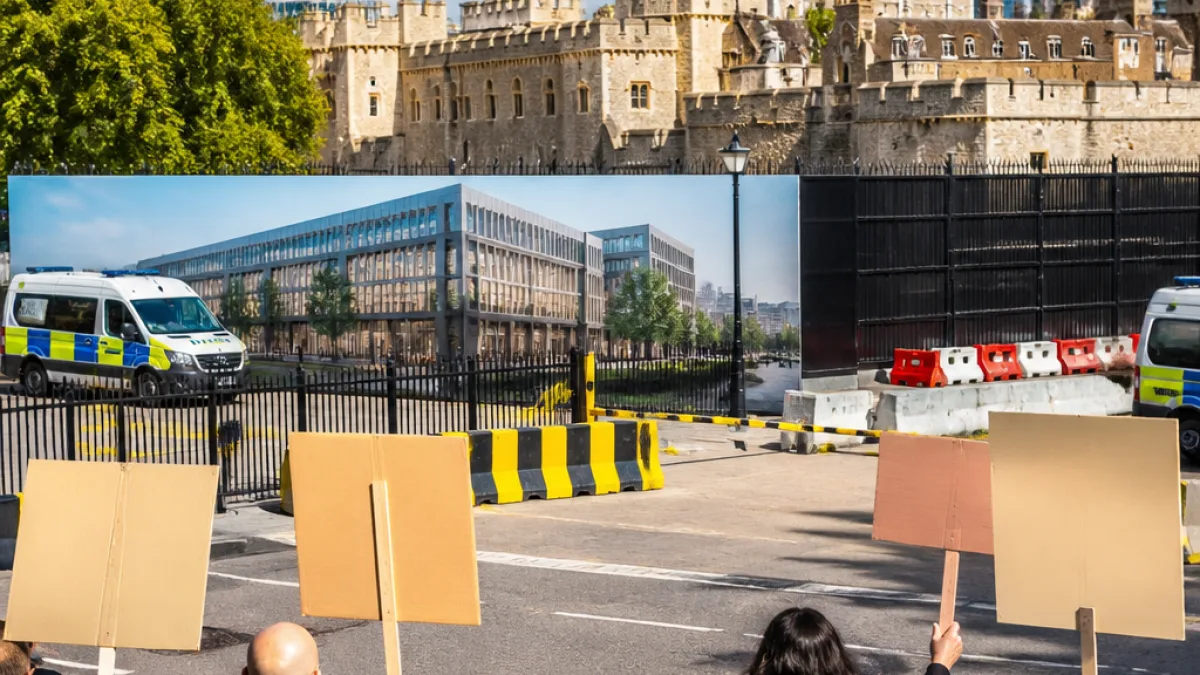
The High Court has dismissed a legal challenge to planning permission for a major new Chinese diplomatic complex at Royal Mint Court, close to the Tower of London, leaving the controversial scheme able to proceed.
Residents' group challenged permission
The action was brought by the Royal Mint Court Residents’ Association (RMCRA), which argued the project could increase the risk of terrorist attacks, enable the repression of protests and be used to enforce Chinese laws or target dissidents on UK soil. The association also raised concerns that, owing to diplomatic immunity, the Chinese government might be able to ignore safety obligations – including fire safety – without effective local enforcement.
“conscientiously and carefully had regard”
The Government and the London Borough of Tower Hamlets defended the planning decision in court, saying they had "conscientiously and carefully had regard" to the residents’ concerns. The High Court found in their favour, dismissing the RMCRA challenge and upholding the planning permission.
What the ruling means locally
For residents and businesses in the immediate area, the judgment removes a legal obstacle to the embassy complex progressing to construction or further preparatory steps. The site at Royal Mint Court sits adjacent to one of the capital’s most visited historic landmarks, the Tower of London, raising particular sensitivity about the location.
The RMCRA’s case highlighted a range of anxieties commonly raised in central London when high‑security diplomatic facilities are proposed: fears about the physical safety of neighbours, potential constraints on public protest, and the perceived difficulty of holding a foreign state to account within UK jurisdiction once diplomatic immunities attach. Those issues are often complex and involve balancing international law, national security assessment and local planning rules.
Council and Government stance
Tower Hamlets Council and ministers at the Ministry of Housing, Communities and Local Government argued in court that they had properly evaluated the planning application and the representations lodged by residents. The High Court’s dismissal indicates the judge accepted that the statutory decision‑making process was followed and that the concerns advanced did not render the permission unlawful.
Concerns raised by residents
- Terrorism risk – residents warned the diplomatic site could be a target for attacks.
- Repression of protest – fears were expressed that the embassy might deter or suppress demonstrations.
- Extraterritorial policing – claims it could be used to enforce Chinese laws against dissidents while in the UK.
- Fire and safety – concerns the Chinese state might ignore safety obligations if those obligations could not be enforced due to diplomatic immunity.
Legal and practical context
Diplomatic premises are afforded protections under international law which can limit the application of domestic enforcement measures on site. That legal framework is a central part of the debate when planning permission is considered for large embassy complexes. Local authorities must balance international obligations with public safety, planning policy and residents’ rights when making decisions.
| Item | Detail |
|---|---|
| Claimant | Royal Mint Court Residents’ Association (RMCRA) |
| Defendants | Ministry of Housing, Communities and Local Government; London Borough of Tower Hamlets |
| Court decision | High Court dismissed the legal challenge |
| Location | Royal Mint Court, near the Tower of London |
The ruling will be welcomed by the Government and the local authority as a vindication of their planning processes. For RMCRA and others who remain uneasy about the consequences of a major diplomatic presence in such a sensitive central London location, the decision is likely to be a setback but not necessarily the end of concern: there may be other avenues available to raise safety or human rights issues, each of which will have to operate within the constraints of domestic and international law.
What residents and the public should know next
The dismissal of this legal challenge does not in itself mean building work will begin immediately. Planning permissions often involve conditions to be met before development starts and further consents can be required. Residents seeking to influence future developments should continue to engage with the local authority planning processes and monitor any applications or discharge of conditions linked to the site.
This judgment underscores the tensions that arise when national diplomatic interests intersect with local community safety and civil liberties in the capital. The outcome will be watched closely by campaigners, legal practitioners and local residents alike.
Reporting from London.