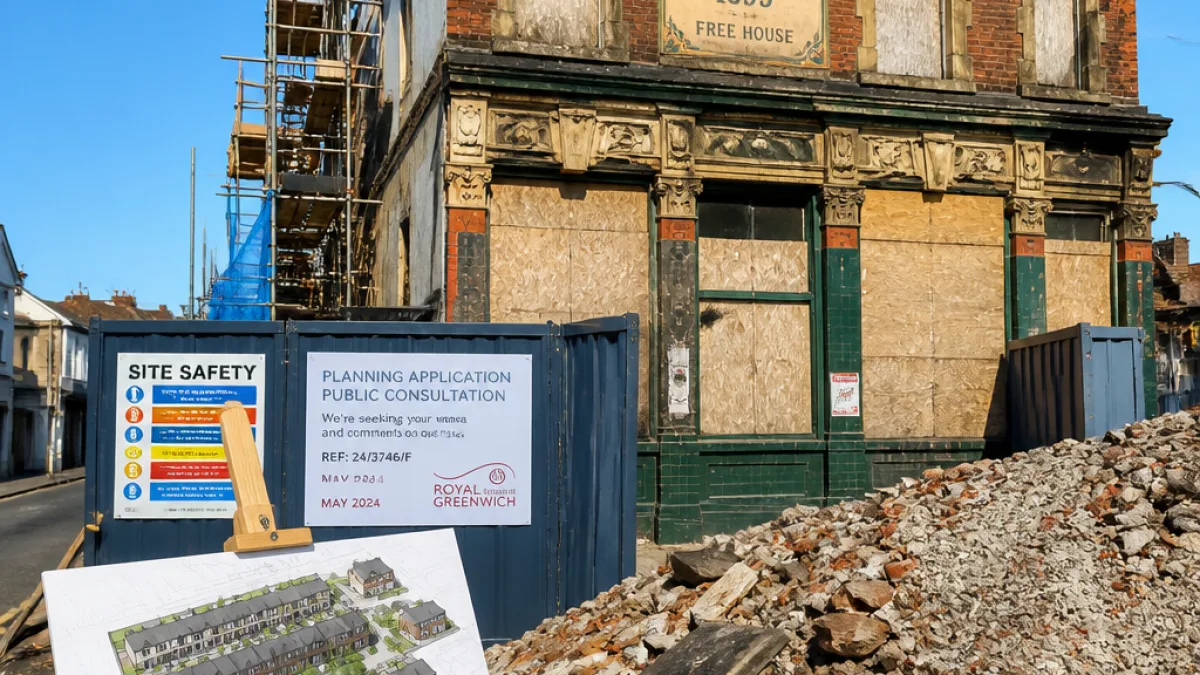
A proposal to demolish much of a 19th Century Plumstead pub and replace it with nine homes has been lodged with Greenwich Council, marking the fourth application in five years to change the fate of the locally listed building.
What is proposed
The applicant, Goldenspark (Timber) Ltd, wants to remove the derelict public house at 7 Timbercroft Lane—known as The Who’d a Thought It and believed to have been constructed around 1845—and build a mix of houses and flats across the site. The scheme retains the historic frontage and the pub’s sign as a heritage reference but involves partial demolition and new residential development within the curtilage.
Under the plans:
- Three homes will be constructed within the curtilage of the original pub building.
- Two further new structures will be erected: one containing a three-bedroom dwelling, and another comprising four one-bedroom flats plus an additional three-bedroom unit forming part of a terrace.
- The applicant anticipates construction could start in December if planning permission is granted and the project would complete in March 2028.
Planning history and council concerns
This application follows a string of unsuccessful or withdrawn proposals to redevelop the site. Previous submissions were refused by the Royal Borough of Greenwich after planners concluded that the loss of the public house was not justified and were unwilling to countenance demolition of a locally listed building.
The most recent earlier proposal, withdrawn in 2025, sought to retain a reduced public house while adding six dwellings; the new scheme abandons the public house element entirely. Planning documents from the current application state that, following engagement with council officers, the applicant has revised the approach and provided fresh paperwork to justify the loss of the pub.
“The council advised that a fully residential scheme could be supported in principle, provided that the loss of the public house use is properly justified through a new viability assessment and marketing report which reflects current marketing conditions.”
Developer’s case and heritage concessions
Goldenspark (Timber) Ltd argues there is “no realistic or viable prospect of the site continuing in public house use” and has supplied supporting documents, including a marketing report and viability assessment, as requested by the council. As a concession to heritage concerns the developer proposes to reinstate the pub sign and preserve the original frontage as a “clear heritage reference”.
Despite those measures, the scheme still involves partial demolition of the historic fabric. The tension between conserving locally listed buildings and meeting housing demand is a recurring theme in London planning decisions, where officers balance heritage value against viability and the benefits of additional homes.
Local consultation and next steps
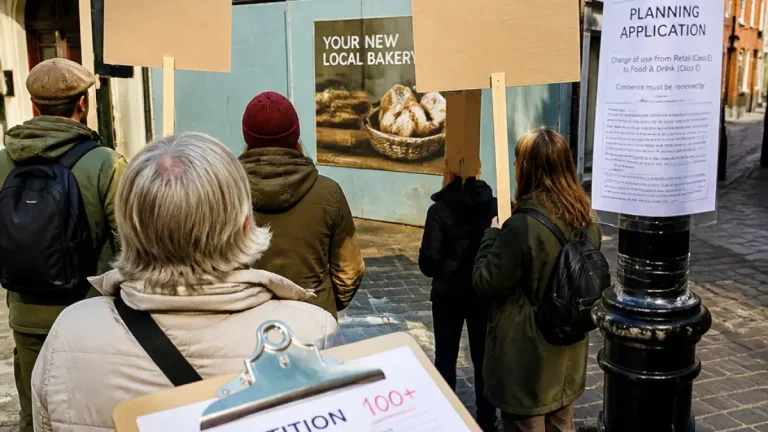
The planning application is listed on Greenwich Council’s planning portal under reference 24/3746/F. Residents have a formal opportunity to comment on the proposals; according to the public notice the consultation runs until 26 August.
If permission is granted, the applicant has indicated a schedule that would see construction start in December and finish by March 2028, a timetable that implies more than a year of works on the site.
What this means locally
For Plumstead, the outcome will be significant. The loss of a locally listed pub is likely to be emotive for long-standing residents and community groups who regard such buildings as anchors of local identity. At the same time, the creation of nine homes will be welcomed by those pressing for increased housing supply.
Members of the public wanting to make their views known should consult the council portal for application 24/3746/F and submit comments before the deadline. Greenwich planners will assess the submission against local and national planning policies, including heritage protection, loss of community facilities and housing supply considerations, before making a recommendation to committee.
The case highlights the delicate choices boroughs face: balancing the conservation of character with the drive for new housing across London, where such decisions can set precedents for other locally important sites.