
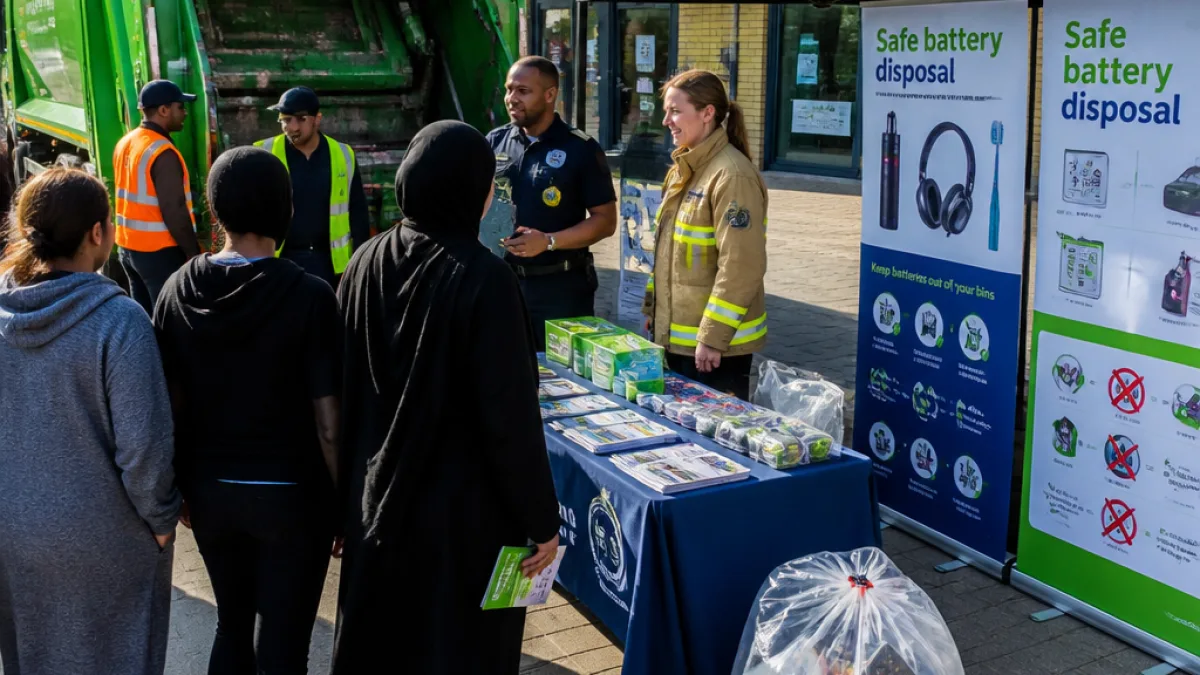
Local waste managers and fire crews are launching a fresh public-safety drive across east London after finding that millions of everyday items containing lithium-ion batteries are being thrown away incorrectly — a practice they say is fuelling a rise in fires involving bin lorries and waste sites.
Hidden batteries posing real danger
The East London Waste Authority (ELWA), which covers the boroughs of Barking & Dagenham, Havering, Newham and Redbridge, says it is especially concerned about "hidden" lithium-ion cells embedded in devices such as vapes, headphones and electric toothbrushes. These batteries can be damaged when crushed in a refuse collection vehicle or at a waste-processing facility and may ignite.
Following research, ELWA estimates that as many as 48 million batteries and small electrical items were wrongly disposed of in household bins in the capital last year. Polling by Censuswide, commissioned by ELWA, suggested 57% of the 1,000 east London residents surveyed admitted to having thrown at least one small electrical item into their household rubbish in the past 12 months — despite the hidden battery risk.
Fire crews stretched and waste temporarily piled in streets
The London Fire Brigade (LFB) warns crews are dealing with fires involving refuse collection vehicles across the capital on a weekly basis. The brigade has also attended several large-scale fires at waste-disposal sites in recent months and years, incidents that can take considerable time to bring under control and often leave waste piled up in residential streets.
"Our crews see first-hand the dangers and risks that incorrectly disposed of batteries can have," said Richard Field, LFB's deputy assistant commissioner. "We continue to be called out to fires involving waste collection vehicles; some of which can take a considerable amount of time to resolve and often results in waste temporarily piled high in residential streets."
Councillor Jo Blackman, chair of ELWA, described the campaign as a straightforward attempt to change everyday habits:
"We want to help people spot the hidden batteries in everyday items, understand why it matters to dispose of them correctly... A small change at home can make a big difference to the safety of frontline staff."
What items and behaviours are implicated?
The authority highlights a range of common items that often contain lithium-ion batteries and are being discarded into household refuse. These include:
- Vapes and disposable e-cigarettes
- Wireless headphones and earbuds
- Toys with rechargeable batteries
- Electric toothbrushes and shavers
- Mobile phones, power banks and e-scooters
ELWA says the batteries become particularly hazardous if they are damaged, crushed or exposed to heat during collection and processing.
Numbers at a glance
| Metric | Figure |
|---|---|
| Estimated wrongly disposed batteries/small electricals in London (year) | 48 million |
| East London residents admitting to throwing at least one such item in household bin (Censuswide poll) | 57% |
| Frequency of LFB call-outs to bin-lorry fires | Weekly |
What the campaign will do — and what residents should know
The roadshow aims to help people identify items with hidden lithium-ion batteries and to explain why correct disposal matters for the safety of waste workers and emergency services. ELWA and partners will provide guidance at community events across the four boroughs.
While local authorities and retailers have established schemes for collecting batteries and small electrical items, ELWA’s campaign underlines that many residents remain unaware that ordinary household bins are not safe for these goods. The message from both waste managers and the fire brigade is clear: separating and disposing of battery-powered items correctly reduces the risk of fires that can endanger crews and cause local disruption.
Practical precautions
- Do not place small electricals or batteries in mixed household refuse where they can be crushed.
- Keep old devices and single lithium batteries separate and insulated — terminals should not be left exposed.
- Use dedicated recycling points or collection services for electrical items and batteries where available.
For many east London residents the guidance is straightforward common sense — but ELWA hopes the roadshow will turn that common sense into consistent action. With fire crews already stretched and waste-collection services vulnerable to disruptive incidents, officials say a small change in how households dispose of everyday devices could make a big difference to safety on local streets.
Coverage of the roadshow and details of event locations will be issued locally by ELWA and partner councils as the tour progresses.