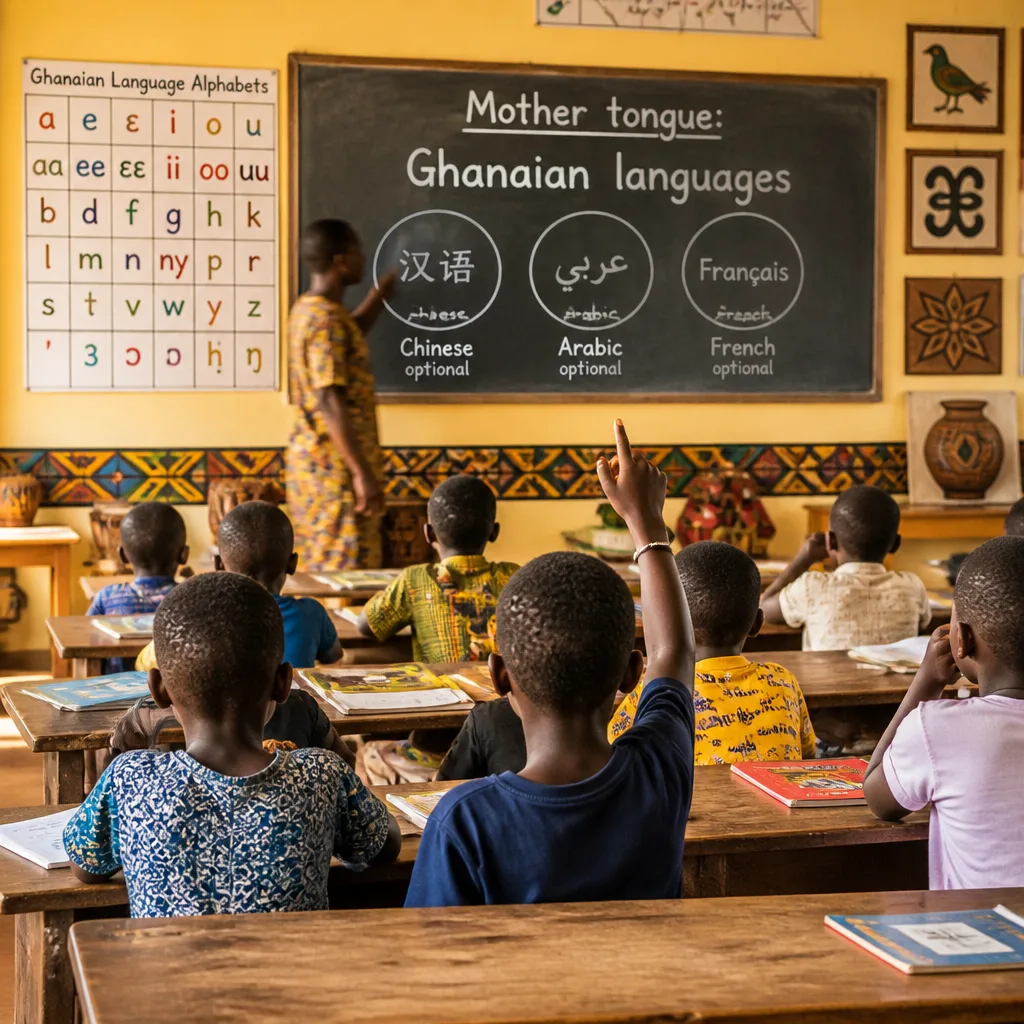
The Ghanaian government has moved to calm public concern over its revised language policy, confirming that Ghanaian languages will be the compulsory medium of instruction from Kindergarten to Primary 3, while Chinese, Arabic and French will not be compulsory and will not be used to teach young children.
Foundation years to be taught in mother tongue
In a statement signed by the ministry’s press office, officials said the updated framework emphasises teaching young learners in the languages they understand best to strengthen early literacy, numeracy and cognitive development. The clarification follows questions from parents, educators and other stakeholders after references to foreign languages in curriculum documents prompted concern that those languages might be used from the earliest grades.
"The key change in the revised framework was the prioritisation of Ghanaian languages at the foundational level rather than increased reliance on foreign languages."
The Education Ministry outlined a staged approach to language of instruction:
- Kindergarten to Primary 3: Ghanaian languages compulsory as the medium of instruction.
- Primary 4 to Primary 6: A transitional bilingual model mixing Ghanaian languages and English to prepare pupils for higher levels of schooling.
- Later stages: Foreign languages such as French, Arabic and Chinese remain optional and will be introduced depending on teacher availability and school resources.
Why the ministry acted
The ministry’s clarification aimed to correct misinterpretations that the overhaul would force early‑grade pupils to learn in foreign languages. Officials said global research supports mother‑tongue instruction in early years because children typically achieve better learning outcomes, retain knowledge more effectively and develop stronger analytical skills when taught in a familiar language.
Practical considerations were also cited: the introduction of foreign language teaching will depend on the availability of qualified teachers and other resources at individual schools. The ministry therefore insisted that Chinese, Arabic and French would be optional subjects, to be rolled out where capacity allows.
What this means in practice
For parents and classroom teachers, the policy places emphasis on the languages children speak at home and in their communities during the most formative schooling years. The transitional bilingual model from Primary 4 means pupils will progressively become accustomed to English alongside their mother tongue before moving fully to English‑medium instruction higher up the system.
| Grade | Medium of Instruction |
|---|---|
| Kindergarten–Primary 3 | Ghanaian languages (compulsory) |
| Primary 4–Primary 6 | Transitional bilingual (Ghanaian languages + English) |
| Later stages | English primary; foreign languages optional |
Education officials have framed the move as a means to improve foundational learning rather than to exclude foreign language study. The ministry also highlighted that where schools have sufficient staff and resources, languages such as French, Arabic and Chinese can be offered as elective options at later points in primary education.
Implications and next steps
Stakeholders will be watching implementation closely. The success of mother‑tongue instruction depends on the availability of teaching materials, teacher training in Ghanaian languages and consistent monitoring to ensure that pupils are making the expected gains in literacy and numeracy. For schools in linguistically diverse communities, decisions will be required about which Ghanaian language to adopt as the medium of instruction.
The clarification is likely to reassure parents who feared an early‑years shift towards foreign languages, while also setting a clear expectation for schools to prioritise local languages to support learning in the critical early stages.
Officials have not published a detailed timeline for teacher training or material production in the revised framework, but say rollout will be shaped by resource availability at the school level.