
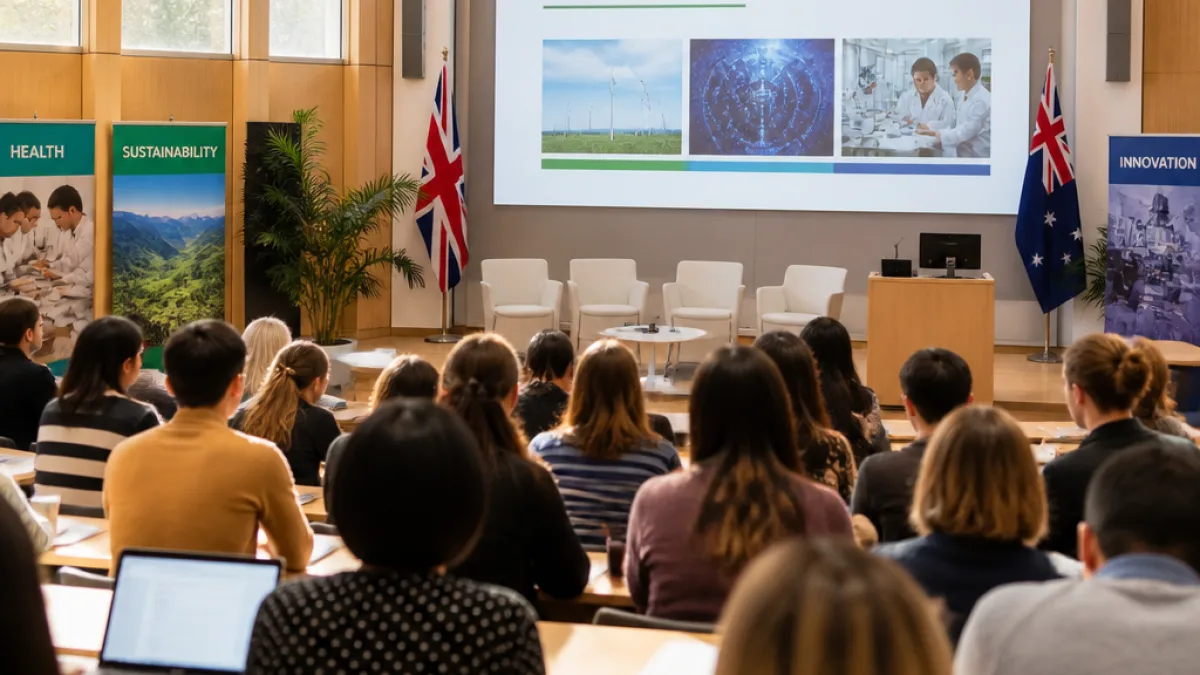
International research partnership celebrated in Exeter
Exeter welcomed researchers, PhD students and industry partners from the University of Queensland this week for a two-day symposium that reviewed nearly a decade of collaborative work between the two institutions. The event, organised under the umbrella of the UQ–Exeter Institute, was billed as an opportunity to turn world-class research into tangible benefits for society through closer engagement with business, government and overseas partners.
The symposium, titled ‘Collaborative Research in Action: Shaping a Positive Future’, reflected on the Institute’s achievements since its formation in 2017 and examined new directions for translating academic discovery into real‑world impact across health, sustainability, digital innovation and mineral security.
- Financial impact: more than AUD$30 million in competitive external research funding attributed to the partnership.
- Publication output: over 300 jointly authored publications directly attributable to the Institute.
- UK–Australia links: Queensland has become Exeter’s leading international publication partner by volume and citation impact, with more than 1,000 co-authored outputs.
“The Institute brings together two world-class universities with a shared ambition to bring our outstanding research talent together to address some of the most pressing challenges of our time,”
said Professor Richard Follett, Vice‑President and Deputy Vice‑Chancellor for Global Engagement at the University of Exeter. He added that the symposium provided space to reflect on achievements and to consider future engagement with businesses, policymakers and research councils.
From publications to partnerships
The figures presented at the symposium underline how an active institutional partnership can create scale and reach. Since the Institute’s establishment, organisers say it has generated both a notable funding pot and a strong body of joint scholarship. Delegates used the sessions to explore routes to ensure research continues to lead to practical outcomes for communities and industries.
Speakers showcased work spanning a broad range of global challenges, including antimicrobial resistance, biomedical innovation and climate resilience, as well as digital and resource security. The programme emphasised applied research pathways — engaging industry and policymakers early to increase the chances that discoveries are taken up outside the laboratory.
Local consequences and opportunities
For Exeter, the symposium does more than celebrate past achievements: it cements the city’s role as a hub for globally connected research and could help attract further investment, talent and collaborative programmes. Universities often act as anchors for local economies, and international partnerships of this scale can create opportunities for local firms and professional services to engage with cutting‑edge research.
For early‑career researchers and PhD students who attended, the event offered direct networking with overseas colleagues and industry representatives, opening channels for joint projects and placements that could, in time, feed skilled workers and innovation into the South West.
| Metric | Value |
|---|---|
| Established | 2017 |
| Competitive external funding | AUD$30 million+ |
| Jointly authored publications (directly attributable) | 300+ |
| Co-authored outputs with Queensland | 1,000+ |
Delegates left the symposium with fresh contacts and proposals for further engagement. Organisers stressed the need to harness the partnership’s momentum: securing follow‑on funding, deepening industry links and ensuring that research delivers benefits beyond academia.
As the UQ–Exeter Institute looks to its next phase, the symposium in Exeter served both as a milestone and a planning forum — a reminder that global academic collaborations can be rooted in a regional city, and that those links have the potential to shape policy and practice far beyond campus boundaries.