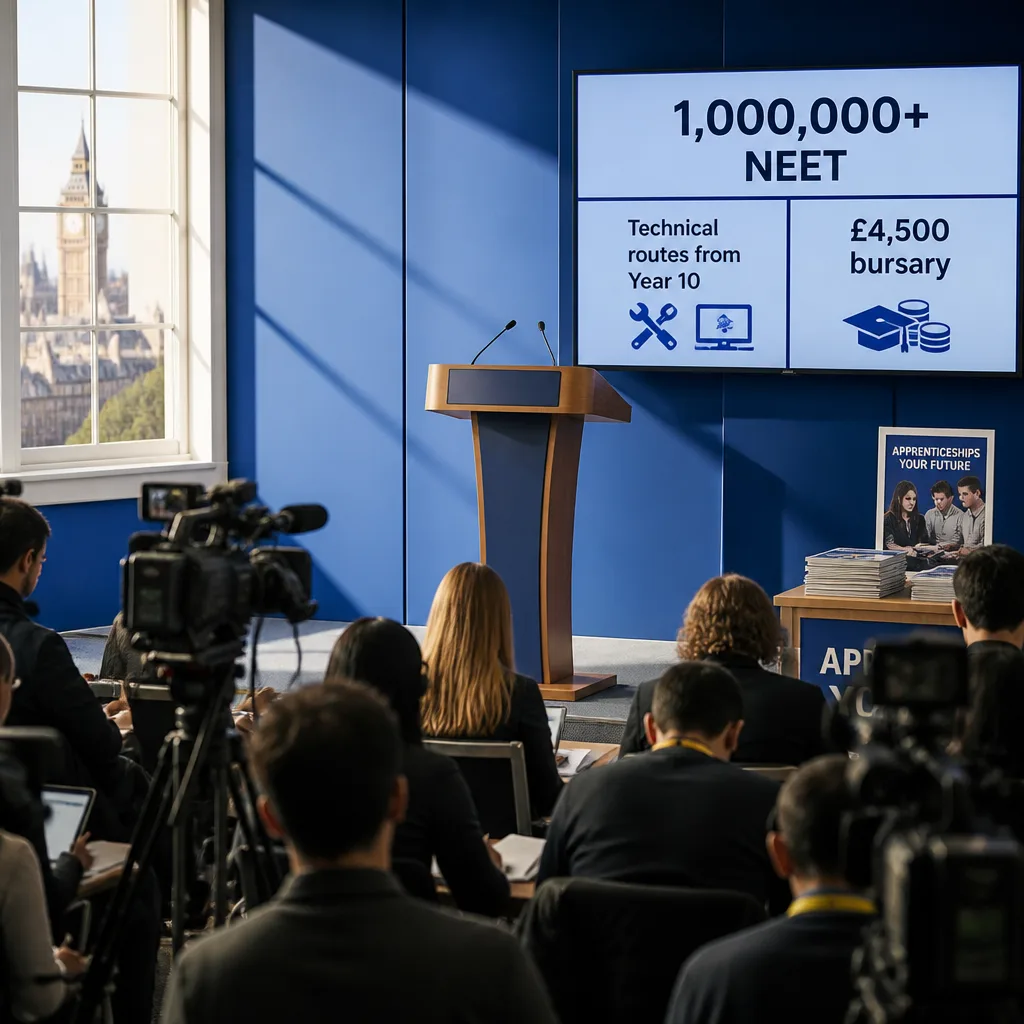
Prime Minister Andy Burnham has set out a package of education reforms designed to address a sharp rise in young people who are not in education, employment or training (NEET), telling reporters he is on “a mission” to bring the figure down. The government said the NEET cohort now stands at more than one million.
New technical routes from Year 10 and an apprenticeship bursary
Under the proposals, pupils will be able to begin combining core academic subjects with technical training from Year 10 (ages 14), as part of pathways that link classroom learning with practical skills, work experience and local employer engagement. The reforms are due to be rolled out in September 2028.
In a bid to make apprenticeships more accessible to families on benefits, ministers announced a new bursary of up to £4,500 for teenagers in households receiving universal credit. Government ministers said the bursary is intended to remove a financial disincentive for applications, where families may be concerned about impacts on benefits.
“I will commit, in my time in office, to get the number of young people who are not in education, employment, and training down,” the prime minister said during a visit to Derby.
Policy goals and timing
Mr Burnham framed the changes as preventative: the reforms aim to stop further increases in youth disengagement rather than immediately reducing the current NEET total. He did not set a specific timetable for delivering a fall in the NEET numbers, saying it is “a hard thing to say right now” when precisely reductions will occur.
The prime minister criticised what he described as an education system that has long favoured the university route, saying it can convey the message that vocational options are a lesser choice. He argued the country should value “the hard hat every bit as much as the gown”, signalling a push to place technical education on an equal footing with traditional academic pathways.
What the reforms will mean for pupils and families
The proposals include several practical elements designed to link education with local labour markets and employer need:
- Pupils able to study technical subjects alongside English and maths from Year 10.
- Technical pathways paired with work experience and employer connections.
- A bursary of up to £4,500 to support apprenticeships for young people in universal credit households.
Ministers say early exposure to vocational and technical routes will give young people clearer options before they make choices about GCSEs and later training, and should reduce the likelihood of disengagement.
Context and implications
The announcement comes as the government grapples with the challenge of a rising NEET population, which advisers and schools say can have long-term consequences for life chances and local economies. By lowering the age at which vocational study can begin and tying courses to employers, the reforms aim to create more direct routes into employment.
However, the measures are focused on future cohorts, with the technical pathways not due to begin until 2028. That timing means there will be a multi-year window before the new routes and the apprenticeship bursary can affect the current NEET figure. The pledge to reduce the overall number of young people not in education, employment or training is a political commitment; ministers have not published a detailed timetable for when the reduction will be achieved.
For parents and pupils considering options beyond the traditional academic route, the announcement promises earlier, clearer pathways. For employers and local authorities, the reforms represent an invitation to strengthen partnerships with schools and colleges to ensure training aligns with local job opportunities.
| Measure | Detail |
|---|---|
| NEET figure | More than 1,000,000 young people |
| New technical routes | Available from Year 10, rolled out September 2028 |
| Apprenticeship bursary | Up to £4,500 for universal credit households |
The government will need to set out further operational detail in the coming months — on curriculum content, employer involvement, funding and how success will be measured — for schools, colleges and families to fully assess the reforms' potential. For now, the announcement marks a high-profile attempt to re-balance the education system and signal that technical and vocational routes are being valued at the highest level of government.