Andy Burnham has set out an energetic and ambitious programme for education and skills that seeks to restore status to vocational routes, introduce earlier industry-linked apprenticeships and underpin a wider ambition to “re-industrialise” Britain. Yet analysts and commentators warn the approach leans heavily on nostalgia for an earlier economic model and could be at odds with the realities of a labour market being reshaped by technology.
Rebalancing academic and technical routes
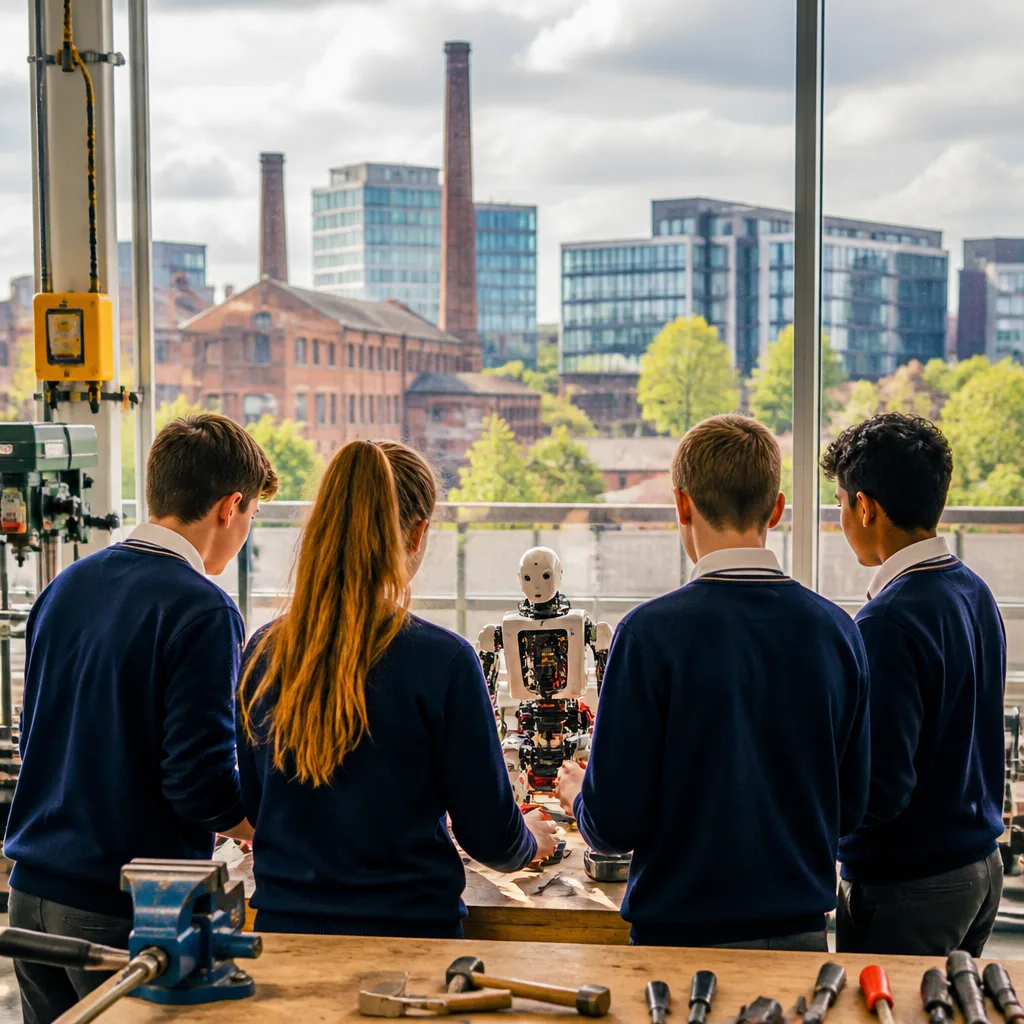
The new leader’s plans aim to give vocational education parity with academic routes and to make technical pathways a serious option for pupils from an earlier age. Central to his pitch are proposals to link apprenticeships more closely to local industry and to extend meaningful technical routes for young people from the age of 14.
Supporters say this would promote social inclusion and provide clear alternatives to an exam-centred culture. But critics argue that parity must be earned rather than imposed, and warn that previous attempts—under successive governments—have struggled to embed long-term employer demand and progression routes.
‘Re-industrialisation’ meets modern supply chains
Alongside the education agenda, the leader has promoted a policy of re-industrialising the economy, seeking to bring manufacturing and strategic production back onshore. Proponents argue this would create employment and anchor skills in local communities. Skeptics counter that returning production to the UK can be costly and that the plan underestimates global competitive pressures and economies of scale elsewhere.
The policy framing often contrasts physical trades with university qualifications, urging that society should value the “hard hat” as much as the “graduation cap”. Yet the move to champion traditional manufacturing raises questions about how it aligns with growth areas driven by digital technologies and automation.
Technology, jobs and the changing curriculum
Concerns are particularly acute given the rapid advance of artificial intelligence and automation. As the new leader himself has said in public remarks about AI’s limits, tools may be able to “make a slide deck” but could “not build a train”.
He insisted that AI could “make a slide deck” but “couldn’t build a train”.
That observation underlines a wider debate: which skills will be needed in the near future, and how should schools adapt? Emphasising traditional industrial skills may help some regions, but it risks overlooking the scale of job transformation AI and other technologies are likely to bring.
Policy trade-offs and past lessons
There is a long history of governments attempting to boost vocational education, with initiatives ranging from technical qualifications to employer-designed routes. The current proposals revive familiar themes—greater parity, employer engagement and localised apprenticeship schemes—yet the record suggests such ambitions often founder on implementation problems, funding constraints and insufficient employer uptake.
Key questions for policymakers include:
- How will new technical routes be funded and regulated?
- What guarantees will there be that industry can provide sufficient, high-quality apprenticeships linked to progression?
- How will the curriculum equip young people for roles that may not yet exist because of rapid technological change?
Policy elements at a glance
| Proposal | Core aim |
|---|---|
| Overhaul of state education | Rebalance academic and vocational emphasis |
| Apprenticeships from age 14 | Connect pupils earlier to local industry |
| Re-industrialisation | Bring manufacturing and strategic production back onshore |
The proposals set an ambitious agenda for schools, colleges and employers. For parents and pupils, the promise is of more choice and clearer pathways into skilled work. For policymakers, the challenge will be to demonstrate how these plans will operate at scale, remain flexible in the face of rapid technological change and avoid repeating the shortcomings of previous reforms.
As ministers and education leaders consider the detail, the central task remains ensuring that any shift in emphasis protects young people’s long-term prospects in a labour market increasingly shaped by automation and digital transformation.