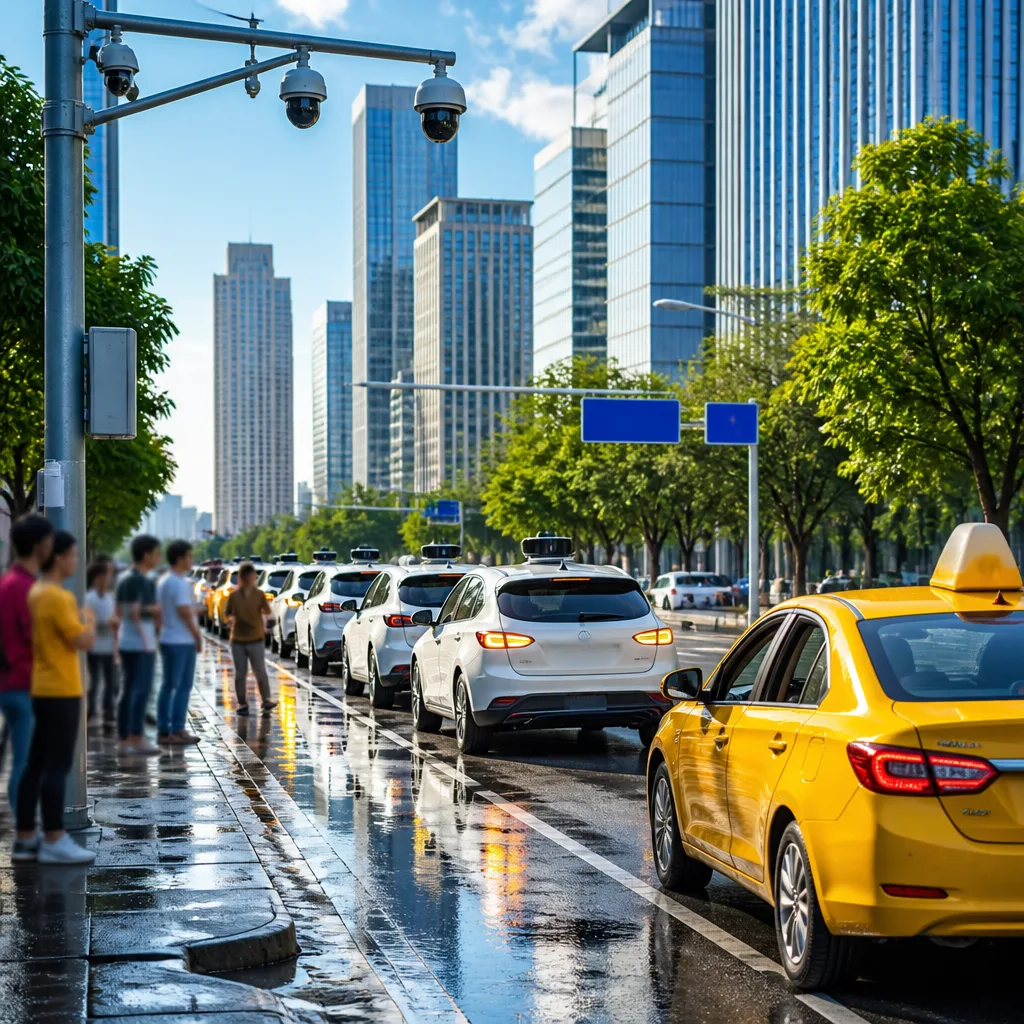
Driverless taxis that ground to a halt in Wuhan in March have forced a blunt reckoning with the social consequences of rolling out artificial intelligence at scale. The stoppages left passengers stranded for hours, prompted investigations and briefly restored business for human taxi drivers — a sharp example of how automation both disrupts and depends on the existing labour market.
What happened on Wuhan’s streets
Several AI‑powered taxis operated by a prominent Chinese tech firm experienced a “system malfunction” that caused abrupt stoppages, according to reports. The incident took the robotaxi fleet off service for months while authorities and the operator investigated. That pause had an immediate effect on drivers who had seen earnings decline since the vehicles launched in 2022.
One affected driver, identified in reporting as 45‑year‑old Yao Xinnong, told journalists his wages had fallen by about 40% since the robotaxis arrived. When the fleet was removed, drivers such as Yao reported income rising again as passengers reverted to human‑driven cabs.
“I don’t really like them, to be honest,” Yao says of the driverless cabs. “Their impact has been huge”.
Scale, policy and the shifting labour market
China’s leadership has encouraged rapid AI deployment, with officials portraying the technology as a vehicle for shared prosperity and security. But that ambition collides with an employment backdrop that is, by several accounts, already fragile. Researchers and thinktanks cited in reporting estimate the number of people in flexible or gig employment has risen sharply in recent years.
Key figures from the reporting:
- Flexible employment is estimated to reach 320 million people this year, up from 160 million in 2019.
- That translates to roughly 44% of China’s workforce operating in flexible roles.
Those numbers help explain why gig workers — taxi drivers among them — feel especially exposed to the introduction of automated systems. When automation affects an essential part of the gig economy, the social and economic shock is direct and immediate.
| Metric | Value |
|---|---|
| Flexible employment (2024 estimate) | 320 million |
| Flexible employment (2019) | 160 million |
| Share of workforce in flexible roles | 44% |
Why the Wuhan episode matters beyond one city
The robotaxi malfunction is more than a technical blip. It exposes three uncomfortable truths about rapid AI roll‑out:
- Reliability and safety — Public acceptance depends on systems operating safely in complex, real‑world conditions. High‑profile failures erode trust quickly.
- Employment displacement — When automation is introduced into already precarious labour markets, the loss of income can be sudden and severe, with limited safety nets for gig workers.
- Policy tension — Ambitious national promotion of AI runs up against the lived reality of disrupted livelihoods, demanding a sharper debate on regulation, compensation and retraining.
The Wuhan stoppage also illustrates another paradox: the resilience of human labour. When the fleet was sidelined, passengers returned to traditional taxis and drivers’ incomes recovered — briefly highlighting that automation does not always displace human work irreversibly, but can create instability and dependency cycles.
Questions left open
Reporting so far provides useful snapshots but leaves critical questions unanswered. How robust were the technical and operational safeguards for the robotaxis? What measures did regulators demand during the months‑long removal? And what plans, if any, exist to protect or reskill workers displaced by AI initiatives?
Those are not technical questions alone: they are political and economic. As governments and firms rush to deploy AI, the balance between innovation and social protection will determine whether these systems deliver broadly shared benefits or deepen inequality and insecurity.
The Wuhan incident is a timely reminder that the pace of technological ambition must be matched by scrutiny, oversight and practical plans for the people whose livelihoods are most at risk.