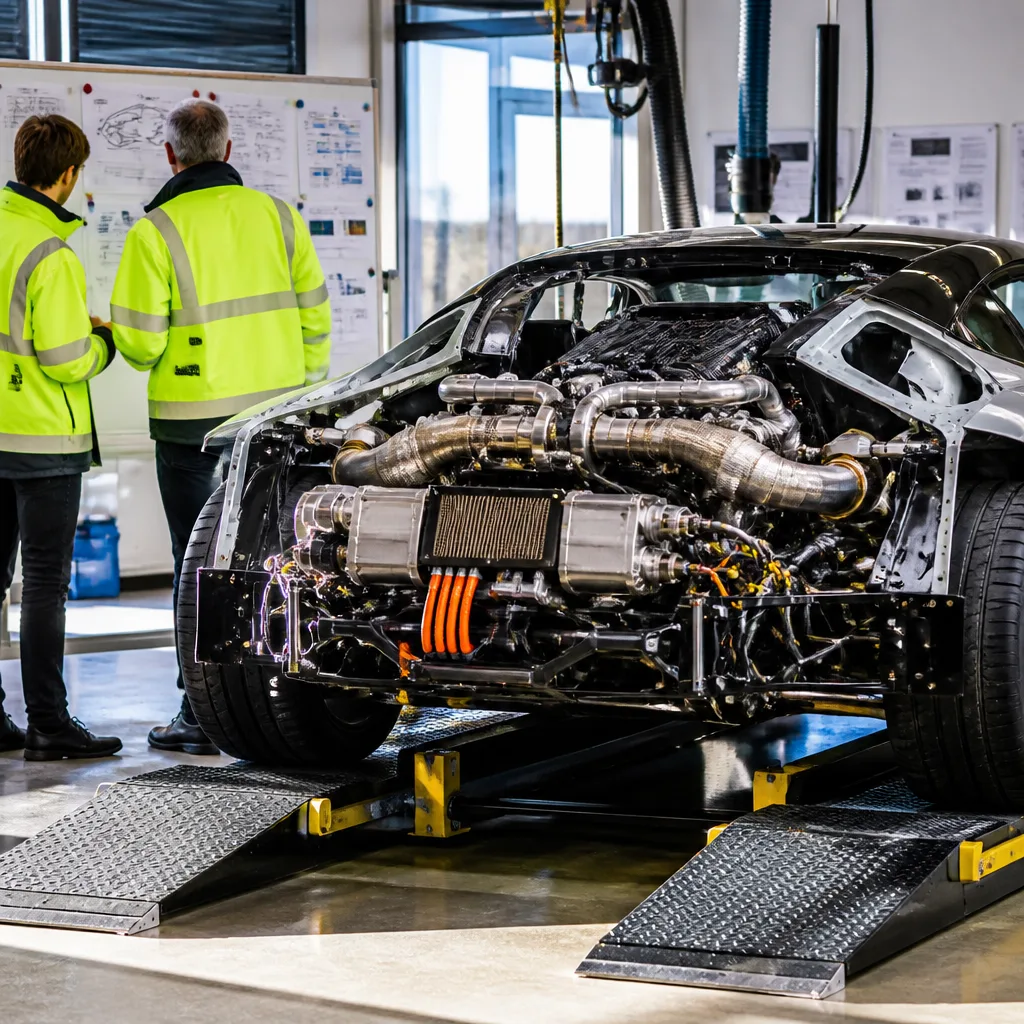
The Mercedes-AMG One represents an uncommon engineering gamble: transplanting a near-standard Formula 1 power unit into a road-legal hypercar. The work, carried out at Mercedes AMG High Performance Powertrains in Brixworth, sought to preserve as much of the F1 technology as possible while meeting the rigours of European road-car homologation.
From F1 dominance to a road car experiment
The genesis of the programme traces back to Mercedes’s dominant 2014 and 2015 Formula 1 seasons, when the 1.6-litre turbocharged V6 hybrid unit powered championship-winning cars. Mercedes and AMG decided to attempt something rarely, if ever, attempted before: use that F1-derived package as the nucleus of a road car. The declared ambition was bold — a limited production run of 275 cars featuring an essentially unmodified F1 power unit alongside a comprehensive hybrid system.
That powertrain package combined multiple elements familiar from the F1 era: the 1.6-litre turbocharged V6 internal combustion engine; the MGU-H harvesting energy from the turbocharger; the MGU-K recovering kinetic energy at the rear axle; and a pair of electric motors powering the front axle. Mercedes’s public materials placed the combined output at in excess of 1,000hp.
What made the job so hard
Turning a race-bred unit into something usable by a paying motorist is more than a straight transplant. Engineers at the Advanced Technology group — the cohort inside HPP charged with concept work from late 2015 — had to answer fundamental questions about feasibility and survivability. Could the high-strung F1 unit tolerate road use and the temperature, vibration and emissions regimes of everyday driving? How much of the original unit could be left intact without undermining reliability or falling foul of certification rules?
Working from concept sketches before the programme formally launched in 2017, the team pursued a preservation-first strategy: retain the core PU architecture where possible, supplement it with auxiliary electrics and controls, and adapt systems to satisfy homologation. That approach aligned with AMG’s brief to make the car a genuine technical showcase rather than a road-going pastiche built around an F1 aesthetic.
Engineering trade-offs and homologation pressure
Even for a group practised in extreme engineering challenges, the Mercedes HPP team found the task taxing. Homologation for Europe demands compliance across emissions, safety and durability — areas where F1 hardware is seldom assessed in the same terms. The unit had been conceived for sprint race duties and carefully controlled service intervals, not the breadth of operating conditions expected from a road car.
That meant significant reworking of cooling, emissions control, and durability strategies, while attempting to keep the core architecture and the performance DNA intact. The result was a hybrid system architecture that remained recognisably F1-derived, but had to be reconciled with practicalities of ownership and regulation.
- Core engine: 1.6-litre turbocharged V6 derived from the 2014–15 F1 power unit.
- Recovery systems: MGU-H (turbo energy harvesting) and MGU-K (rear-axle braking recovery).
- Front drive: two electric motors providing additional traction and performance.
- Production: limited series of 275 cars.
The team’s work underscores why no one had previously succeeded in putting an unadulterated F1 engine into a road car. Past projects have married race-derived or modified competition engines to road chassis, but the AMG One sought to keep the F1 PU much closer to its original form than earlier attempts.
Legacy and lessons
Technically, the Mercedes-AMG One stands as a rare instance of road-car engineering attempting to keep F1 substance rather than just style. It illuminates the gulf between motorsport power-unit design and the demands of everyday motoring — and the lengths required to bridge it. For British engineering, the project also highlights the capacity of facilities such as Brixworth to tackle extreme R&D challenges for both competition and road contexts.
Whether the approach represents a scalable route for future performance cars is another matter. The AMG One was always framed as a halo project: limited in number and costly to deliver. Its real value may lie less in spawning a new class of production cars and more in the trickle-down of technologies and techniques from a specialised team capable of turning racing hardware into roadworthy performance.