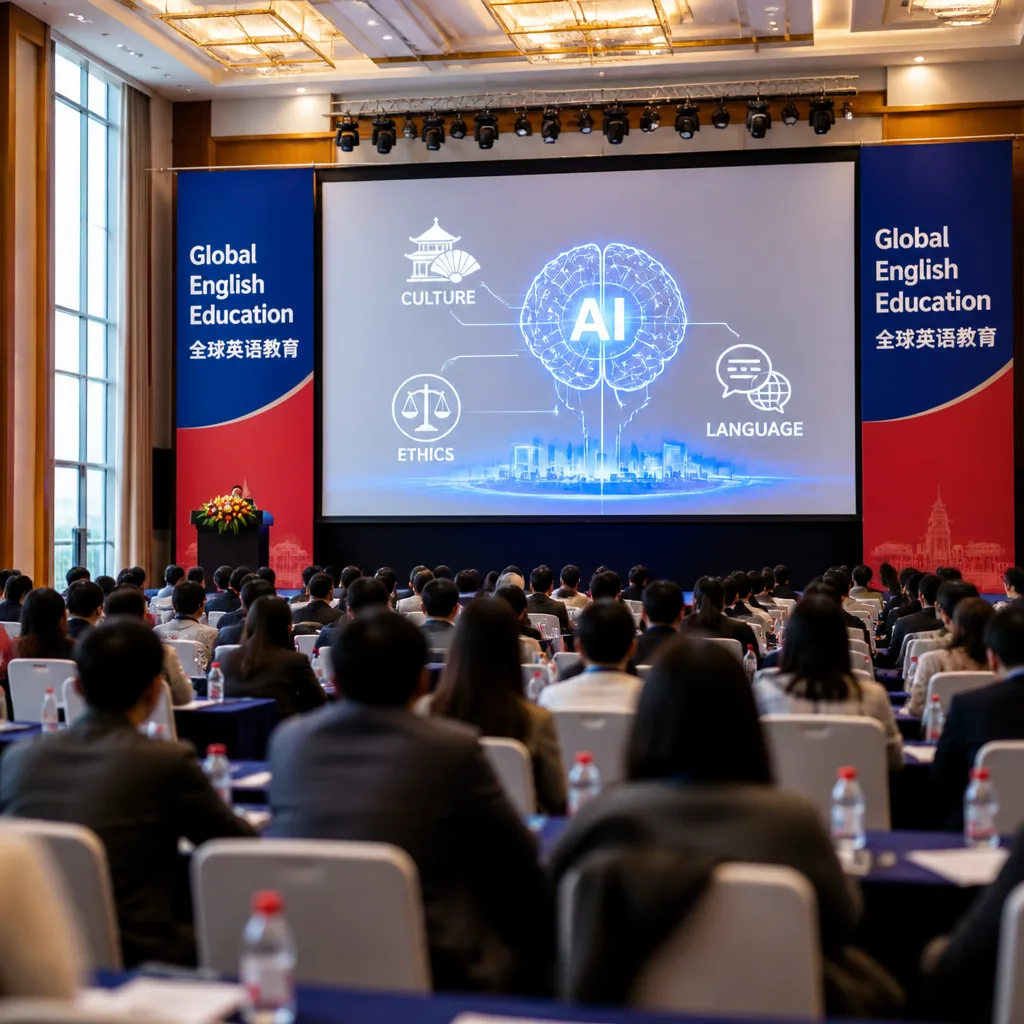
Leading figures in university language departments have urged a rethink of how foreign languages are taught in an era of rapidly improving artificial intelligence. At the 2026 Global English Education China Assembly in Beijing, senior academics from China’s top institutions argued that AI tools are reshaping what counts as essential competence — and that universities must adapt curricula accordingly.
AI handles routine tasks but not cultural judgement
Speakers at the keynote roundtable said routine language work such as translation, proofreading and vocabulary explanation can increasingly be executed by machine learning systems, freeing educators and students to focus on skills machines cannot reliably reproduce. They warned that sticking to a model that prizes narrow linguistic proficiency risks producing graduates unprepared for an interconnected world in which technology is ubiquitous.
"AI can generate language, but it cannot generate values."
The remark, attributed to Chen Jing, dean of the College of Foreign Languages and Cultures at Xiamen University, summarises the mood of the session: technology accelerates change, but humanistic and interpretive capabilities gain relative importance. Chen argued the central question is not whether foreign language education faces a difficult period, but whether traditional specialist training has reached its limits.
From expansion to transformation
Gao Yongwei, dean of the College of Foreign Languages and Literatures at Fudan University, said the era of rapid numerical expansion in language study has passed. Instead of assuming quantity is the primary goal, departments should recalibrate toward interdisciplinary teaching that pairs linguistic expertise with broader literacies.
Wu Xia, dean of Tsinghua University’s Department of Foreign Languages and Literatures, reinforced the panel’s view that large language models fall short when interpreting historical nuance, cultural perspective and the emotional context that underpins communication. These are areas where human judgement, shaped by education in the humanities, remains central.
Practical implications for universities and students
Speakers outlined what a reoriented curriculum might emphasise. These are taken from the themes that emerged in Beijing and represent priorities universities may consider when revising programmes.
- Interdisciplinary training — integrating technology literacy, ethics and cultural studies with language instruction.
- Human-centred skills — critical thinking, cultural interpretation and trust-building that machines cannot replicate.
- Applied digital literacies — teaching students to work with AI tools as collaborators rather than competitors.
None of the contributors suggested abandoning language proficiency assessment. Rather, they urged a broadened definition of outcomes: graduates should be able to combine linguistic skills with technological literacy and a nuanced understanding of culture and context.
What this means for employers and policy
The arguments carry implications beyond academia. Employers who once sought narrowly trained language specialists may increasingly prize candidates able to interpret cultural signals, mediate between people and AI outputs, and exercise ethical judgement in multilingual settings. Policymakers and funding bodies that reward large intake figures rather than demonstrable capability may need to revise their metrics.
| Area | AI capability | Human advantage |
|---|---|---|
| Translation & proofreading | Automatable | Quality control, cultural nuance |
| Cultural interpretation | Limited | Historical context, trust-building |
| Ethical decision-making | Insufficient | Values, judgement |
Speakers emphasised that educators must not compete with machines by trying to out-automate them; instead, the task is to prepare graduates to work alongside AI, bringing judgement and cultural understanding to situations where algorithmic outputs require interpretation.
The roundtable did not outline a single reform blueprint, but the consensus was clear: as AI matures, language education should evolve into a more interdisciplinary, human-centred endeavour. For institutions, that will mean revising assessment methods, course content and the skills they advertise to students and employers.
How quickly universities act will determine whether graduates are simply fluent in another tongue or genuinely prepared to navigate the ethical, cultural and technological complexities of a globalised world.