Labour has won a decisive victory in the Greater Manchester mayoral byelection, with Bev Craig, the leader of Manchester city council, set to succeed Andy Burnham as mayor. The result represents a substantial recovery for Labour in a region that saw dramatic inroads by Reform UK and the Greens earlier this year.
Vote shares and the supplementary system
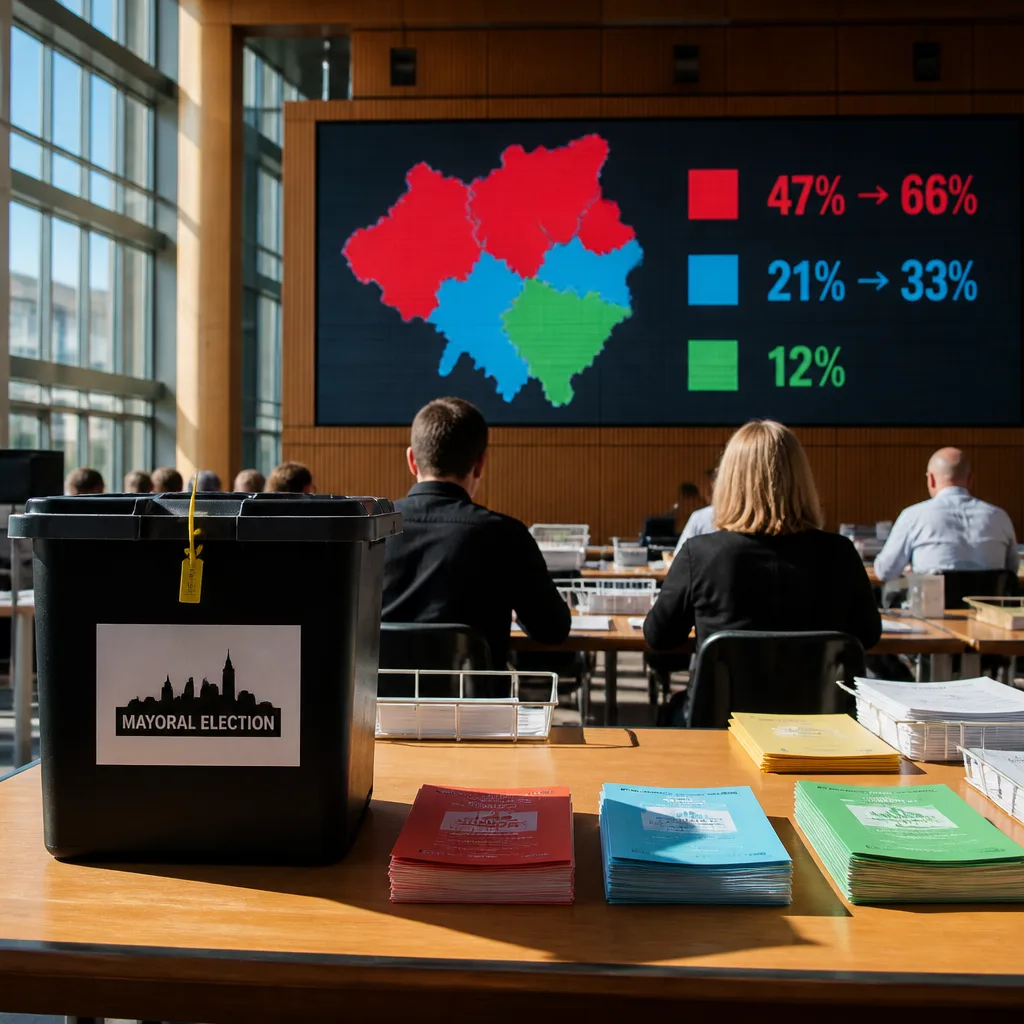
On first preferences Labour secured 47% of the vote, with Reform UK on 21% and the Green party on 12%. Under the supplementary voting system, where second preferences are reallocated if no candidate reaches an outright majority, Labour’s share rose to 66% and Reform UK’s to 33% after the count of second preferences and the exclusion of other candidates.
| Stage | Labour | Reform UK | Green |
|---|---|---|---|
| First preferences | 47% | 21% | 12% |
| After second preferences | 66% | 33% | — |
Geography of the recovery
Labour sources said the party won in every ward in boroughs including Bury and Tameside, and all but one ward in Trafford. In Oldham, where Reform UK had made large council gains in May and ended Labour’s 15-year administration, Labour won 17 of the 20 wards in the mayoral contest, it is understood. The party also prevailed in every ward in Gorton and Denton, the constituency that the Greens’ Hannah Spencer captured in February.
- Labour edged back into territory where it had lost large numbers of council seats in May.
- Reform UK, which secured more than 100 councillors across Greater Manchester in May, was well behind on first preferences and behind again after transfers.
- The result removes one of the most prominent offices outside Westminster from the political uncertainty that followed the May local elections.
National implications
The scale of the victory will be read as an endorsement for Labour at a national level, offering comfort to the party and the new prime minister by demonstrating the capacity to reclaim support from both the left and the right where it had been lost under the previous leadership. It also presents a setback for Reform UK and the wider ambitions of its principal founder, whose party had been polling strongly in the region before recent controversies.
Reform UK’s campaign was complicated by the decision of its most prominent figure to stand down from a parliamentary seat to contest a separate byelection amid questions over party funding. The sequence of events appears to have contributed to a loss of momentum in the mayoral contest.
"massive"
The source of that short remark, attributed to a senior Labour official in reporting during the count, reflected the view within the party that the scale of the swing was substantial.
Context from the May local elections
In May, Reform UK made unusually large advances in Greater Manchester councils, winning more than 100 seats across the conurbation. The party captured all but one of 25 seats contested in Wigan and 18 of 19 seats in Tameside — long-held Labour areas that were seen as barometers of working-class disaffection.
Those gains had constituted a major political story and raised questions about whether Labour could recover ground ahead of other national and local tests. The byelection result indicates that, at least in this contest, Labour was able to reassemble a winning coalition by attracting second-preference support and by regaining wards that had swung away in May.
Bev Craig will assume one of the most powerful elected positions outside Westminster. The job carries significant responsibilities for regional investment, transport and devolved services — a platform from which Labour can demonstrate delivery ahead of future electoral contests.
While the outcome is a clear short-term victory for Labour, the result will be parsed by parties across the political spectrum for lessons on voter mobilisation, the impact of high-profile personnel decisions and the importance of transfer strategies under the supplementary voting system.