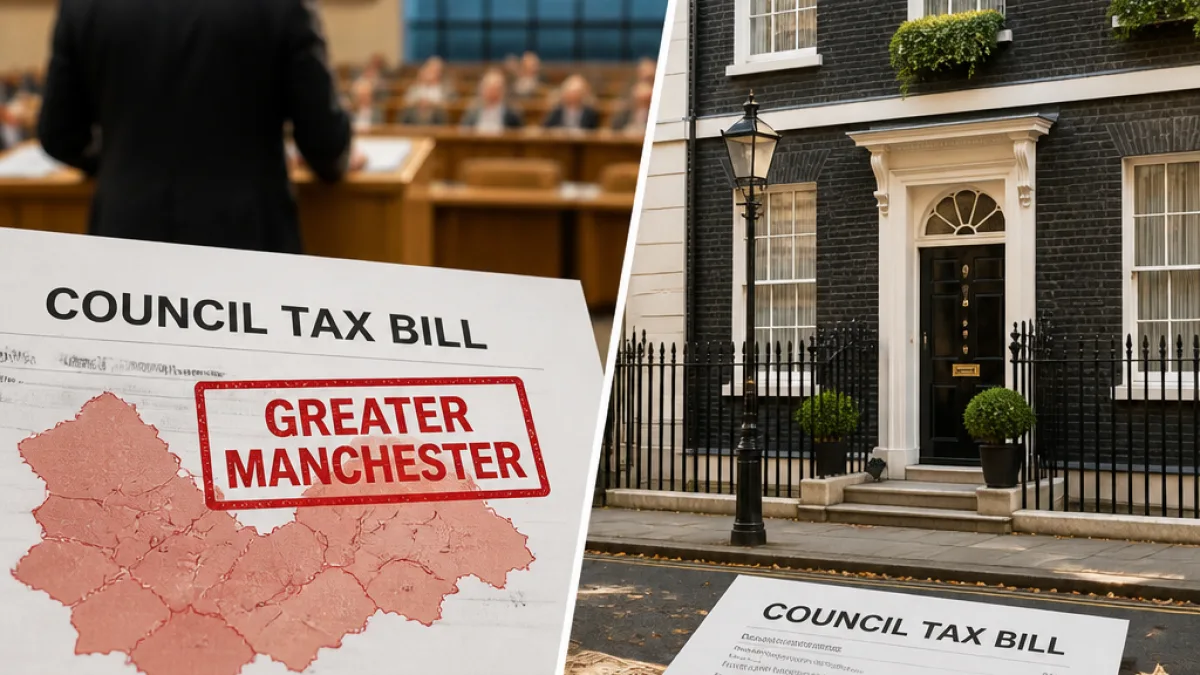
Andy Burnham has launched a sharp critique of the council tax regime, telling audiences that the current set-up is unjust and pointing to stark regional disparities in what households are asked to pay.
Mayor highlights regional inequalities
The Greater Manchester mayor said difficult choices lie ahead for his administration as Labour considers how to respond to what he described as an inherently unequal charge. Mr Burnham argued that, in many cases, households in Greater Manchester face higher council tax bills than owners of larger and more expensive properties in parts of London.
“There are big decisions ahead on an unfair council tax system,”
The intervention comes amid growing calls from Labour MPs for wide-ranging change to the tax, with supporters saying the banding system is outdated and produces anomalous and inequitable outcomes across England.
Political response and official position
Downing Street has moved to distance the government from any plan to abolish council tax in favour of a new property or land value tax, stressing that such choices would rest with the Chancellor. The prime minister’s office denied ministers were actively considering replacing council tax and stamp duty with an alternative tax on property value.
Meanwhile, Labour backbenchers including Jonathan Brash — the party’s candidate for Hartlepool — have urged a thorough overhaul of the system, citing examples they say lay bare the unfairness of existing valuations and bands.
Examples used to illustrate the disparity
Labour figures point to cases where Band A homes in towns outside the capital can face significantly higher council tax rates than similar-band properties in central London boroughs. One cited example suggests a Band A property in Hartlepool can attract a bill nearly 2.5 times that of a comparable Band A home in Westminster.
| Location | Comparative claim |
|---|---|
| Hartlepool (Band A) | Nearly 2.5× the council tax of a Band A home in Westminster |
Conservative reaction and risks highlighted
Conservative politicians have pushed back, warning that any wholesale reform could result in higher bills for what they describe as “middle England”. Sir James Cleverly, the party’s Shadow Housing Secretary, said changes of the kind being suggested would amount to seeking more ways to tax homeowners — a message designed to chip away at support for reform among suburban and rural voters.
The Conservatives argue reform risks a political backlash if it shifts the tax burden onto groups who currently pay less under the banding system, a line likely to feature as the debate intensifies.
What reform advocates want
- Labour backbenchers call for a radical reassessment of council tax bands and valuations.
- Campaigners favour systems that better reflect current property values and local capacity to pay.
- Some voices have floated replacing council tax with a new property or land value tax, although Downing Street has dismissed active consideration of such a move.
Proponents of change say the system, which was set around three decades ago, has not kept pace with shifts in the housing market and local government funding, and therefore produces inconsistent outcomes between areas.
Local impact and next steps
For households, the debate matters because council tax contributes directly to local services — from social care and waste collection to policing and street maintenance. Any substantial reform could lead to winners and losers among taxpayers and would require careful political management.
At present, the government has not announced a timetable for any reform. Labour’s internal discussions, however, suggest the party will press the case publicly as it frames its alternative to the present system — a process likely to attract scrutiny from councils, taxpayers and political opponents.
As the story develops, attention will fall on whether Labour’s proposals translate into detailed policy and how Downing Street and Treasury officials respond to calls for systemic change.
Reporting from London for NEXO RADAR.