
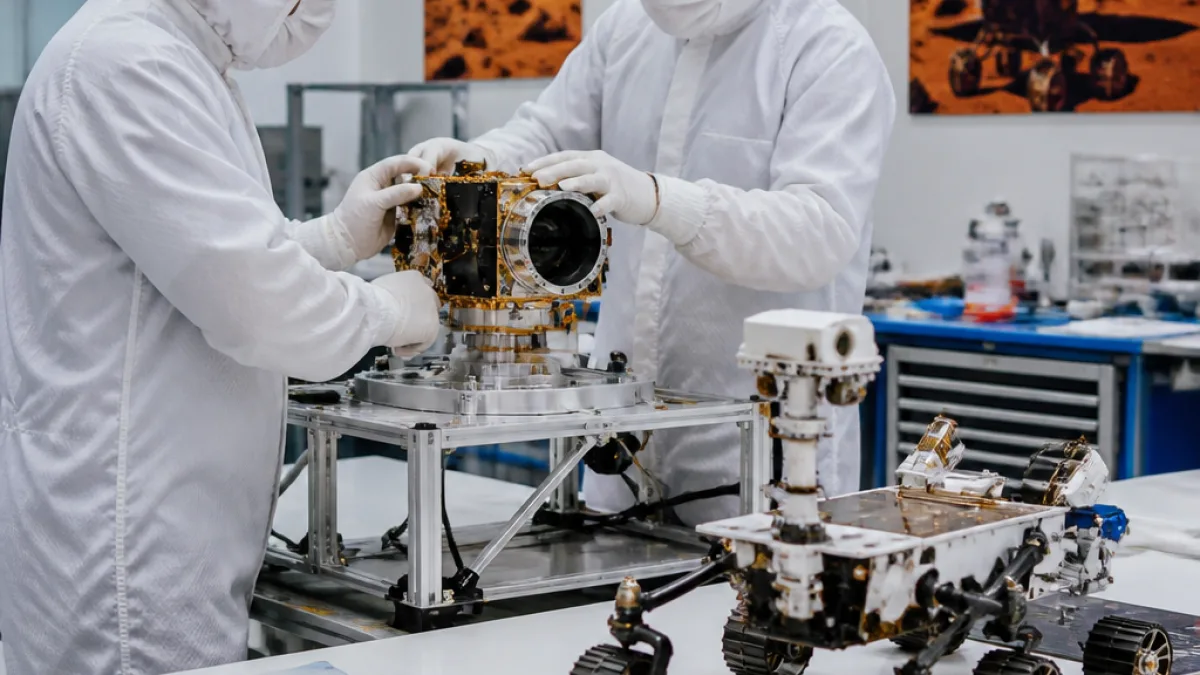
Aberystwyth has taken another bold step into the space age after scientists from Aberystwyth University unveiled an infrared spectrometer they have developed for the ExoMars Rosalind Franklin rover, a cornerstone of the European Space Agency's campaign to search for signs of life on Mars.
Local expertise meets global mission
The instrument, named Enfys, will be mounted on the Rosalind Franklin rover, which is scheduled for launch in 2028. Aberystwyth is leading development and testing of the system, which is designed to identify mineral targets on the Martian surface and help select drilling sites that may preserve traces of past life.
Dr Matt Gunn, the principal investigator for Enfys at Aberystwyth, recently met NASA administrator Jared Isaacman to present the university's work on the project. The visit underlines the international interest in the instrument and highlights Aberystwyth's contribution to one of the most advanced planetary exploration projects in recent history.
"It was a real honour to meet Administrator Isaacman and present our work to him. Our work on the ExoMars rover places Aberystwyth, and Wales, at the heart of one of the most advanced planetary exploration projects in history."
Enfys will work alongside PanCam, a camera system led by UCL’s Mullard Space Science Laboratory, to guide the rover’s exploration across rugged Martian terrain. The Rosalind Franklin rover is designed to drill up to two metres below the sun‑baked surface — a depth where preserved evidence of past microbial life is considered more likely to survive.
Collaboration, funding and changed responsibilities
Development and testing of Enfys is being led by Aberystwyth with support from several UK partners: UCL, the STFC Rutherford Appleton Laboratory, and Qioptiq Ltd. The university assumed a greater role in the instrument’s development after the original collaboration with Russia’s space agency, Roscosmos, was cancelled following Russia’s invasion of Ukraine in 2022.
That reallocation of responsibility was accompanied by further support from the UK Space Agency. Enfys received an additional £10.7 million in funding to enable its development to continue in the revised international programme.
- Instrument: Enfys infrared spectrometer
- Lead institution: Aberystwyth University
- Partners: UCL Mullard Space Science Laboratory, STFC Rutherford Appleton Laboratory, Qioptiq Ltd
- Mission: ExoMars Rosalind Franklin rover
- Launch: Scheduled for 2028
- Drilling capability: Up to two metres beneath the surface
| Item | Detail |
|---|---|
| Launch year | 2028 (scheduled) |
| Drill depth | Up to 2 metres |
| Additional UK Space Agency funding | £10.7 million |
The work represents a significant vote of confidence in local scientific talent and engineering capability. For Aberystwyth — a town with deep cultural roots and a longstanding university presence — the project offers a high-profile example of Welsh research contributing directly to an internationally important scientific endeavour.
As preparations progress, the instrument team in Aberystwyth will continue development, integration and testing, ensuring that Enfys is ready to operate in the demanding conditions of the Martian environment. The collaboration illustrates how regional centres of excellence can play central roles in missions that capture global attention.
Locally, the involvement of Aberystwyth University is likely to foster opportunities for students and researchers to engage with cutting‑edge planetary science, building experience that could seed future space instrumentation projects in Wales.