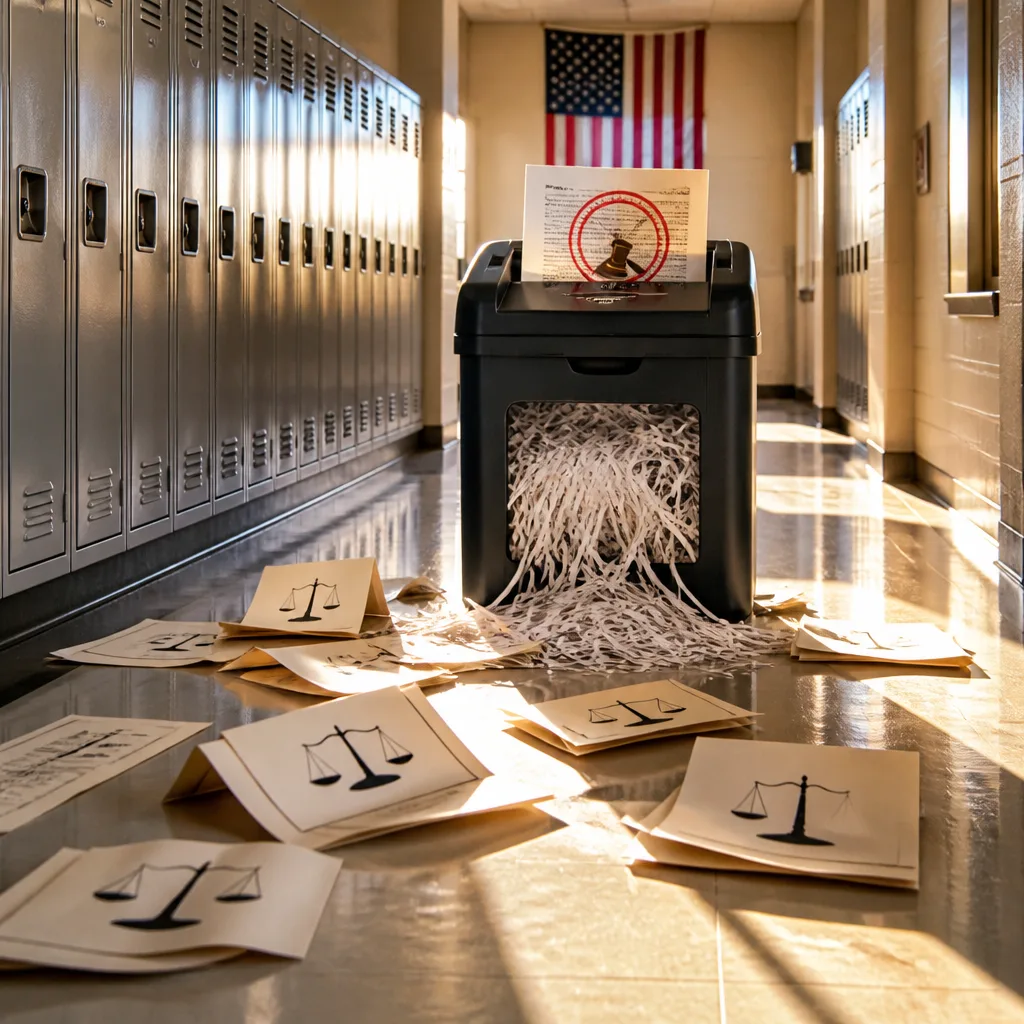
The US Department of Education announced on Thursday that it will no longer treat school policies that have a disproportionate effect on particular groups of pupils as discriminatory unless there is proof of intentional discrimination. The change rescinds decades of guidance used by courts and advocates to challenge school practices, most notably in school discipline, that remove children from the classroom at disparate rates.
What has changed
The department said it was removing several disparate impact provisions from its regulations implementing Title VI of the Civil Rights Act, which prohibits discrimination on the basis of race or national origin. The rule was published and took effect immediately, without public comment — an uncommon step for a major regulatory revision.
| Previous standard | New standard |
|---|---|
| Policies that produce a disproportionate adverse effect on protected groups could be unlawful, regardless of intent. | Disparate effects will generally not be treated as discrimination under Title VI unless intentional discrimination can be shown. |
Why it matters for pupils
Data cited in public debates over the policy has repeatedly shown that Black pupils are more likely than their peers to be punished in ways that remove them from class — suspensions, expulsions and transfers to alternative settings. Advocates have used the disparate impact framework to press for reforms aimed at reducing those gaps, arguing that policies with unequal outcomes can entrench educational disadvantage even where there is no explicit discriminatory statement.
The Education Department framed the change as giving schools room to address classroom management and safety without fear of federal enforcement actions around racial balancing or other compliance concerns. In its statement, the department quoted the Assistant Secretary for Civil Rights, Kimberly Richey:
“With these changes, schools will be empowered to address classroom issues without fearing the federal government will weaponize antidiscrimination laws.”
Reaction from civil‑rights advocates
Civil‑rights and educational organisations responded sharply. A coalition of 60 groups warned that discrimination is not always explicit and stressed courts have long recognised the disparate impact analysis. In a letter they said the move was an attempt to roll back enforcement of civil‑rights protections.
“Today’s action has no basis in law or morality and is further evidence that this administration is determined to undermine our laws, abandon civil rights enforcement, and deny the existence of systemic discrimination,”
They argue the change removes an important legal tool that has been used to challenge policies producing racial disparities, particularly in discipline and resource allocation.
Broader context and potential consequences
The decision follows a period of executive and administrative guidance from the same administration encouraging a re‑examination of school discipline policy and the organisations that had promoted interventions to reduce racial disparities. Supporters of the change say it prevents what they describe as overreach by the federal government into local education matters.
Legal experts and civil‑rights lawyers are likely to test the new rule in courts. Because the department implemented the rule immediately and without the usual notice‑and‑comment period, organisations opposing the change have grounds to challenge the process as well as the substance. Any litigation could take months or years to reach a conclusion, leaving schools, districts and families in a period of uncertainty.
- Immediate effect: Disparate impact provisions removed from Title VI regulations and the change took effect on publication.
- Practical impact: Schools will generally not face Title VI enforcement for policies that disproportionately affect a group unless intentional discrimination is shown.
- Potential fallout: Litigation and renewed advocacy efforts are expected from civil‑rights groups seeking to restore or defend disparate impact protections.
For parents and pupils, the practical consequences will depend on how state and local systems respond. Some districts may pursue reforms independently, while others may feel emboldened to maintain stricter disciplinary approaches. The coming months are likely to see a mix of legal challenges, policy debates and local decisions that will determine how the change plays out in classrooms across the country.