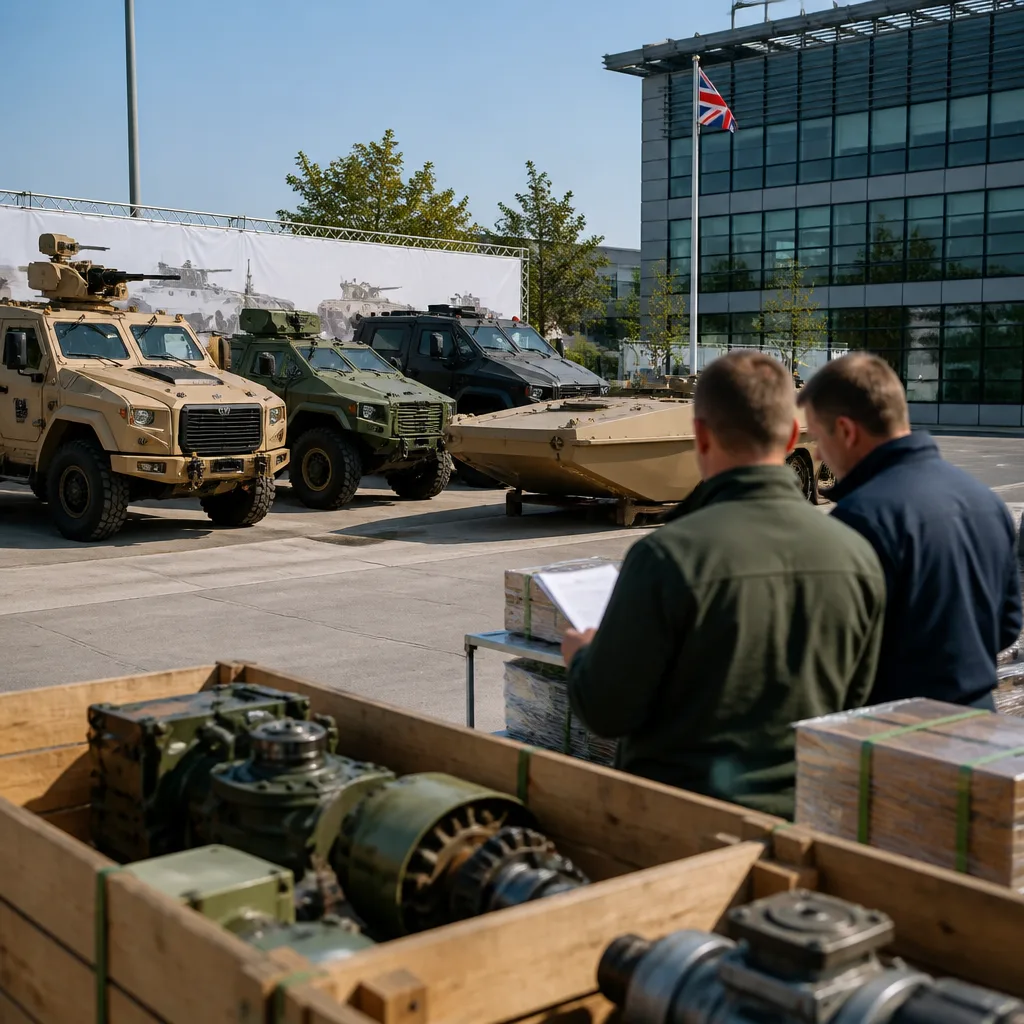
The Ministry of Defence has opened a competitive procurement process for a new family of Light Mobility Vehicles (LMVs) designed to replace legacy fleets such as the Land Rover and Pinzgauer. The tender notice, issued from Abbey Wood, Bristol on 31 July 2026, sets out plans for a common base platform to underpin a range of battlefield and support roles across the Joint Force.
Scope and scale
The programme envisages an initial vehicle purchase with contractual options to meet future operational needs, including fleet growth and replacement. The tender makes clear the Authority may increase the number of vehicles to in excess of 9,500, providing flexibility to respond to evolving operational demands and technological developments.
The MoD expects the common base platform (CBP) to support nine distinct vehicle variants, each tailored to particular roles:
- General Purpose Vehicle (GPV)
- Battlefield Ambulance (BFA)
- Tactical Mobility Vehicle (TMV)
- Utility Vehicle (UV)
- Enhanced Protection Vehicle (EPV)
- Command and Control (C2V)
- Equipment Support Vehicle (ESV)
- Troop Carrying Vehicle (TCV)
- Mission Systems Vehicle (MSV)
Long-term support and development
Alongside vehicle acquisition, the contract will incorporate support services and options for ongoing technical development. The Authority has specified the ability to call upon Post Design Services (PDS) to evolve vehicle variants as new technologies mature. This indicates an intent to maintain a development pathway rather than treat the procurement as a one-off purchase.
The tender frames the CBP as a means to enhance interoperability, flexibility and operational effectiveness across the Joint Force by delivering a single platform that can be configured for multiple warfighting and support roles.
Operational context
The programme is presented as a modernisation of capability currently provided by older fleets. The tender text references the Land Rover and Pinzgauer as examples of legacy vehicles the LMV family will supplant in routine and deployed operations. Photographic captions in the notice allude to the use of such vehicles on NATO exercises and operations in Estonia, underscoring their continued operational prominence and the requirement for a contemporary replacement.
| Element | Detail |
|---|---|
| Contract origin | MoD tender issued 31 July 2026, Abbey Wood, Bristol |
| Platform | Common Base Platform supporting nine variants |
| Fleet potential | Options to increase to in excess of 9,500 vehicles |
| Support | Associated support services and Post Design Services (PDS) |
The inclusion of PDS clauses suggests the MoD wants to preserve the capacity to adapt vehicles over their service life, either to integrate new protection systems, communications suites or mission modules, or to respond to changing threats and roles.
Industry implications
The competitive assessment and award process will open an opportunity for UK and international suppliers able to provide a modular, scalable wheeled utility platform. The scale of potential procurement — with options to substantially grow the fleet — makes the programme strategically significant for vehicle manufacturers and defence supply chains seeking long-term contracts for production and in-service support.
The tender notice marks a formal step in a wider modernisation effort to field more flexible, interoperable vehicles that can be adapted for a range of conflict and support tasks. Bidders will be required to demonstrate how their platforms can meet variant-specific requirements while delivering commonality to reduce through-life costs and simplify logistics.
Further procurement milestones and detailed requirements will be revealed as the competitive process progresses and the MoD evaluates submissions from industry.