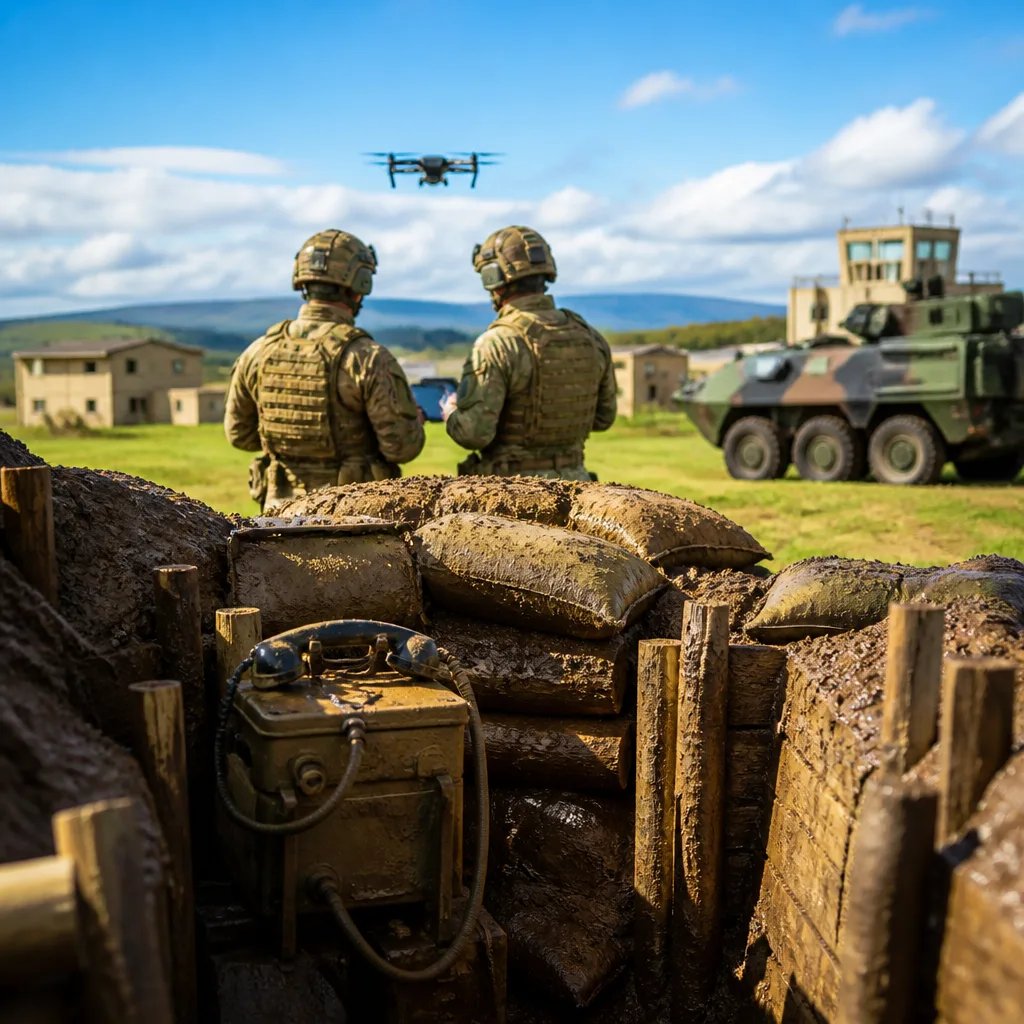
As the war in Ukraine forces a reassessment of battlefield doctrine, the familiar image of soldiers hunkered down in lines of earthworks is losing ground to more manoeuvre-focused approaches. While British training establishments continue to teach trench techniques, instructors and historians say modern conflict is encouraging militaries to move away from protracted static defences.
From textbook to theatre
Trench systems became synonymous with industrial-scale warfare during the First World War, when networks of dugouts and emplacements stretched for many hundreds of miles and accommodated command posts, medical stations and logistical facilities. The main system on the Western Front extended roughly 475 miles from the English Channel to the Swiss frontier, according to historical accounts.
That scale was only possible because of the mass mobilisation of manpower: the UK alone called up around six million men. Soldiers were routinely cycled through these lines, typically spending about 10 days a month within the trench belt.
| Feature | First World War statistic |
|---|---|
| Western Front length | ~475 miles |
| British mobilisation | ~6 million |
| Typical trench rotation | ~10 days per month |
| Early anti-trench weapon | British tanks, first used at Flers-Courcelette, September 1916 |
Lessons that shaped weapons and doctrine
The stalemate of trench warfare prompted rapid development of systems intended to break static lines. Novel battlefield platforms and firepower were scaled up, including armoured vehicles and heavy artillery. Tanks were introduced in part to overcome the barrier posed by entrenched defenders; British forces first deployed them in combat at the Battle of Flers-Courcelette in September 1916. Large-calibre howitzers were also used to batter enemy positions, with prolonged bombardments a hallmark of offensives such as the Somme.
Yet these historical remedies now sit alongside fresh lessons drawn from fighting in Ukraine, where manoeuvre, precision fires, and combined-arms operations are changing the calculus of defensive works. The invasion has, according to observers, accelerated a move away from doctrines that place prolonged reliance on dug-in lines.
“The only way you can protect your soldiers is to get them dug into the ground,”
This observation, made by a specialist in First World War history, captures why trenches were created and why they dominated earlier conflicts. At the same time, the same expert and contemporary military practitioners note that each era’s technology and strategic aims alter what defensive measures are viable.
- Training continuity: Trench warfare remains part of the syllabus at institutions including Sandhurst and the University Officer Training Corps.
- Practical exposure: Cadets on exercises in the Netherlands have practised aspects of entrenchment alongside other field skills.
- Operational shift: Recent combat in Ukraine is prompting armed forces to prioritise mobility, surveillance and precision over long-term static emplacements.
What this means for British forces
For UK military education and doctrine, the tension between historical discipline and contemporary realities is tangible. Teaching the mechanics and conditions of trench warfare provides cadets with an understanding of how industrial warfare constrained commanders and shaped human experience on the battlefield. At the same time, the changing character of war — evident in Ukraine — compels a broader curriculum that emphasises flexible tactics, joint operations and new technologies.
British Army units and officer training programmes must therefore balance retaining institutional memory with integrating lessons from modern combat. The result is likely to be a synthesis: preparing leaders to understand the protective logic of entrenchment, while equipping them with the tools and doctrine to avoid becoming tied to static positions that contemporary adversaries can exploit.
As armed forces worldwide digest both historical precedent and present-day evidence from active war zones, the story of the trenches remains an instructive chapter rather than an immutable template for future fighting.