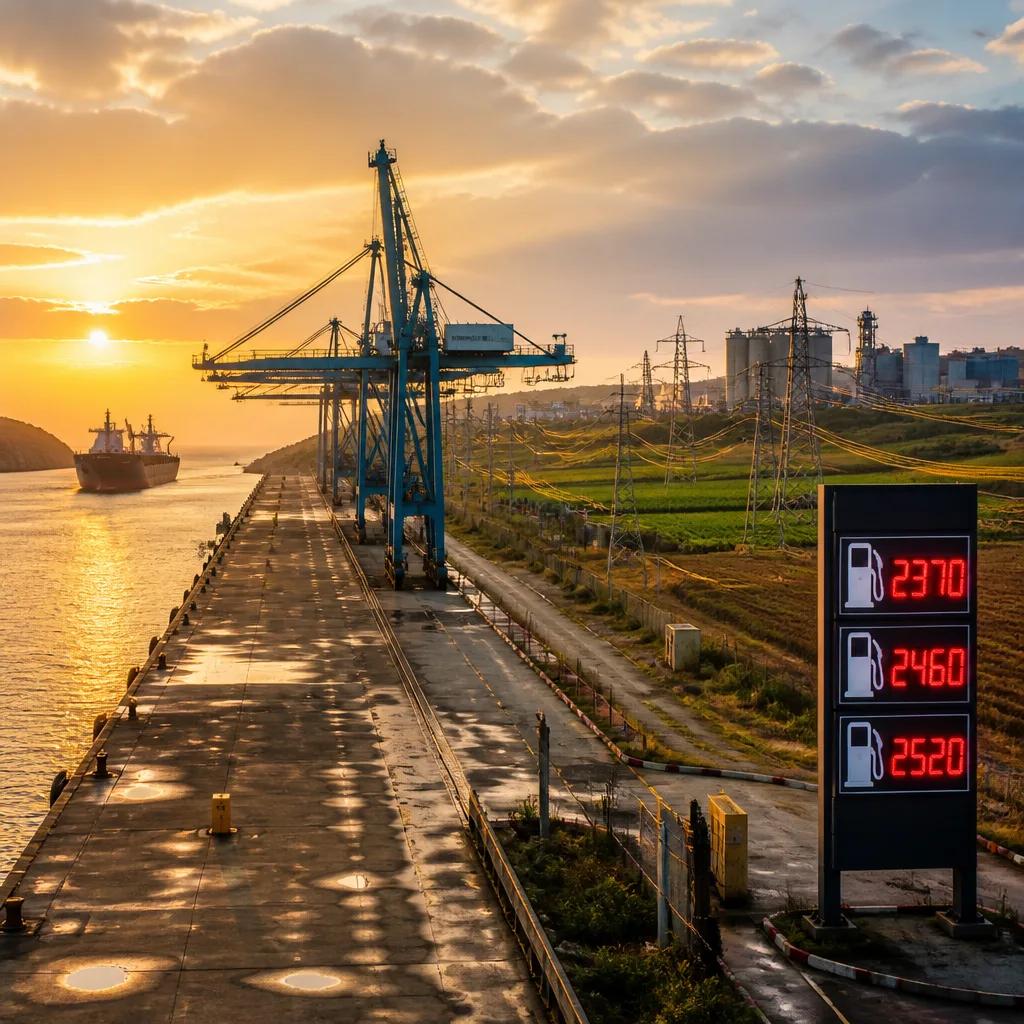
Intermittent disruption to shipping through the Strait of Hormuz and persistently elevated fuel prices have forced a stark reassessment of economic strategy across Africa, according to economists who argue the continent must reinvent how it pursues industrialisation.
Shock exposes longstanding vulnerabilities
The recent disturbances to shipments passing the Hormuz chokepoint have amplified an already acute problem: many African economies remain highly dependent on imported petroleum from the Middle East. That dependency has left countries from Ethiopia to South Africa exposed to energy price volatility, undermining growth and complicating efforts to move labour out of low‑productivity activities such as subsistence farming.
Economists describe this structural shift — moving workers into manufacturing and modern services so they can earn substantially higher productivity wages — as structural transformation. While it remains central to lifting incomes, the pathway that produced rapid industrial growth in East Asia looks increasingly difficult to replicate in today’s fractured global economy.
Why the old export‑led model is harder to repeat
Between the 1960s and later decades, countries such as Japan, South Korea, Taiwan, China and Vietnam industrialised by expanding exports of labour‑intensive manufactured goods: garments, footwear, furniture and electronics. Those industries generated millions of jobs for workers with limited formal education while building technological capability and logistics capacity.
That model depended on a relatively stable and predictable global trading system: falling trade barriers, expanding demand for manufactured goods and a long period in which richer countries gradually relinquished labour‑intensive product lines. Africa, the analysis reminds us, did not fully participate in that wave of export‑manufacturing.
| Region | Manufacturing (% of GDP) |
|---|---|
| Sub‑Saharan Africa | ~10% |
| East Asia and the Pacific | ~22% |
The gap is stark: manufacturing accounts for around 10% of GDP in sub‑Saharan Africa compared with roughly 22% in East Asia and the Pacific, a statistic that encapsulates the continent’s long‑running challenge in creating large numbers of manufacturing jobs.
Four priorities for a reimagined industrial strategy
Rather than attempting to copy yesterday’s model, economists argue Africa must adapt to present realities. They propose four interlinked priorities:
- Larger markets — regional integration and wider access to demand to make manufacturing ventures viable.
- Reliable electricity — stable power provision to underpin productive factories and services.
- A focus on comparative agricultural advantages — using agriculture as a springboard for higher‑value processing and agribusiness.
- Reinvented structural transformation — policies calibrated to current geopolitical fragmentation, fragmented supply chains and the impacts of automation and artificial intelligence.
These priorities reflect a pragmatic shift: industrial policy that acknowledges geopolitical rivalry and changing technology, rather than relying on an assumption of predictable global demand and stable supply chains.
Consequences for policymakers and international partners
The implications are immediate for governments across Africa and for international partners, including the UK. Ensuring energy security, expanding regional trade corridors and investing in reliable electricity infrastructure become not just development aims but strategic necessities. For African economies already strained by higher fuel costs, the task is to translate comparative agricultural strengths into higher‑value activities and to create labour‑absorbing industries that fit a more fragmented world.
As global trade rules and the geography of production shift, the debate about how Africa industrialises is no longer academic. It will determine whether the continent can generate broad‑based employment, reduce poverty and withstand the next geopolitical shock that raises commodity prices or interrupts supply routes.
For British policymakers and firms, the changing contours of Africa’s growth path present both challenges and opportunities: supporting reliable energy and regional market integration could help create the more diversified, resilient economies that will be stable trade and investment partners in the decades ahead.