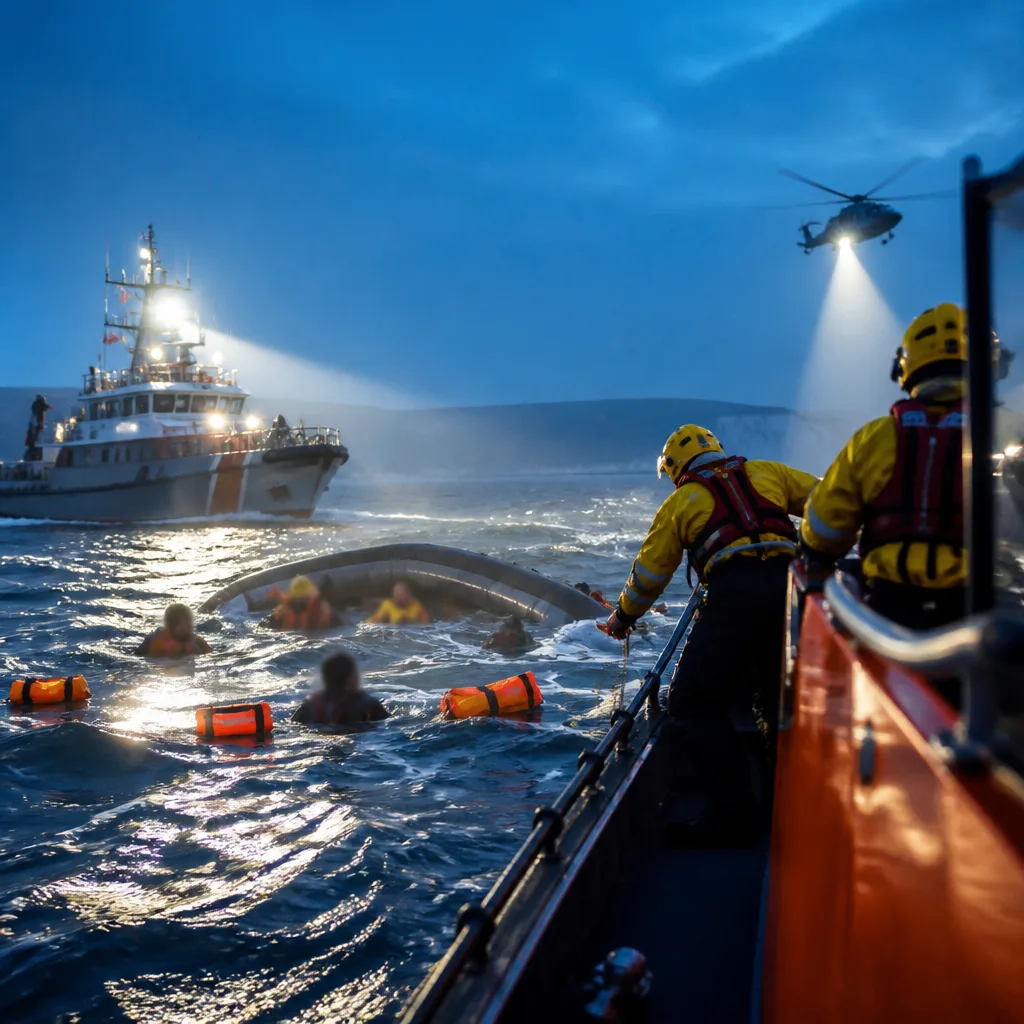
A dinghy carrying 157 people capsized after its engine caught fire while attempting to cross the English Channel from France, officials said, prompting a major air and sea rescue operation involving UK and French vessels alongside an RNLI lifeboat.
Rescue effort and immediate facts
French authorities said there had originally been 162 people on board, but five were removed overnight in an earlier incident and taken back to Boulogne; the remainder chose to continue the journey. The dinghy capsized after an engine fire while in the French search and rescue region.
“A vessel caught fire earlier this morning whilst in the French search and rescue region. UK vessels and a lifeboat are assisting.”
The RNLI confirmed that Eastbourne’s all‑weather lifeboat launched at 6am on Tuesday to assist with the response. Border security craft and French vessels also took part in the operation that recovered those in the water.
- People on board: initially 162; five removed earlier; 157 subsequently aboard when the dinghy capsized.
- Rescue units involved: UK border security vessels, French vessels and an RNLI lifeboat (Eastbourne).
- Departure point reported: Dieppe, roughly 112km (about 70 miles) from the UK — substantially further than the Calais–Dover route.
Context and wider pattern
The boat on Tuesday was carrying the second‑highest number of people recorded so far this year; the largest involved 165 passengers on 23 July. Officials and charities have repeatedly warned that smuggling gangs are resorting to ever more hazardous methods and using more distant launch points along the French coast to try to evade interceptions.
Last week, four people died attempting Channel crossings on overcrowded vessels. The incident on Tuesday comes as the new prime minister, Andy Burnham, has pledged to continue efforts to halt crossings; government measures intended as deterrents remain in place, but crossings have continued, with more than 2,000 people reported to have made the crossing since he took office.
Political reaction
The episode was seized on by Reform UK, which has proposed deploying the Royal Navy to return people to France or Belgium under a plan it has labelled “operation fortress”. The party describes its proposal as a humanitarian response intended to prevent deaths at sea.
Responding to the capsizing on social media, Reform figures argued for immediate action:
“We must put a stop to this. Our plan will save lives.”
The party’s deputy leader added: “Just like Reform policy: rescue and return. It’s the humanitarian thing to do. We must stop people dying.”
Consequences and unanswered questions
The incident raises renewed questions about the safety of small, overloaded craft and the effectiveness of current deterrents and co‑operation between UK and French authorities. Using launch points farther from the UK increases time at sea and exposure to mechanical failure and poor weather, heightening the risk to those on board.
Authorities are likely to focus on several strands in the wake of the incident: the immediate welfare and legal status of those rescued, intelligence and enforcement against smugglers, and any further measures to reduce crossings without adding to the danger faced by people taking to the sea.
| Item | Detail |
|---|---|
| People originally reported on board | 162 |
| People aboard when dinghy capsized | 157 |
| Largest boat crossing so far this year | 165 passengers (23 July) |
| Reported departure point | Dieppe — about 112km (70 miles) from the UK |
The full details of how the incident unfolded, the causes of the engine fire and the outcomes for those rescued — including whether any will be returned to France — have not been disclosed. Government departments and rescue agencies involved have provided limited comment, and the investigation is ongoing.