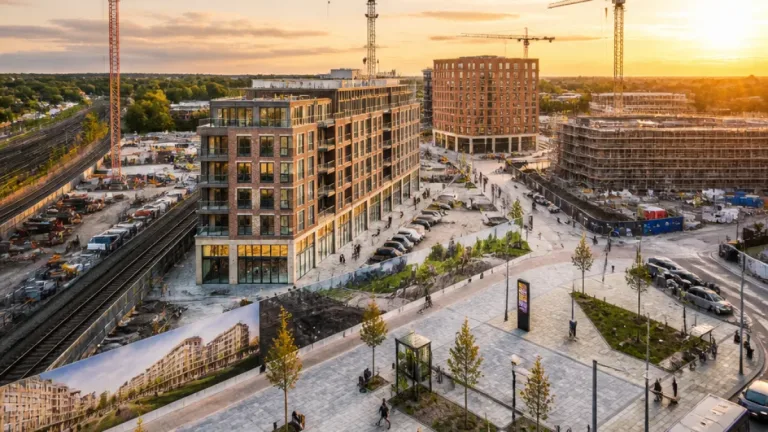

Large-scale redevelopment aims to reshape North East Cambridge
The Crown Estate has formally submitted planning proposals for a £2bn redevelopment of Cambridge Business Park, setting out a long‑term masterplan that would change the character of one of the city’s principal innovation areas.
The application describes a mixed‑use scheme delivering up to 1.8 million sq ft of office, research and development space, around 500 homes including a 40% affordable allocation, and up to 200 co‑living homes. The proposal also envisages nearly 60,000 sq ft of retail and leisure floorspace, new public spaces and community infrastructure.
Jobs, economy and local spending
The Crown Estate estimates the redevelopment could support as many as 8,000 jobs and contribute about £650 million a year to the UK economy. It also anticipates around £35 million of annual local expenditure linked to the site once completed.
Those figures underscore the developer’s intent to position the park as a focal point in the emerging North East Cambridge Innovation District, reinforcing the city’s broader role in the national innovation economy.
Sustainability, connectivity and design
Proposals stress a sustainable, low‑carbon approach. The masterplan targets a 55% reduction in water use compared with standard benchmarks and promises improved active travel and public transport links, including enhanced cycling and walking routes plus bus and rail connectivity.
- Office/R&D: up to 1.8m sq ft
- Homes: around 500 (40% affordable)
- Co‑living: up to 200 units
- Retail/leisure: nearly 60,000 sq ft
- Jobs supported: up to 8,000
- Local spend: c. £35m pa
Social impact funding and local pledges
Alongside the planning submission, The Crown Estate has pledged £1.5 million to Greater Cambridge Impact (GCi), a £10 million investment vehicle created to tackle inequality in the area. GCi plans to deploy place‑based capital over the next decade to organisations addressing skills for young people, children in care and homelessness.
“Cambridge plays a critical role in the UK’s innovation economy as one of the world’s leading innovation hubs, with Cambridge Business Park at its heart,” Kristy Lansdown, managing director, development at The Crown Estate, said.
Local consequences and next steps
For Cambridge residents the scheme raises several immediate questions. If approved, the development would intensify employment in the north‑east of the city, increasing demand for public transport, local services and affordable housing. The inclusion of a high affordable housing share and community infrastructure is intended to mitigate pressure on local housing markets, but delivery and phasing will be crucial.
Transport and environmental measures will be examined closely through the planning process, particularly the credibility of promises to improve cycling, walking and public transport links and the claimed reductions in water consumption. Planning officers and elected members will also consider how the site will integrate with existing communities and the wider North East Cambridge Innovation District.
Facts at a glance
| Element | Figure |
|---|---|
| Estimated construction cost | £2 billion |
| Office / R&D space | Up to 1.8 million sq ft |
| Homes | Around 500 (40% affordable) |
| Co‑living | Up to 200 |
| Retail & leisure | Nearly 60,000 sq ft |
| Jobs supported | Up to 8,000 |
| Annual contribution to UK economy | £650 million |
| Annual local expenditure | £35 million |
| GCi pledge | £1.5 million |
The planning application represents a pivotal moment for Cambridge’s built environment and its role in the national innovation landscape. As the proposals enter the statutory process, residents and local stakeholders will be watching how commitments on housing, transport and social impact are converted into deliverable outcomes.