Australian start-up Siltrax is advancing a silicon-based approach to fuel-cell bipolar plates after laboratory tests at the University of New South Wales (UNSW) recorded results that the company and researchers say could materially improve both performance and longevity of hydrogen systems.
Testing claims: more power, less corrosion, better heat transfer
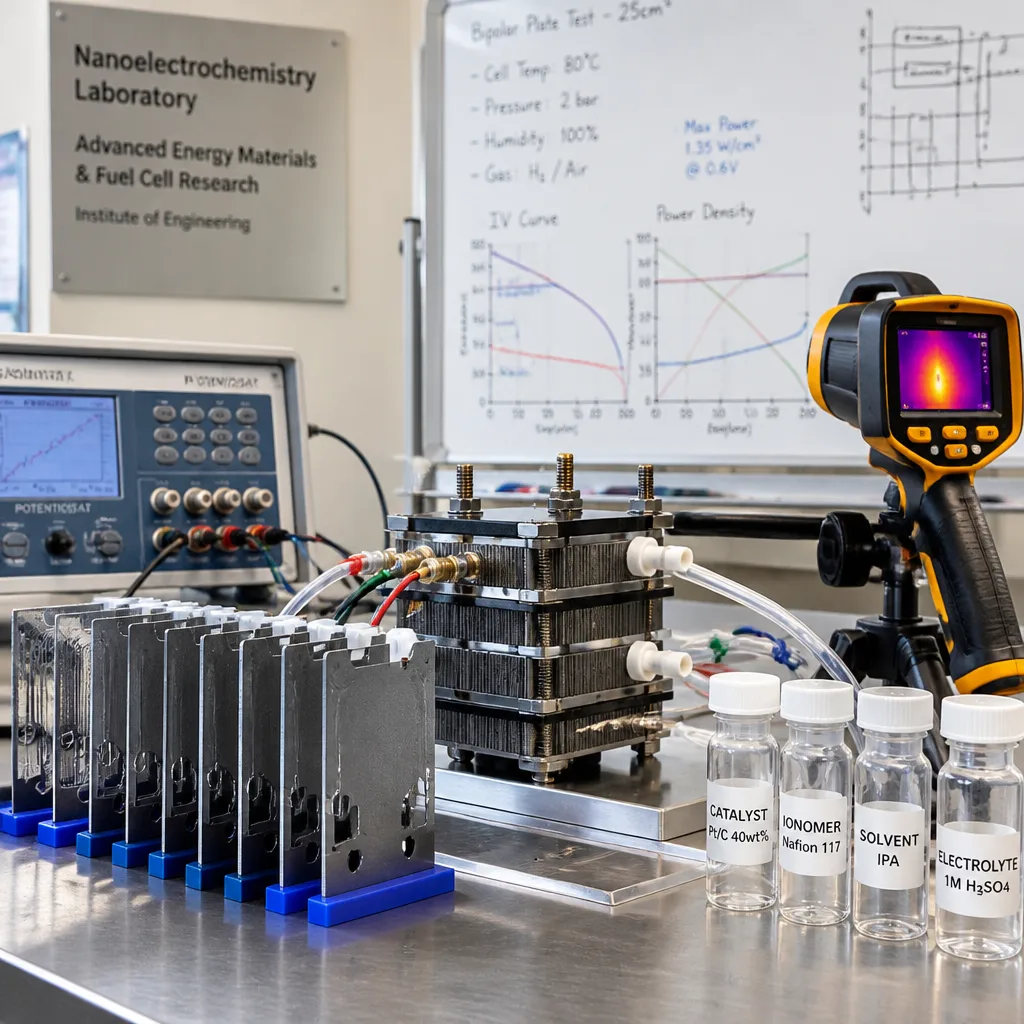
Researchers in UNSW’s NanoElectroChemistry Lab found Siltrax’s ultra-thin silicon plates produced roughly twice the power output of conventional graphite plates in bench trials. The silicon material also exhibited markedly improved durability and thermal behaviour compared with stainless steel, a commonly used metal in bipolar plate manufacture.
“These results far surpassed what we anticipated,” Dr Quentin Meyer said.
The UNSW team quantified the differences: the bare silicon plates corroded at a rate about 26 times slower than stainless steel in their tests, and the silicon’s heat-transfer properties were measured to be approximately 10 times superior to the same steel. Those two characteristics are important because corrosion undermines long-term reliability and poor thermal management reduces efficiency and shortens component life.
Why bipolar plates matter
Bipolar plates are the thin internal panels that collect and conduct electrical current and help distribute gases, water and heat within a fuel cell. Historically, manufacturers have chosen either metal plates, which are conductive but can corrode and need protective coatings, or graphite plates, which resist corrosion but are relatively heavy and brittle.
Siltrax’s proposal is to substitute those conventional materials with silicon formed into extremely thin plates. If the laboratory performance translates into commercial stacks, the trade-offs could be significant: higher specific power, reduced mass for transport applications, and fewer protective coatings that add cost and complexity.
Next steps and caveats
Siltrax is targeting commercial trials following the UNSW work. The company says the silicon approach offers a lower-cost route for next-generation hydrogen systems, particularly in sectors that are hard to electrify, such as heavy road haulage, shipping and aviation — the very markets where fuel cells are often presented as an alternative to batteries.
There are, however, important limitations to the published detail. The source material describes laboratory testing but does not specify stack or system-level results, long-term field durability under real-world conditions, manufacturing yields at scale, or costs for producing ultra-thin silicon plates in commercial volumes. Those are the practical hurdles that typically determine whether promising lab materials can be adopted by industry.
Scaling silicon into large-area, mechanically robust bipolar plates without introducing new failure modes — for example due to cracking, contamination or interface losses — will be a major engineering task. Equally, the economics of silicon processing versus existing metal or graphite production pathways must be demonstrated.
Fred Qi, director of sales engineering at Siltrax, and UNSW academics including Laureate Professor Chuan Zhao were involved in the experiments, but the published account stops short of disclosing independent validation beyond the described laboratory tests.
What to watch
- Whether Siltrax can organise and publish peer-reviewed, independent replication of the UNSW tests.
- Results from planned commercial trials: stack-level performance, lifetime under cycling and real-world environmental conditions.
- Manufacturing demonstrations showing cost, throughput and defect rates for ultra-thin silicon plates at scale.
To place the reported figures side-by-side, the UNSW testing produced these comparative metrics:
| Metric | Silicon (Siltrax) | Comparator |
|---|---|---|
| Power output | ~2x | Conventional graphite plates |
| Corrosion rate | 26x slower | Stainless steel |
| Heat transfer | 10x better | Stainless steel |
Siltrax’s claims, backed by UNSW laboratory work, represent a credible materials advance. Whether it becomes a transformative industrial solution will depend on validation beyond the lab, demonstrable costs and durability in operating environments, and the ability to integrate the plates into commercially viable fuel-cell stacks.
The hydrogen sector has seen many material and component innovations that showed promise in controlled tests but faltered when scaled; this development will be judged by how it negotiates that same gauntlet.