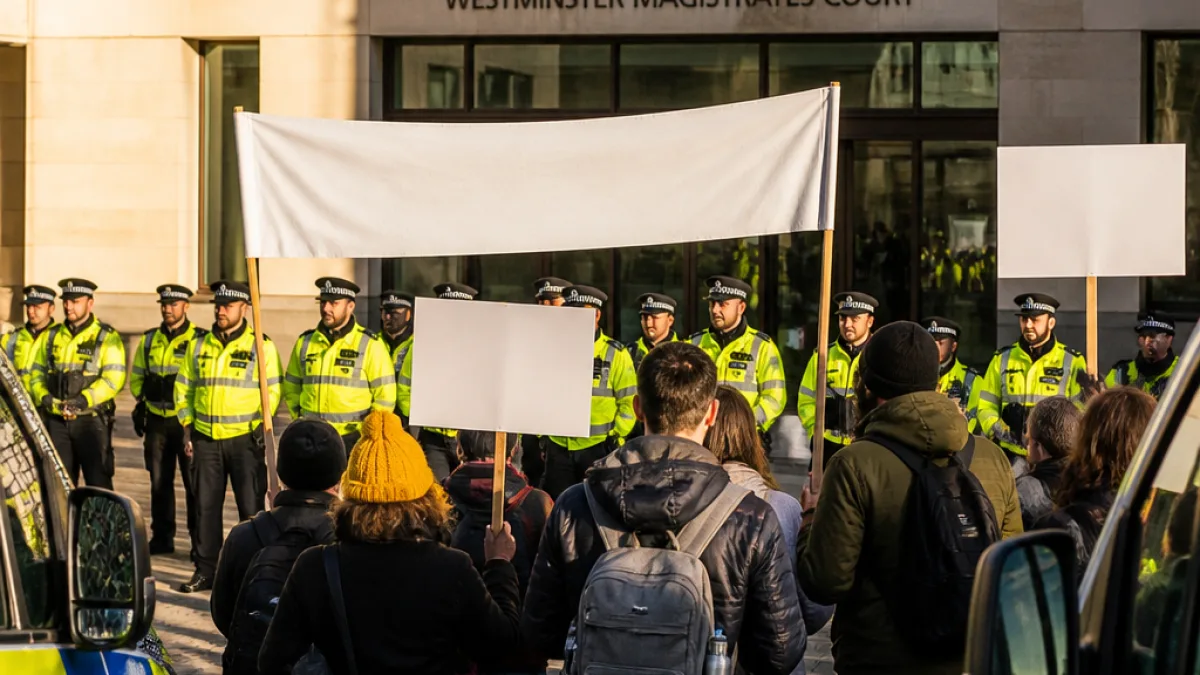
Seventy‑seven people were arrested by Metropolitan Police officers during a demonstration outside Westminster Magistrates Court on Thursday after protesters publicly declared support for the proscribed group Palestine Action.
What happened outside the court
The gathering was organised by the group Defend Our Juries, which has staged similar events in recent months in a tactic where volunteers place themselves in a visible location, proclaim support for Palestine Action and allow officers to detain them. Court hearings that day – including the cases of several people previously arrested in connection with support for Palestine Action – were postponed.
Witnesses described a small cluster of demonstrators who had designated themselves as willing to be arrested. On making statements of support for the proscribed group, participants were taken into custody, in some instances being carried away by officers.
Police warning and legal context
The Met had issued a clear warning the evening before the protest that anyone expressing support for Palestine Action could be arrested. Assistant Commissioner Andy Valentine reiterated that position, stressing the legal consequences of openly supporting a banned organisation.
"The law is clear. Expressing support for proscribed organisations is a criminal offence and anyone doing so can expect to be arrested."
The force also pointed to the wider impact of such actions on court staff, victims and witnesses attending hearings, and on the public using court facilities.
Organisers' response
Defend Our Juries, which says it has carried out a number of similar demonstrations over the past year, described the arrests as an attack on civil liberties and framed their actions as morally driven opposition to what they characterised as judicial treatment of people acting to "save lives".
"These arrests ... are an assault on our democracy, our civil liberties and our moral obligation to step in to prevent genocide," a spokesperson for Defend Our Juries said.
The group also claimed thousands have been arrested at comparable events, and cited a figure of 1,855 people listed as needing to appear in court on the same day – a figure they used to underline the scale of recent policing and prosecutions they oppose.
Numbers and immediate effects
Thursday's operation saw 77 people taken into custody. Some court hearings scheduled for the day were delayed or adjourned, compounding pressure on court timetables. The demonstration was contained to the area outside the magistrates' court and did not spill into neighbouring streets, according to police briefings.
- Arrests made: 77
- Group organising protest: Defend Our Juries
- Proscribed organisation named: Palestine Action
- Court affected: Westminster Magistrates Court (hearings postponed)
| Item | Figure |
|---|---|
| People arrested at the demonstration | 77 |
| People reportedly listed to appear in court that day (cited by organisers) | 1,855 |
Broader implications for London
The incident highlights the tensions in the capital between activism and the criminal law following the proscription of Palestine Action. It also raises questions about policing tactics at politically charged demonstrations and the practical consequences for court timetables when large numbers of people are arrested at a single event.
For Londoners, the episode is a reminder of how protests can directly affect public services around central criminal courts, from access for jurors and victims to the scheduling of hearings. It also feeds into continuing national debate around protest policing, free speech and the threshold at which expression becomes criminal support for a proscribed organisation.
What to expect next
Those arrested are likely to be processed through the magistrates' court system in due course. The legal route taken in individual cases will depend on police decisions on charging and the prosecution service's assessment. Defend Our Juries has signalled it will continue to organise similar events.
The Met has set out its position publicly and says it will continue to enforce the law where criminal offences are alleged. With both sides signalling further action, London's courts, police resources and public order units can expect renewed pressure in the weeks ahead.
For live updates and practical information: members of the public planning to attend or travel near Westminster Magistrates Court should check Transport for London service notices and Met Police public briefings for any disruption.