University-led training strengthens local leadership and shopfloor efficiency
The University of Salford’s Centre for Sustainable Innovation (CSI) has reported measurable improvements in leadership skills and operational performance at Salford-based Mettler‑Toledo Safeline Ltd following a six-month business improvement programme.
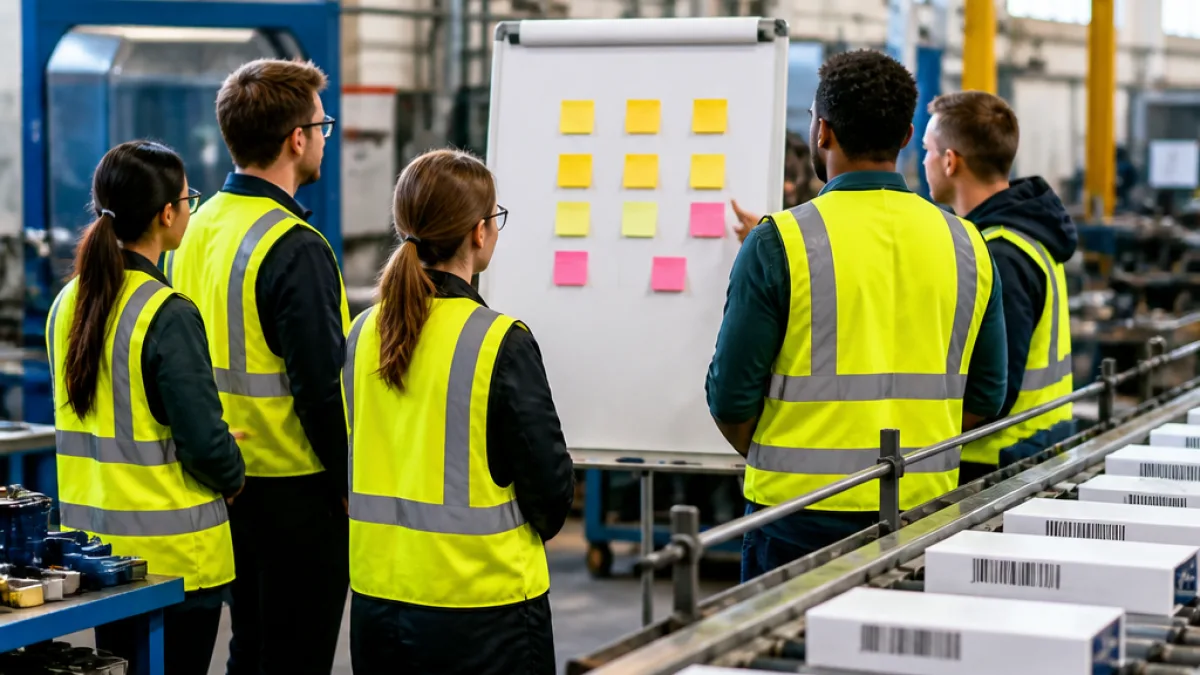
Between October 2025 and April 2026, 13 operational leaders from across production, engineering, service and supply chain completed a tailored learning programme that combined classroom-based modules with live operational improvement challenges on the factory floor. An assessment at the end of the project showed a 13% uplift in leadership skills compared with initial baselines.
Practical projects to tackle day-to-day bottlenecks
One of the projects focused on the delivery process between goods-in and production, often an area where manufacturers experience delays and extra handling. Participants identified several causes of inefficiency, including multiple handling stages and weak coordination across departments.
- Streamlined delivery routing to remove unnecessary movements
- Introduction of prioritisation using structured day one/day two queues
- Real-time tracking via barcode scanning
- Clearer cross-functional communication processes
Those changes were credited with improving workflow efficiency, reducing delays and strengthening quality control. Company staff also reported better alignment between stores, planning, purchasing and production teams.
Cultural benefits as well as process gains
Beyond the immediate operational gains, the programme aimed to embed continuous improvement thinking and to boost confidence in leading change. The CSI said participants demonstrated improvements in collaboration, change management and the consistent use of structured improvement methods.
"During my time on the programme, I was a trainee with no department to manage. Since then, the knowledge I have gained has enabled me to go straight into my new leadership role with a fresh mind and an eye for continuous improvement."
The remark came from Mat Wyke, a production leader at Mettler‑Toledo Safeline Ltd, who highlighted how the experience helped his transition into a leadership role and encouraged cross-departmental collaboration.
Local implications and potential for wider adoption
For Salford, the programme demonstrates how collaboration between higher education institutions and industry can deliver measurable returns: improved leadership capability, operational efficiencies and cultural change in an advanced manufacturing setting. Mettler‑Toledo Safeline specialises in inspection systems for food and pharmaceutical sectors, so gains in efficiency and traceability could have knock-on benefits for clients served by the Salford operation.
| Metric | Result |
|---|---|
| Participants | 13 operational leaders |
| Programme period | Oct 2025–Apr 2026 |
| Measured uplift in leadership skills | 13% |
University-led programmes such as this are increasingly viewed as a route to help local firms tackle skills gaps without lengthy recruitment cycles. By working on live problems within the business, participants can implement changes that deliver immediate benefits while developing leadership and continuous improvement capabilities for the longer term.
Those involved said the initiative has led to stronger ownership of operational performance and more consistent use of structured improvement tools across teams — outcomes likely to be welcomed by manufacturers and supply-chain partners in and beyond Salford.