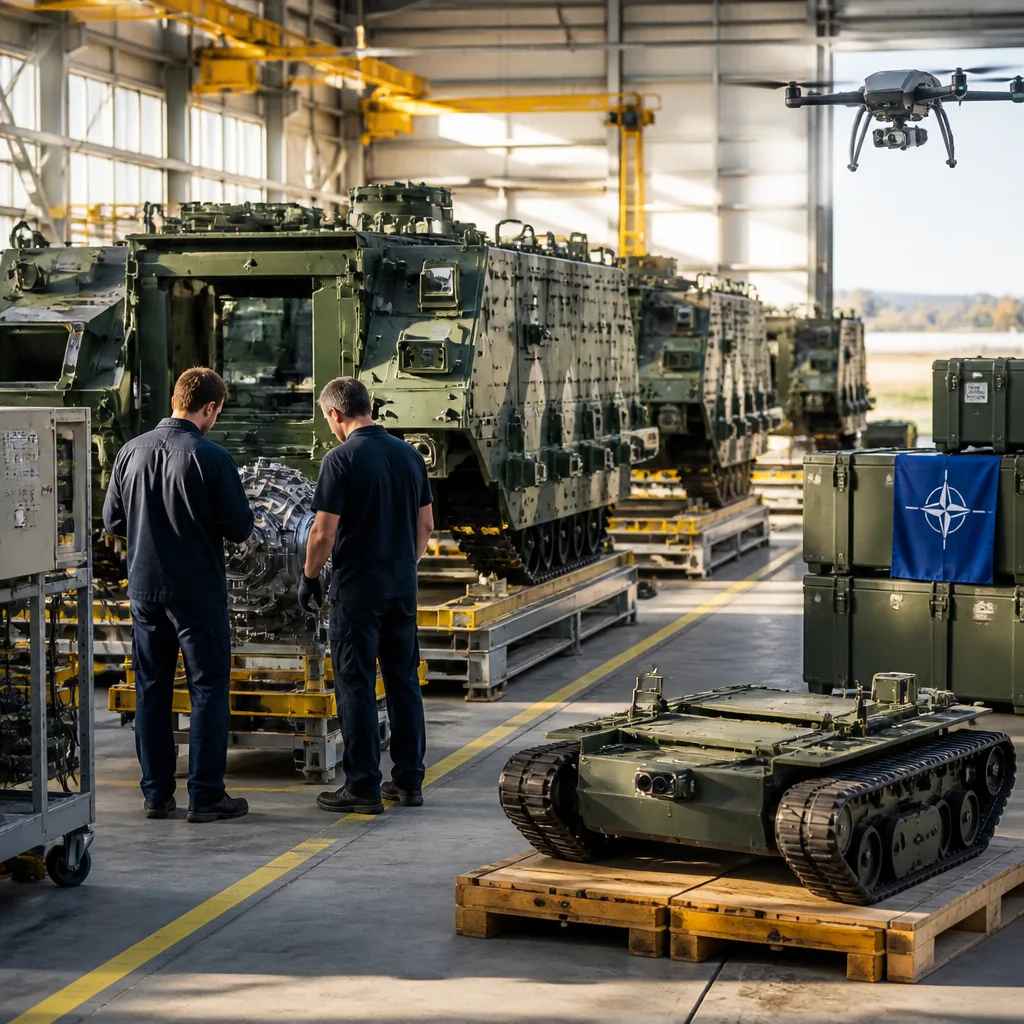
Renk, the German supplier of transmissions and drive systems for armoured vehicles, told investors that almost all of its land-market business will still involve human-crewed platforms through 2030 and that substantial demand for unmanned heavy platforms is not expected until at least 2035.
Company verdict on the drone debate
Speaking on Renk’s second-quarter earnings call, Chief Executive Alexander Sagel pushed back against the notion that drones and loitering munitions will render heavy armour obsolete. He argued that a broad mix of capabilities will remain necessary and that unmanned systems will supplement — rather than supplant — existing crewed vehicles and naval platforms.
"you cannot end a war, and you cannot win a war ... just by drones, just by airstrikes, and just by long-range smart missile attacks."
Sagel pointed to the conclusions reached at NATO’s July summit in Ankara, saying the alliance reaffirmed the need for layered capabilities including air defence, long-range strike, unmanned systems and what he described as "conventional mass" on land and sea.
Products, partnerships and orders
Renk is already positioning itself for a mixed future. The company highlighted a heavy tracked unmanned ground vehicle developed in collaboration with Finland’s Patria, and disclosed a Finnish pre-series order with deliveries scheduled to start in the second quarter of 2027. Renk also said Ukraine has shown strong interest in the transmission system used in that vehicle.
| Programme | Partner / Customer | Notable timing |
|---|---|---|
| Heavy tracked unmanned ground vehicle | Patria / Finland (pre-series order) | Deliveries begin Q2 2027 |
| Transmission system | Interest expressed by Ukraine | Undated |
Those moves signal Renk is hedging: continuing to serve traditional armoured markets while developing kit for the unmanned sector. The company’s assessment that 99% of its land business will still be crewed by 2030 gives European procurement officials a clear signal about likely industrial demand over the coming five years.
Implications for defence budgets and suppliers
- Procurement balance — Governments will need to weigh spending on new autonomy and drone programmes against maintaining and renewing armoured fleets.
- Industrial strategy — Suppliers such as Renk are likely to invest simultaneously in mature armoured systems and nascent unmanned platforms.
- Operational doctrine — NATO’s reaffirmation of a mixed-capability approach suggests alliance members will continue to require conventional mass alongside precision and autonomous systems.
Renk’s stance arrives amid a wider debate within defence circles across Europe about how fast militaries should pivot resources to autonomous systems and drones. Some analysts argue that the proliferation of loitering munitions and advances in remote sensors reduce the effectiveness of large armoured formations; Renk’s chief executive disagrees, pointing to recent conflicts to underline the enduring value of crewed platforms.
The company’s public remarks also matter commercially. Many defence contracts are multi-year, involve long lead times and support extensive domestic supply chains. If major suppliers maintain that demand for crewed vehicles will remain robust until 2030 and beyond, that will influence how national defence ministries plan procurement, sustainment and industrial partnerships.
For investors, the message is straightforward: Renk expects continued relevance for its core products even as it adapts to growth in unmanned systems. The firm is signalling a dual-track strategy — service the present market for heavy armoured systems while building capability and partnerships for the unmanned programmes that it expects to materialise more fully after 2030, with meaningful demand only likely by about 2035.
How governments and prime contractors allocate funding between established armoured platforms and novel autonomy programmes will determine who benefits most from that transition — and on what timetable.