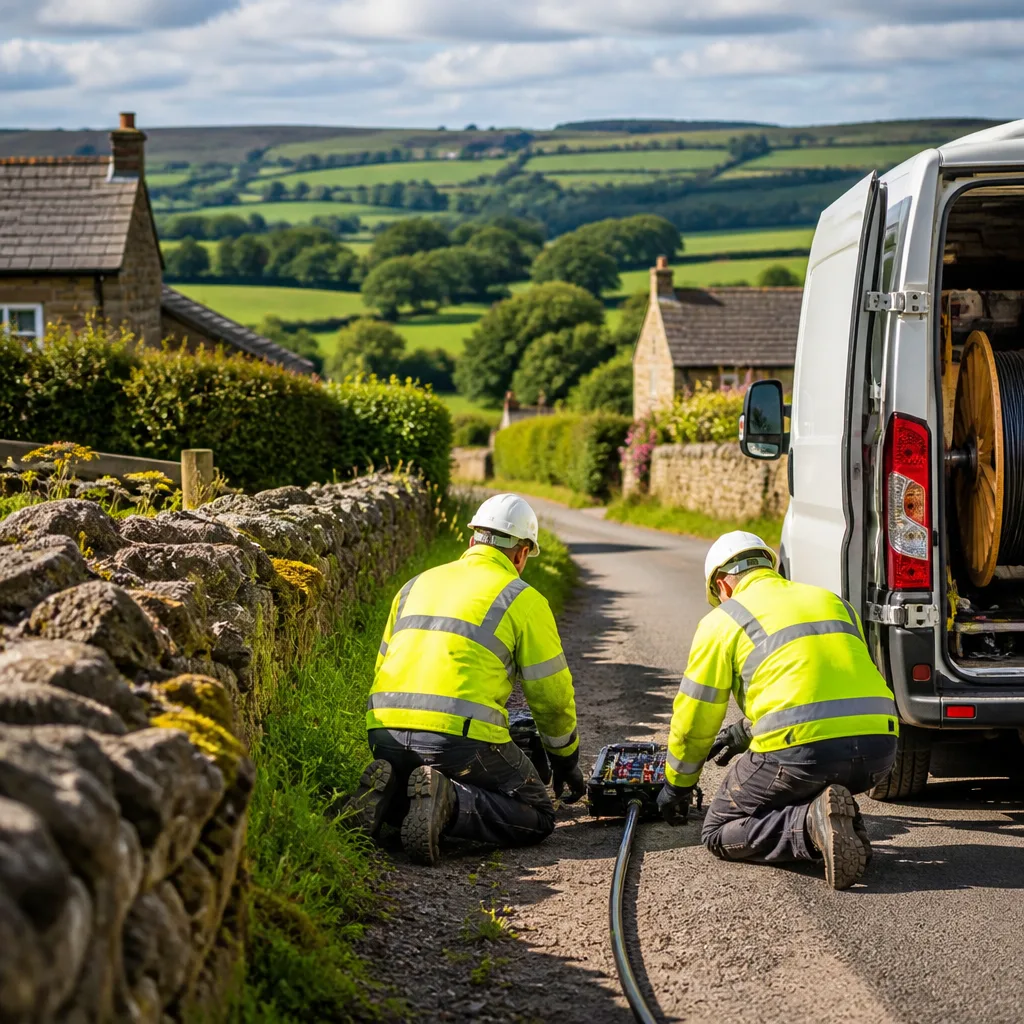
More than 60,000 rural homes and businesses across Lincolnshire and Yorkshire now have access to faster, more reliable broadband under the UK Government’s Project Gigabit, officials said, as deployments extend into villages and hamlets around Barnsley, Huddersfield, Hull, Bradford, York, Boston and Wisbech.
What the rollout delivers
The acquisition of gigabit-capable connections is intended to reduce dropouts for video calls, support online learning and enable local firms to take payments and reach customers more easily. The government-backed programme is being delivered in the region by private-sector partners; the announcement highlights Quickline as a key provider in the area.
Quickline’s involvement with the rollout is being positioned as delivering benefits beyond higher speeds. The company has received £127 million through Project Gigabit to expand its network across the two counties, and the announcement pairs infrastructure investment with workforce and community activity.
- 60,000 rural homes and businesses reached across Yorkshire and Lincolnshire.
- £127 million of Project Gigabit funding delivered to Quickline for the regional rollout.
- Community and skills programmes: Quickline reports supporting more than 1,700 young people in STEM activity, running workshops for 80 Year 5 and Year 6 pupils, and providing hands-on experience to over 130 people via apprenticeships.
Local impact and skills pipeline
The rollout timetable lists several communities benefiting in this phase, including Winterton in North Lincolnshire, Fosdyke in Lincolnshire, and Sessay and Linton on Ouse in Yorkshire, with further villages, hamlets and rural homes being connected each week.
Those behind the project emphasise immediate practical gains for households and businesses — from smoother video calls to better online study — while also highlighting the creation of training and early-career opportunities in engineering and telecoms. Quickline’s STEM workshops in East Yorkshire targeted Year 5 and Year 6 pupils at Skirlaugh Primary School, intended to introduce engineering and telecommunications to primary-age children.
“Good broadband is about giving families, workers and local businesses the tools they need to get on, wherever they live. This milestone is proof that Project Gigabit has put better digital opportunities into local communities across Yorkshire and Lincolnshire,”
The comment was attributed to Ian Murray, Minister of State at the Department for Digital, Culture, Media and Sport.
Context and consequences for regional economies
Project Gigabit is the UK Government’s flagship programme to extend gigabit-capable connections in harder-to-reach areas where commercial roll-out is slower. In places with lower population densities, the economics of full fibre are challenging for private firms; public funding is intended to close that gap and improve digital inclusion.
For rural businesses, immediate benefits are operational: better payment processing, more reliable remote services and customer engagement. For households, improved broadband supports remote working, online education and social connectivity. For the local labour market, the combination of apprenticeships and outreach into schools aims to widen the pipeline of young people considering telecoms and engineering careers.
While the announcement sets out the numbers connected to date and associated community activity, further updates will be needed to track adoption rates, speeds delivered in practice and whether the new connections materially raise local business productivity or employment in the medium term.
| Metric | Figure |
|---|---|
| Homes and businesses reached | 60,000 |
| Project Gigabit funding to Quickline | £127 million |
| Young people engaged in STEM activity | 1,700+ |
| Primary pupils in specified workshops | 80 |
| Apprenticeship placements cited | 130+ |
The rollout underscores the government’s priority to tackle the digital divide between urban centres and rural communities. For policymakers and regional businesses, the task now is to ensure that improved connectivity is matched by commercial take-up and by skills pathways so local residents can benefit from the jobs created by the build-out.