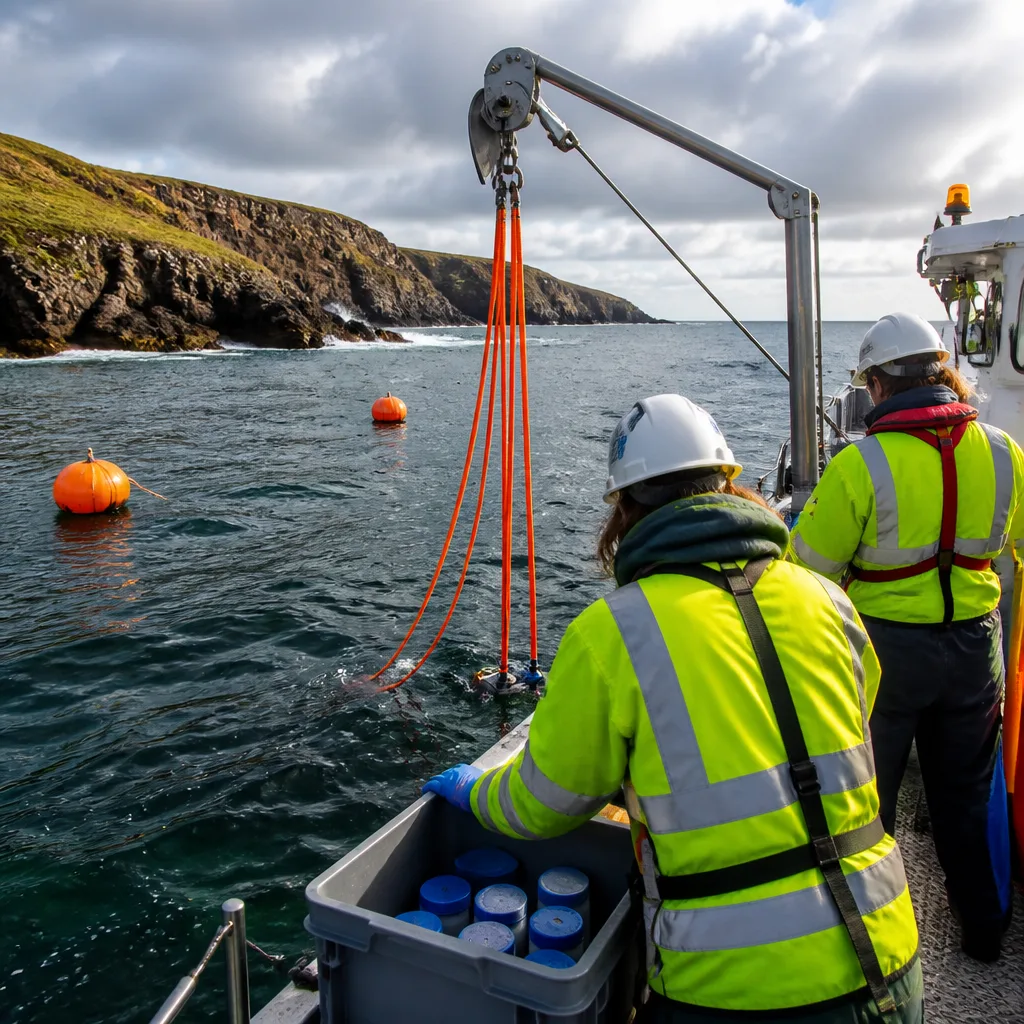
SuperCritical Materials has announced plans to commercialise a sea‑water uranium extraction technique that draws on research conducted at the US Department of Energy’s Pacific Northwest National Laboratory (PNNL) and by earlier private partners. The company says the approach aims to tap a resource estimated at roughly 4.5 billion metric tonnes of uranium in the world’s oceans — more than 1,000 times known terrestrial reserves — if it can be done economically.
From lab milestone to commercial push
The method traces back to work at PNNL that reached a public milestone in 2018, when the laboratory reported producing five grams of yellowcake (U3O8) using acrylic fibre adsorbents that had captured uranium from seawater. That result demonstrated the underlying chemistry and materials science could recover measurable quantities of uranium in controlled tests.
PNNL stated at the time the result indicated the approach "can eventually provide commercially attractive nuclear fuel derived from the oceans — the largest source of uranium on earth." SuperCritical Materials says it builds on that legacy, and key personnel links exist between the prior private actor LCW Supercritical Technologies and the new company: Gary Gill, a PNNL researcher involved in related work, is listed on SuperCritical’s advisory board, and Chien Wai, previously president of LCW, is part of the new firm’s technical team.
"that this approach can eventually provide commercially attractive nuclear fuel derived from the oceans — the largest source of uranium on earth."
What remains unreported and why it matters
While the science has cleared an early proof‑of‑concept, key commercial details remain opaque. Public filings and the company’s materials do not disclose the full chain of transactions that transferred technology and know‑how from LCW to SuperCritical Materials; the new company’s website lists a 2024 founding date, but it is not clear whether this represents a rebrand, merger or separate entity building on prior work.
Commercial viability hinges on several factors that have stalled previous attempts to scale seawater extraction technology:
- Cost per kilogram recovered compared with mined uranium;
- Durability and regeneration of adsorbent materials in harsh marine environments;
- Deployment logistics — the ability to place, retrieve and process adsorbents at the scale required; and
- Environmental and regulatory impact assessments for large‑scale operations.
Past research programmes in the United States, Japan and China demonstrated the scientific plausibility of recovery but concluded that production had not reached commercial competitiveness. SuperCritical’s statement implies a fresh attempt to close that gap, leveraging advances in materials and process engineering made over the last decade.
Strategic implications for nuclear fuel supply
If a commercially feasible route were established, the oceans represent a near‑effectively limitless uranium reservoir in supply terms, periodically replenished by riverine inputs. That could alter long‑term dynamics for nuclear fuel security: nations with limited terrestrial reserves could reduce dependence on mined supplies and geopolitical supply chains.
However, the presence of vast quantities of uranium in the ocean is not in itself an economic guarantee. The industry must still weigh the capital intensity of infrastructure, the lifecycle costs of materials and operations, and compliance with environmental standards. The transition from laboratory achievement to industrial reality will require transparent data on cost structures, recovery rates and environmental impacts — none of which SuperCritical has published in detail so far.
| Item | Reported figure |
|---|---|
| Estimated uranium in oceans | ~4.5 billion metric tonnes |
| Ratio vs identified terrestrial reserves | ~1,000× |
| PNNL 2018 production milestone | 5 grams of U3O8 |
For technology reporters and policymakers, the watchpoints are clear: independent verification of recovery rates and costs; peer‑reviewed lifecycle studies; and clarity on intellectual property chains and corporate structure. SuperCritical’s announcement marks a revival of interest in a technically promising but commercially elusive technology. Whether it can make the leap from laboratory demonstration to an economically competitive supply source remains to be proven.
As governments weigh energy transitions and the role of nuclear power, innovations that could expand accessible fuel supplies attract attention. But hype must be measured against hard figures: demonstrated throughput, capital and operating costs, and environmental safeguards. The oceans may be rich in uranium; the pressing question is how cheaply and responsibly industry can extract it.