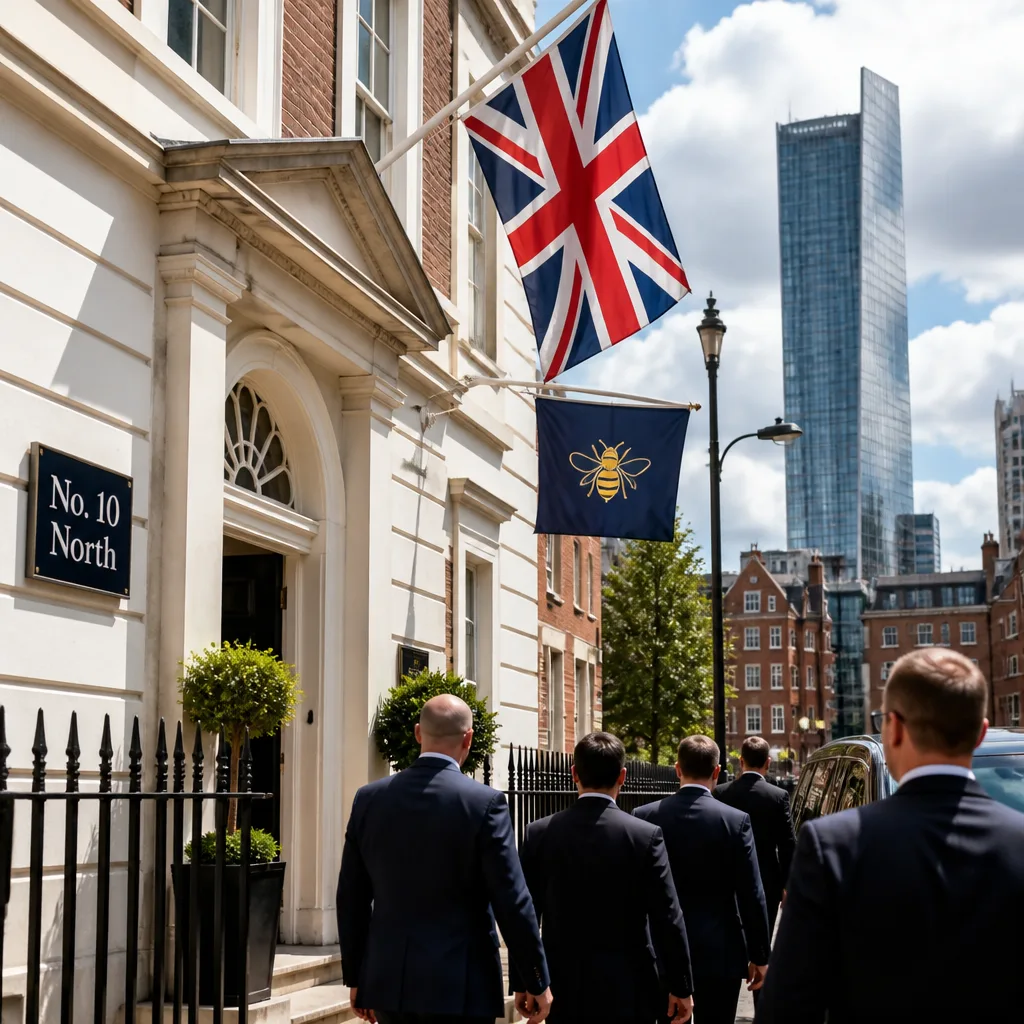
The Prime Minister has unveiled plans for a permanent ‘Number 10 North’ office in Manchester, signalling a deliberate shift in how and where senior government business — including hosting foreign dignitaries — might be conducted outside central London.
Devolution by location
Downing Street has confirmed that the new operational branch of Number 10 could be used to receive overseas leaders, reflecting the Prime Minister’s wider aim to move some government functions and decision-making away from Whitehall.
Officials indicated there is "no reason why Number 10 North wouldn't host" visiting heads of state or government and that it will form part of the options when arranging diplomatic engagements. The move comes as the Prime Minister is expected to spend a substantial portion of his time in Manchester — where he served as mayor prior to entering national office.
Political and economic ambitions
Supporters argue Number 10 North could help persuade foreign investors and visiting dignitaries to consider regions, cities and towns across Britain rather than concentrating activity in London. Backers say that bringing senior guests to the north would showcase the industrial and commercial strengths of areas outside the south-east and make the country’s decision-makers appear more geographically dispersed.
John Slinger, a Labour MP and government trade envoy, described the idea as a "bold move" for a country often criticised for centralisation, while commentators noted the potential diplomatic and commercial advantages of demonstrating that the government’s attention and decisions are not confined to Westminster.
"It is an operational branch office of Number 10, so the biggest question is: would anything be happening there that would be of interest to foreign dignitaries? And in general terms, yes so that will definitely be in the mix,"
Practical considerations and implications
The Downing Street spokesman said the north-based office would be treated as an extension of Number 10, with the capacity to host activities of interest to foreign leaders. That opens up a range of practical questions about security, protocol, and how ministerial diaries and departmental responsibilities will be managed when the Prime Minister is operating from outside London.
Advocates hope the initiative will encourage foreign delegates — particularly from regions such as the Gulf, where government trade envoys already cultivate relationships — to broaden their view of the UK and consider investment and partnerships in regional centres.
- New base: Number 10 North to be established in Manchester as an operational arm of Downing Street.
- Diplomatic use: Downing Street says the venue could be used to host foreign leaders and high-level delegations.
- Policy aim: Part of a broader attempt to decentralise power and promote regional economic engagement.
| Aspect | Implication |
|---|---|
| Location | Manchester (Prime Minister's hometown and former mayoral base) |
| Function | Operational branch of Number 10; potential site for hosting foreign dignitaries |
| Expected benefit | Raise regional profile; attract investment; decentralise decision-making |
Reaction and next steps
Proponents say Number 10 North could alter long-standing perceptions that major decisions and high-profile diplomatic meetings are confined to London, potentially delivering both symbolic and material benefits to regional economies.
Critics may dispute the practical impact of relocating meetings or the degree to which real power is shifted from Whitehall. Details on how frequently the Manchester office will host state visitors or senior foreign delegations, and the full operational structure of the office, have not been published.
Downing Street made clear that plans for Number 10 North will include the option to put events and visits there "in the mix" when arranging official business — a change that could reshape how and where the UK presents itself to foreign governments and investors.
Implications to watch: the new office’s role in trade and investment promotion, the logistics of ministerial accountability when operating outside London, and whether the initiative leads to more sustained devolution of decision-making powers.