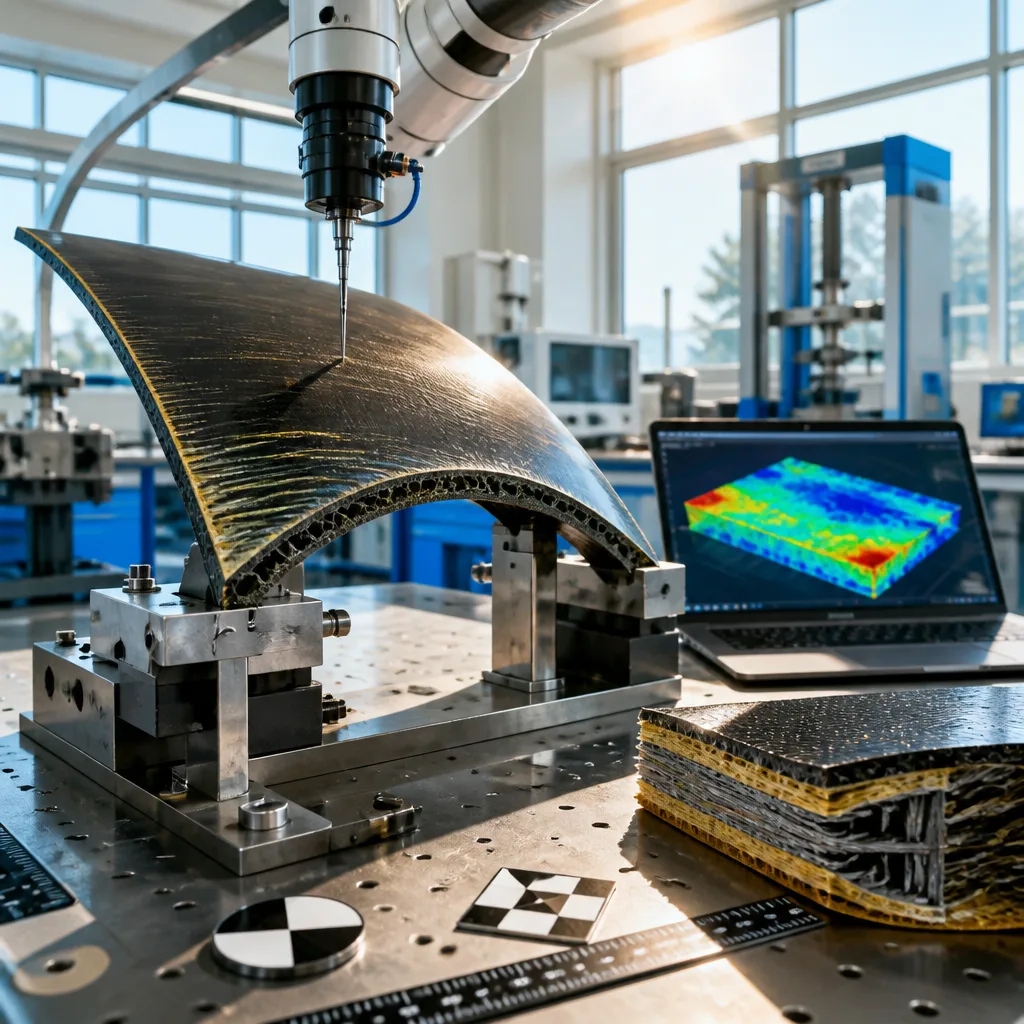
Researchers are advancing methods to measure microscopic stress concentrations deep inside polymer composites, a development that could improve prediction of failure in structures from utility-scale wind turbine blades to high-pressure hydrogen vessels and aerospace components.
Why the hidden stresses matter
Polymer composites pair stiff reinforcing fibres with a comparatively compliant polymer matrix so that the fibres carry most of the load while the matrix transfers stresses between them. But that very mismatch in stiffness produces highly localised stress concentrations at buried sites of the material. Those localised stresses can trigger interfacial damage or matrix cracking long before any macroscopic crack is visible, making early detection and prediction of failure a serious engineering challenge.
The recent review in Nature Reviews Clean Technology argues that reliable lifetime prediction for composite components depends on mapping these stress fields throughout the material. Quantitative, calibrated stress maps can expose severe local stress hotspots and reveal how stresses interact between neighbouring fibres — data that are otherwise inaccessible using conventional inspection methods.
What the measurements deliver
According to the review, precise mapping of internal stresses does three things:
- identifies regions at greatest risk of initiating damage;
- establishes mechanistic links between microscale load transfer and onset of failure; and
- provides experimentally grounded input for designers to improve damage tolerance.
Those outcomes matter because they bridge a persistent gap between laboratory-scale material characterisation and real-world structural performance. For very large, expensive structures such as wind turbine blades — which can span tens of metres — failure often begins in a microscopic region hidden deep inside the composite. By exposing these hidden fields, engineers can move from descriptive inspection to predictive design.
Where the technology would have impact
The review highlights several application areas where the insights from stress mapping could be particularly valuable:
| Application | Why internal stress mapping helps |
|---|---|
| Utility-scale wind turbine blades | Detect early damage sites, extend service life, reduce catastrophic failure risk |
| High-pressure hydrogen vessels | Ensure integrity under cyclic and pressurised loading to improve safety |
| Lightweight aerospace structures | Optimise material layouts for damage tolerance without excessive weight penalty |
The review is authored by Nazmul Haque of Purdue University and is presented as a tools-and-methods overview aimed at linking microscale measurements with macroscopic structural behaviour. It emphasises that calibrated maps — not just qualitative images — are required to make the data useful for predictive engineering.
What to watch for and the practical limits
Mapping buried stress fields is not trivial. The review makes clear that measurements must be carefully calibrated to be quantitative, and that interpreting interactions between adjacent fibres or defects requires high spatial resolution. There is also an implicit challenge in scaling laboratory methods to components that are metres long and operate under variable environmental conditions.
Nevertheless, the potential gains are significant. Better understanding of how load transfers through the microstructure and where stress concentrates offers a route to materials and structural designs that tolerate damage rather than fail catastrophically. For industries pushing lightweight, high-performance composites — wind energy, hydrogen storage and aerospace among them — such advances could translate into longer service lives, lower maintenance costs and improved safety margins.
As the energy transition continues to demand larger and lighter composite structures, tools that can peer into the material and quantify the invisible stresses will be essential. The review does not claim a single silver-bullet technique, but it lays out the case that calibrated, quantitative mapping of internal stresses is a necessary foundation for more resilient composite design.