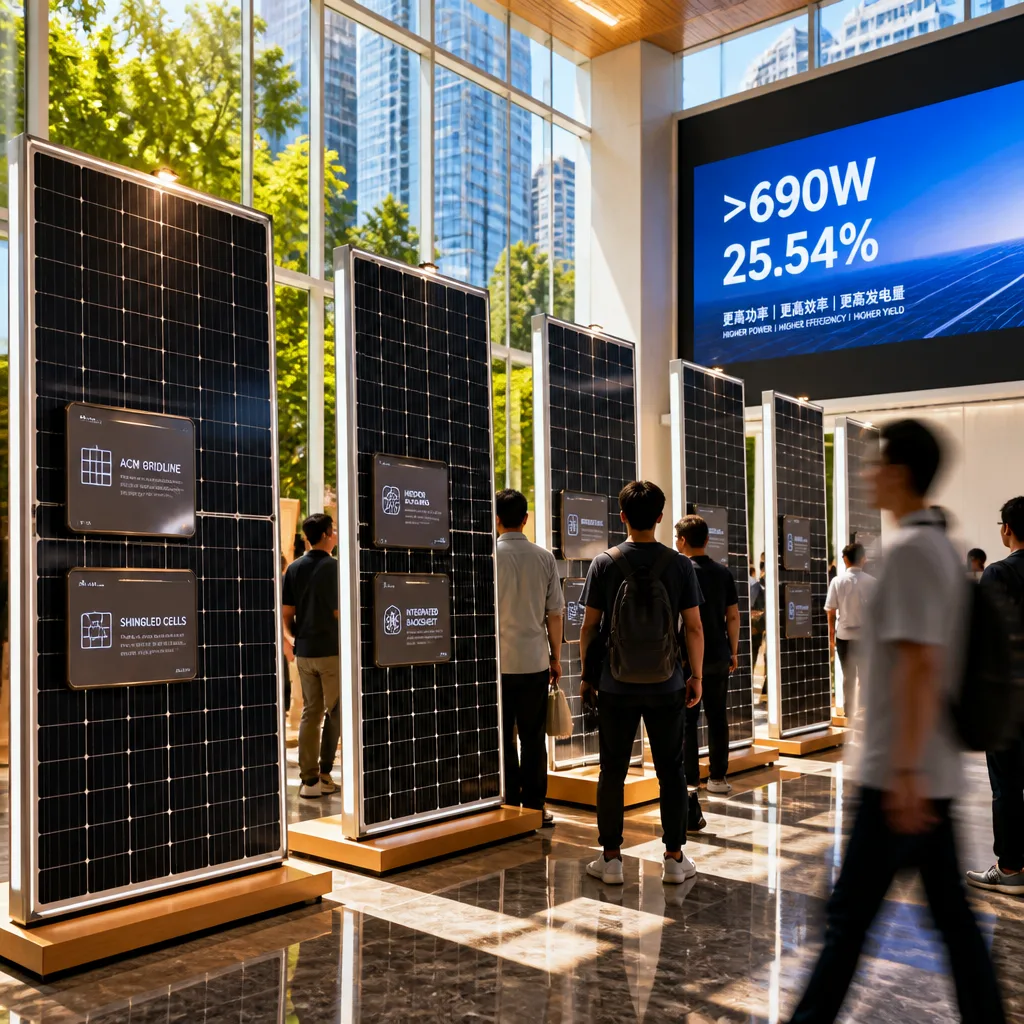
LONGi has presented a bundled set of eight photovoltaic technologies it calls a Technology Forest, saying the measures can be used together or separately to boost the output of large-format modules to above 690 watts and lift module efficiency to around 25.54% on a standard 2,382 mm by 1,134 mm panel.
What was announced
The launch, held in Shanghai on 14 July 2026, covered improvements at cell, module and hardware levels and included an energy management platform for hybrid sites. LONGi framed the package as a way to break what its chairman described as destructive pricing dynamics in the solar industry.
“a route out of "vicious price competition" for the PV sector
The most prominent technical claims include:
- Advanced Contact Matrix (ACM) gridline technology using a patented nano-alloy with anti-oxidation treatment, said to halve gridline resistance compared with conventional TOPCon and add 0.2–0.3 percentage points to mass-production efficiency in Hi-MO 9 and Hi-MO X10 modules, supporting ratings up to 672 W.
- Integrated Conductive Backsheet Technology that replaces long-standing solder ribbons by merging rear encapsulant, conductive ribbon and insulation into a single backsheet, widening current paths, reducing mechanical stress and cutting water vapour permeability.
- Shingled Cell Technology overlapping cells by 0.4 mm to increase active generating surface by roughly 2%.
- Hidden Busbar Technology relocating busbars to the rear to gain about 1.1% more light-absorbing area.
- Selective Temperature Alloy Connection (STAC), described as a low-temperature fusion bond compatible with BC cells to relieve thermal stress.
- Smart Module Technology adding on-panel intelligence (details in the announcement were limited in scope).
- A claim that LONGi has pushed perovskite tandem cells beyond a 35.5% efficiency barrier.
- LONGi One OS, an energy management platform for hybrid sites that recalculates charging and discharging every 15 minutes using market prices, forecasts and consumption data and, the firm says, improves operations and maintenance efficiency by 90%.
How the gains are framed — and what to watch for
The company provided specific percentages and wattage targets for several elements, but the announcement leaves gaps that matter for buyers, integrators and policymakers.
For example, LONGi claims the integrated backsheet both reflects light to add 3–5 W per module and reduces water vapour permeability by 90%. Those are measurable effects, but the implications for long-term reliability, thermal cycling or fielded performance over decades are not detailed in the briefing. Likewise, ACM is said to halve gridline resistance relative to “conventional TOPCon”; whether that holds across manufacturing tolerances and in large-scale production lines needs independent verification.
The package bundles incremental gains — overlapping cells, hiding busbars and enlarging current paths — each of which is modest alone, but combined they are claimed to push module ratings into the upper 600W territory. That cumulative approach is common across the industry now: small percentage improvements add up. The crucial questions will be actual yields on production lines, degradation rates in real-world conditions and balance-of-system impacts such as inverter matching and mounting considerations.
System software and operational claims
LONGi One OS is positioned as a site-level energy manager that changes battery and charging decisions every 15 minutes based on forecasted generation, consumption and market prices. The firm asserts a 90% improvement in O&M efficiency, a striking figure that will need substantiation from deployed sites. How the platform integrates with third-party inverters, whether it requires proprietary hardware, and its cybersecurity posture were not addressed in the launch material.
Implications
If the claimed gains are reproduced in independent testing and in mass production, module-level efficiencies above 25% at high wattages would squeeze generation costs and alter procurement choices for large projects. Yet the history of PV innovation shows that performance, manufacturing throughput and field durability must all align before a technology reshapes market dynamics.
| Feature | Claimed benefit |
|---|---|
| ACM gridline | Halves gridline resistance; +0.2–0.3% efficiency; supports up to 672W |
| Integrated conductive backsheet | Wider current path, -60% mechanical stress, -90% water vapour permeability, +3–5W |
| Shingled/Hidden Busbar/STAC | ~2% extra surface; +1.1% area; thermal stress relief |
| LONGi One OS | 15-minute optimisation; claimed 90% O&M efficiency improvement |
The announcement is a significant marker of where one major supplier believes value will be created: through stacking modest hardware improvements with smarter system software. The next step is independent validation and, critically, demonstration that these advances can be produced at scale without unacceptable cost or reliability trade-offs.