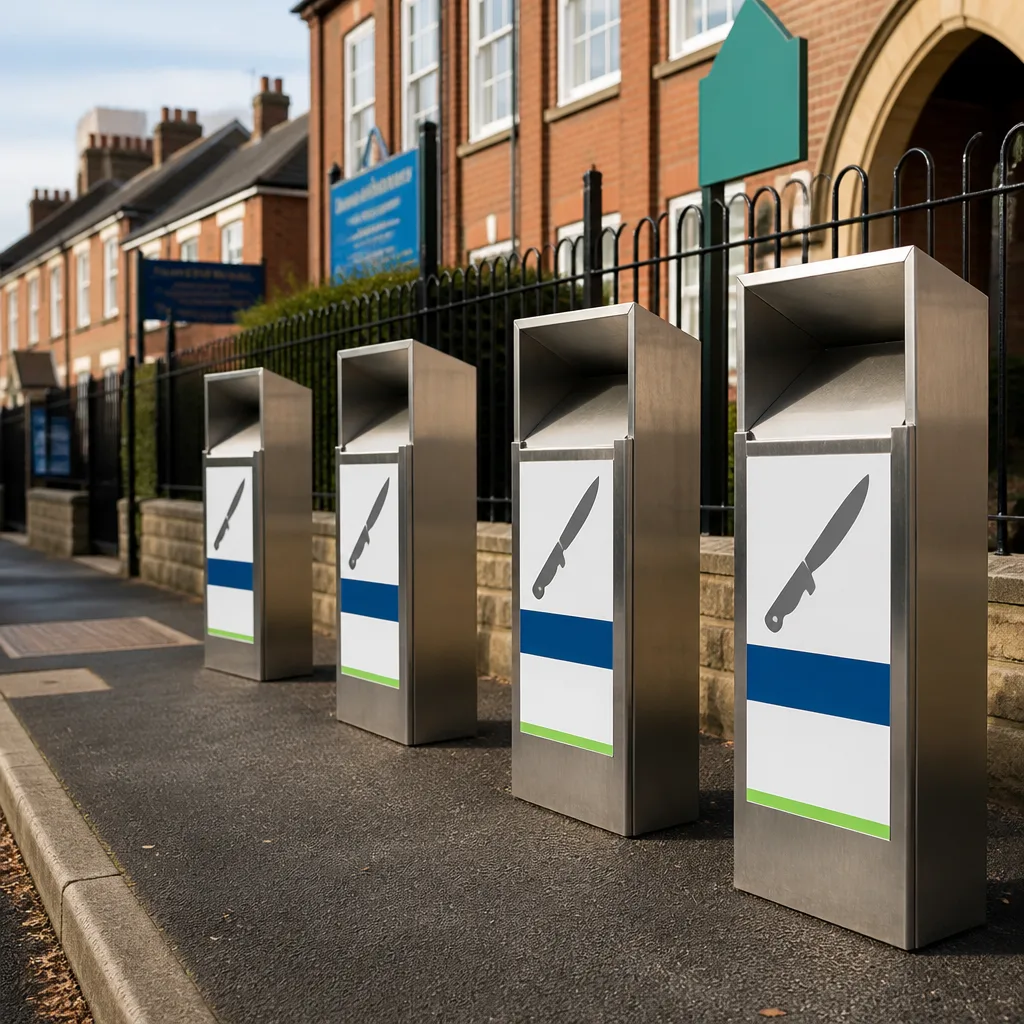
The Home Office is funding the installation of eight knife surrender bins across towns and cities in South and West Yorkshire, officials said, in a measure intended to provide an anonymous route for the disposal of blades and other weapons.
Locations and purpose
The bins will be placed in Barnsley, Dewsbury, Doncaster, Halifax, Leeds, Rotherham, Sheffield and Wakefield, local authorities confirmed. They are modelled on existing surrender initiatives that allow people to hand in knives without providing their details, a step ministers and campaigners say aims to reduce the number of weapons circulating on the streets.
The announcement follows widespread public concern after the death of a 15-year-old pupil at a Sheffield school in February 2025, when a fellow 15-year-old attacked him with a hunting knife. The victim's mother, Caroline Willgoose, who has since campaigned on knife crime issues, welcomed the new bins as part of a legacy for her son and a move towards protecting young people.
"With the new surrender bins being installed in Yorkshire, this is just a further step on the road to a positive future," Caroline Willgoose said. "I feel like that's leaving a legacy for our Harvey, he's being talked about and they're taking it seriously now."
Campaigning and community impact
Caroline described the profound effect her son's killing has had on his family and the wider community in Sheffield, saying many people remain affected by the loss. She called the bin installations "a further step" towards preventing similar tragedies.
Campaigners and officials see surrender bins as one element of a broader strategy to tackle knife crime, offering a low-barrier option for people to remove dangerous items from circulation. They typically operate alongside public awareness campaigns, policing activity and youth intervention programmes.
- Number of bins: eight
- Areas covered: Barnsley, Dewsbury, Doncaster, Halifax, Leeds, Rotherham, Sheffield, Wakefield
- Funding: Home Office
Questions and context
While surrender bins are a visible, low-cost measure, their effectiveness as a lone intervention is debated. Evidence from previous amnesties and surrender initiatives suggests they can collect large numbers of weapons, but preventing violent offending typically requires a mix of targeted policing, community engagement and early intervention with at-risk young people.
The Sheffield school killing, in which a 15-year-old was fatally wounded with a hunting knife, intensified scrutiny of knife possession among children and the measures in place in and around schools. The victim's mother has campaigned publicly for stronger action to protect pupils and to reduce knife carrying among young people.
| Aspect | Detail |
|---|---|
| Number of bins | 8 |
| Regions | South and West Yorkshire |
| Placed in | Barnsley, Dewsbury, Doncaster, Halifax, Leeds, Rotherham, Sheffield, Wakefield |
| Funding source | Home Office |
Officials have not suggested the bins are a replacement for policing or for school safety measures. Instead, they frame them as part of a package of responses intended to reduce the number of knives in circulation and provide a straightforward, anonymous disposal option for members of the public.
The announcement is likely to be welcomed by victims' families and community groups pushing for tangible action. At the same time, policymakers and law enforcement will face pressure to show how physical measures such as surrender bins are integrated with prevention and enforcement strategies to achieve lasting reductions in youth violence.
Further details on the timing of the installations and how the collected items will be processed are expected from local authorities and the Home Office in the coming weeks.