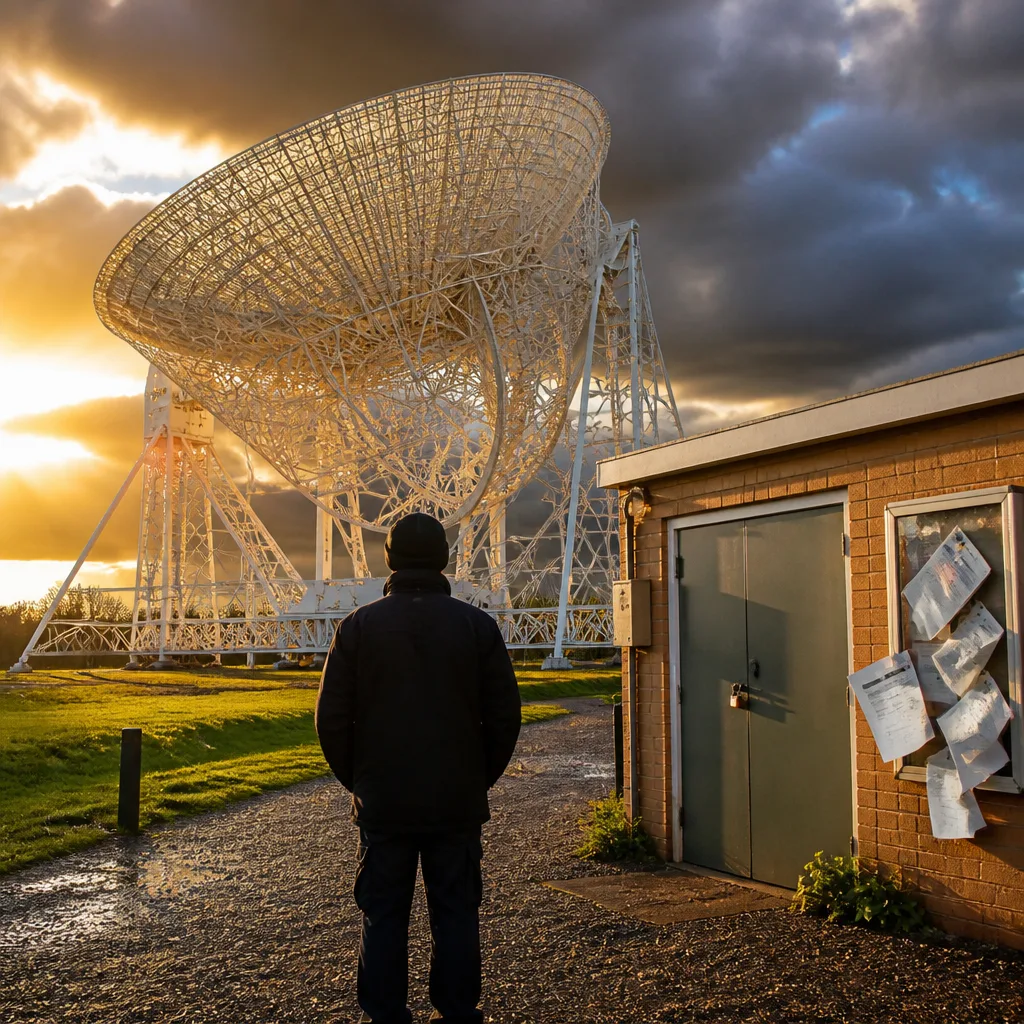
The British government funding body UK Research and Innovation (UKRI) has announced it will no longer fund the Lovell radio telescope at the Jodrell Bank Observatory, placing the future of one of the country’s most storied scientific instruments in doubt.
The decision was confirmed on Monday and affects the network of seven radio telescopes known as e‑Merlin, run by the University of Manchester at the Jodrell Bank astrophysics centre south of Manchester. UKRI said the array will not receive public funding after March 2028, following what it described as a “rigorous prioritisation process to focus investment on the areas that will deliver the greatest long‑term scientific capability, impact and value for the U.K.”
Alarm among scientists and institutions
The announcement drew immediate, forceful reactions from the scientific community. Professor Brian Cox, a University of Manchester particle physicist, called the cuts “devastating and irreversible.” Paul Howarth, president of the Institute of Physics, described recent reductions in physics funding, including this decision, as “a terrible blow to the scientific community”, and urged the incoming prime minister, Andy Burnham, to reconsider.
“For the sake of U.K. physics and our national reputation as a place to do science, conduct research and innovate, we would urge the new government to review this ruinous set of decisions,”
The University of Manchester, which operates e‑Merlin, said it is seeking alternative sources of finance from business, government or charitable bodies. Sarah Sharples, the university’s dean of science and engineering, warned that without replacement funding the Lovell Telescope faces the prospect of not being “an actively functioning scientific facility for radio astronomy” after the funding end date.
Heritage, history and capability at stake
Completed in 1957, the Lovell telescope has been a continuous presence in British radio astronomy for almost seven decades. It formed part of early Cold War space tracking — including monitoring the Soviet Sputnik launch — and later scientific milestones such as receiving lunar data in the 1960s. The dish’s prominence also contributed to the Jodrell Bank site being designated a UNESCO World Heritage Site.
Beyond its historical significance, the telescope is an active research instrument integrated into national observing networks. UKRI’s stated aim of concentrating funding where it sees greatest long‑term return has prompted debate over how to balance heritage and ongoing scientific capability.
Options and consequences
With public funding scheduled to cease in under two years, stakeholders are weighing options. The University of Manchester has begun looking for alternative funding streams but acknowledged the risk that operations could lapse. Researchers warn that losing or downgrading such a facility would reduce the U.K.’s capacity to participate in international radio astronomy projects and could deter future talent and investment.
- UKRI decision: No public funding for e‑Merlin after March 2028.
- Operator: University of Manchester running the array.
- Historical milestone: Lovell telescope completed in 1957 and part of UNESCO World Heritage Site.
How the government responds, and whether alternative backers step in, will determine whether the Lovell telescope continues as an operational scientific instrument or is preserved solely as a heritage landmark.
| Item | Detail |
|---|---|
| Funding end date | March 2028 |
| Operator | University of Manchester (e‑Merlin) |
| Completion year | 1957 |
The announcement intensifies a broader conversation about research funding priorities and the government’s strategic choices for science investment. It also sets a tight timetable for the University of Manchester and potential partners to mobilise alternative support if the Lovell telescope is to remain an active tool for radio astronomy.