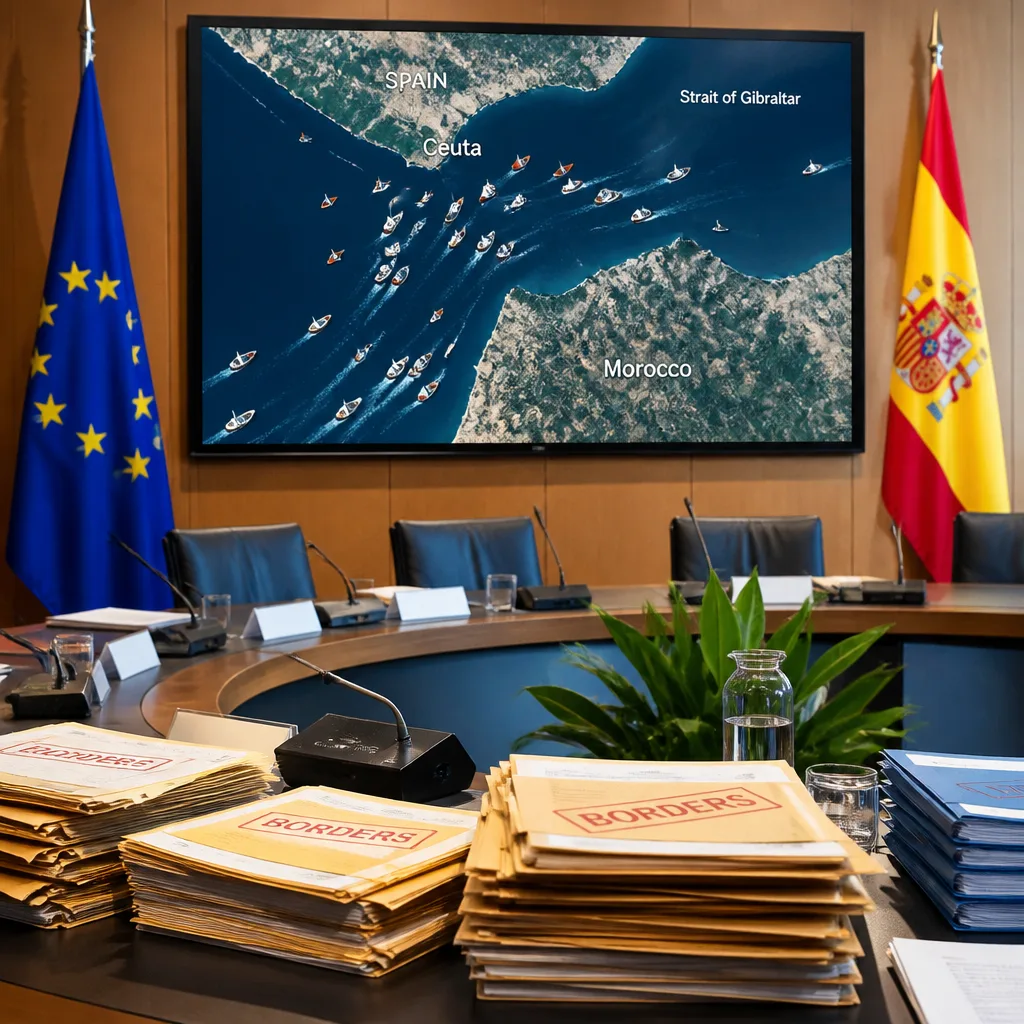
European Commission president Ursula von der Leyen has urged collective measures to bolster border security after tens of thousands of migrants crossed from Morocco into the Spanish enclave of Ceuta, prompting emergency talks among EU interior ministers on Tuesday.
Immediate response and political pressure
The sudden movement of people into Ceuta has triggered alarm in Brussels and Madrid, accelerating plans for an urgent discussion among national ministers responsible for internal affairs. The Commission president framed the situation as requiring a coordinated approach across EU member states to manage the pressures at external frontiers and to prevent similar episodes.
“We must do more to further strengthen our borders,”
The warning underlines the political urgency surrounding migration ahead of a period in which migration policy remains a sensitive issue for governments across the continent. The incident has amplified existing debates on the balance between humanitarian obligations, border control and co-operation with neighbouring non-EU countries.
What has happened and why it matters
The crossings involved people arriving in the Spanish territory from Moroccan shores. While precise, independently verified totals are not available in the source material, reports describe the influx as numbering in the tens of thousands. The scale of the movement has stressed Spanish authorities and attracted immediate attention from EU institutions.
Ceuta and Melilla, Spain’s two small enclaves on the north African coast, have long been focal points for migrants seeking entry to the European Union. Episodes of large-scale crossings place direct pressure on local services, testing asylum systems, law enforcement and diplomacy with Morocco, a crucial partner for migration management and security co-operation.
Potential policy consequences
Brussels’ push for a unified response increases the likelihood of fast-tracked proposals for reinforcing external border controls, enhancing information-sharing, and intensifying co-operation with transit and origin countries. For the UK — which is no longer an EU member — the episode still matters because European migration flows influence broader regional policy and operational arrangements for search-and-rescue at sea, asylum case management, and bilateral co-operation with North African states.
- EU interior ministers will meet urgently to discuss border security measures.
- The Commission president has urged unified action to strengthen external frontiers.
- The incident centres on migrants arriving from Morocco into the Spanish enclave of Ceuta.
| Element | Detail |
|---|---|
| Location | Ceuta (Spanish exclave on Moroccan coast) |
| Trigger | Large-scale migrant crossings from Morocco |
| Immediate action | Emergency EU interior ministers' talks |
Diplomatic and operational dimensions
Any response will require a combination of operational measures at borders and diplomatic engagement with Morocco. Madrid is likely to press for EU-level support to manage arrivals and to prevent recurrence, while Brussels seeks to marshal a coherent, cross-border approach among member states. Negotiations over resources, legal responsibility for asylum claims and co-ordination of return procedures are typically contentious and may be sharpened by this episode.
For British policymakers and security agencies, the episode is a reminder that migration crises in Europe can produce knock-on effects — influencing migration routes, policy dialogues with North African states and international search-and-rescue norms. The UK may follow EU deliberations closely, weighing whether and how to align operational co-operation or offer assistance in areas such as border management, intelligence sharing and humanitarian support.
While the immediate priorities are practical — managing arrivals and ensuring security and humanitarian needs are met — longer-term questions will revolve around the effectiveness of external border controls, the legality and fairness of asylum processing, and the political appetite among EU capitals for deeper co-operation with neighbouring countries to address root causes and transit flows.
The emergency talks set for Tuesday will test whether member states can translate high-level appeals for unity into tangible steps that both secure borders and uphold legal obligations towards people seeking protection.