The Solar Team Eindhoven at TU Eindhoven has unveiled Stella Juva, which the project team describes as the world's first solar-powered ambulance, designed to deliver medical care at the point of need in locations with little or no access to reliable electricity or fuel. The vehicle is scheduled for field testing in Kenya in August.
Purpose and design
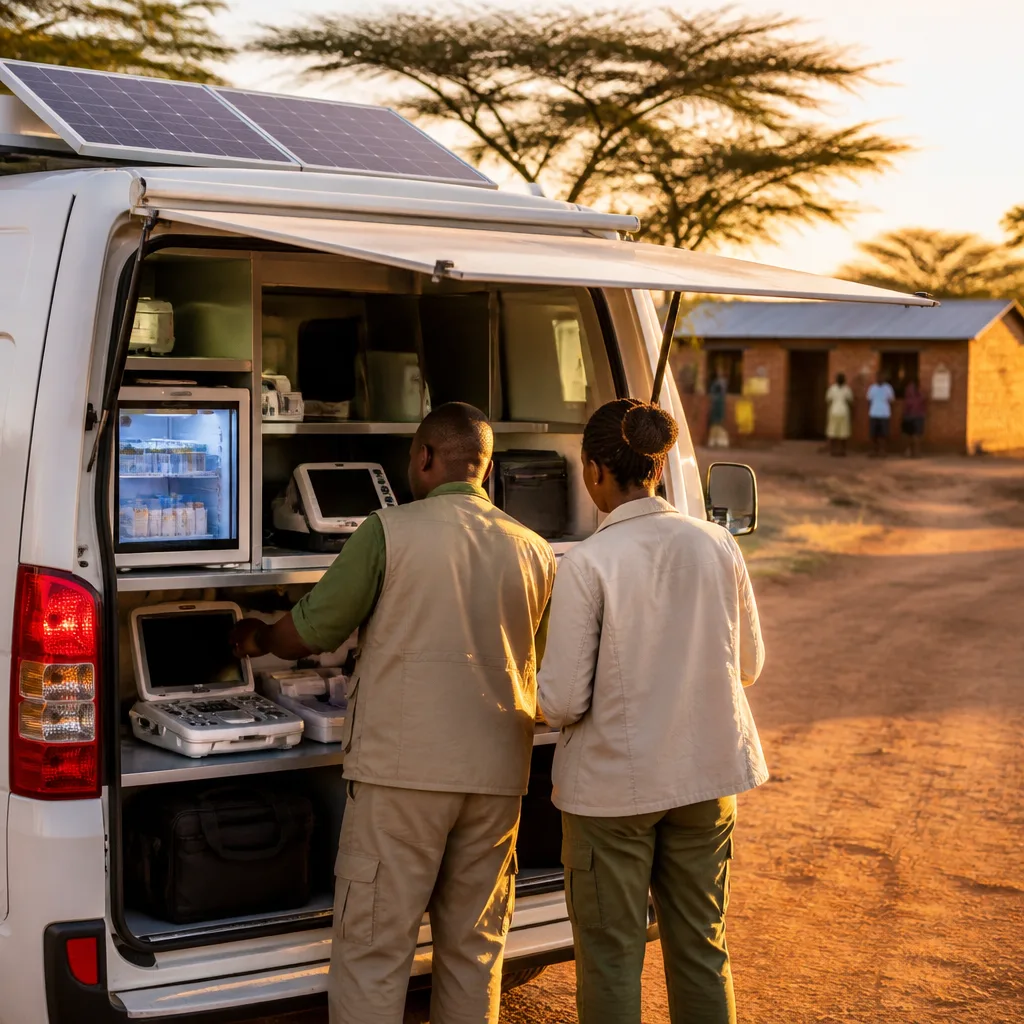
Unlike conventional ambulances, Stella Juva is not built primarily to transport patients to hospital. Instead, its layout and systems are tailored to deliver diagnostics, treatment and vaccine storage where patients are located. Solar cells integrated into the roof supply power both to the electric drivetrain and to onboard medical equipment, enabling the vehicle to operate independently of conventional charging infrastructure under favourable sunlight.
The vehicle carries equipment intended to support a range of primary-care interventions, including mobile X-ray and ultrasound machines and refrigeration for vaccines. Under sunny conditions the team reports an all-electric range of up to 715 kilometres on paved roads — a figure that helps the vehicle remain operational across long distances without access to the electricity grid.
Collaboration and practical testing
Stella Juva was developed by a student team with more than a decade of experience in solar vehicles. The project was produced in close collaboration with partner organisations, including Amref Health Africa, to ensure the concept meets real-world operational needs.
“We were inspired by the United Nations’ Sustainable Development Goals, which strive to make good healthcare accessible to everyone,”
said team manager Mathijs van Gerven. Yarno Basten, partnerships manager for the student team, added the project demonstrates what can be achieved when technology and social organisations collaborate:
“If twenty-three students can achieve this in a single year, it shows what’s possible when the technological industry and social organisations work together.”
Representatives from aid organisations have emphasised the potential for such a vehicle to address infrastructure gaps. Femke Maurits, Partnerships Manager at Amref Health Africa in the Netherlands, highlighted the reliance of many clinical services on reliable energy:
“For millions of people, access to quality healthcare remains out of reach. However, access to medical care should not depend on the availability of electricity or fuel.”
Implications for healthcare delivery
The concept behind Stella Juva speaks to several persistent challenges in global health delivery: unreliable power, long distances to facilities and the difficulty of maintaining cold chains for vaccines. A vehicle that can both power diagnostic devices and keep vaccines at the required temperatures without grid infrastructure could increase the reach of screening, treatment and immunisation campaigns in remote and rural settings.
However, questions remain about how the vehicle will perform in operational conditions beyond controlled demonstrations. Field testing in Kenya will be critical to assess real-world endurance, maintenance needs, the practicality of equipment use in variable environments, and how the vehicle fits into existing health systems and referral pathways. It will also be important to evaluate cost, supply chains for replacement parts, and training requirements for clinical teams and drivers.
For health services and charities considering similar solutions, Stella Juva offers a proof of concept that energy independence can be integrated into mobile medical platforms. But scaling such an approach will depend on robust evidence from field trials and clear plans for upkeep and integration with local health infrastructure.
- Main capability: point-of-care diagnostics and vaccine refrigeration
- Range: up to 715 km on paved roads in sunny conditions
- Not designed for: primary patient transport to hospital
- Partners: Solar Team Eindhoven, Amref Health Africa and student collaborators
| Feature | Detail |
|---|---|
| Propulsion | Electric drivetrain powered by rooftop solar |
| Medical equipment | Mobile X-ray, ultrasound, vaccine refrigeration |
| Operational aim | Deliver care at point of need, independent of grid/fuel |
Field testing in Kenya in August will provide the first opportunity to observe the vehicle’s performance in a health-delivery setting marked by the very infrastructure constraints it aims to address. The outcome may inform whether similar solar-powered platforms can be adopted more widely by aid organisations and health services seeking resilient, low-emission solutions for remote healthcare delivery.