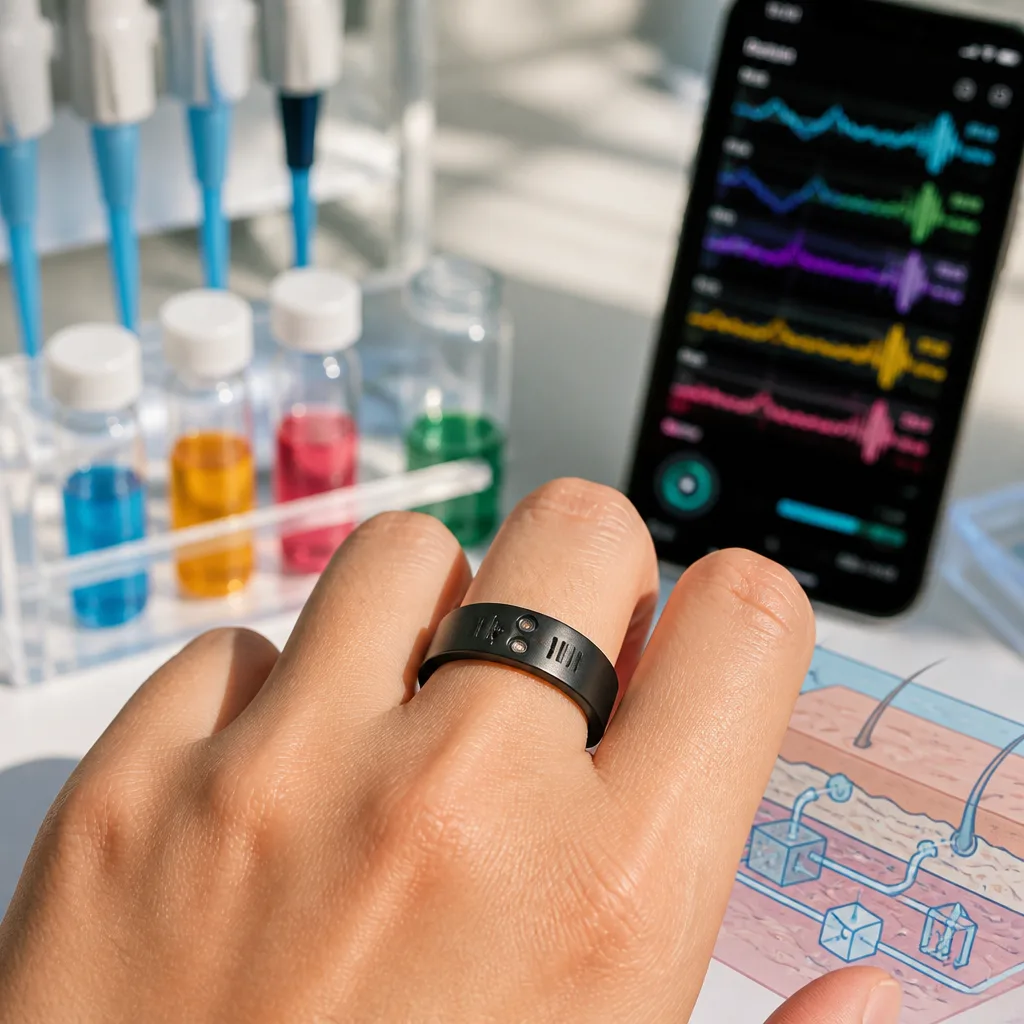
Engineers at the University of California San Diego have unveiled a wearable “smart ring” that can continuously and simultaneously monitor up to four chemical biomarkers from finger sweat, potentially expanding the information available to people managing long‑term conditions such as diabetes. The device also supports measurements of a wider set of analytes, making it a candidate for broader health and wellness monitoring.
What the ring measures and how it works
The team describes the device as the first fully integrated smart ring capable of daily biochemical monitoring. While the ring can monitor up to four biomarkers at once, the full array of biomarkers demonstrated by the researchers includes glucose, ketones, vitamin C, uric acid, lactate and alcohol. Sweat is drawn passively through the skin by an osmosis‑based technique, so the user does not need to exercise or exert themselves to produce a sample.
"Commercial rings only provide biophysical information, but they lack molecular information about biochemical markers that offers deeper insights about an individual's health status," said study first author Tamoghna Saha.
The technology uses miniaturised chemical sensors within a ring form factor. In trials reported by the team, glucose measurements from the ring closely tracked readings from commercial continuous glucose monitors (CGMs), while ketone readings aligned with those from commercial blood ketone meters. The researchers suggest simultaneous tracking of glucose and ketones could particularly inform decisions around insulin dosing and metabolic management.
Clinical and practical implications
Wearable biochemical monitoring has been a longstanding ambition in digital health. Many commercial rings and wristbands today provide biophysical data — heart rate, temperature and activity — but lack direct molecular readouts. The UC San Diego ring aims to fill that gap by delivering dynamic molecular information in near real time.
- Diabetes management: Continuous glucose and ketone data in one device could help people with type 1 diabetes and their clinicians make more informed insulin and dietary decisions.
- Nutrition and lifestyle: Monitoring lactate, vitamin C and uric acid may offer additional context on metabolic status, hydration and nutritional state.
- Alcohol monitoring: On‑ring alcohol detection could have applications in both personal and clinical settings.
The research was conducted in the laboratory of Professor Joseph Wang and led by postdoctoral researcher Tamoghna Saha. The team reports tests in healthy volunteers and people with type 1 diabetes; in those comparisons the ring’s glucose and ketone trends were consistent with established commercial devices. The published results appeared in Nature Communications.
Limitations and next steps
Important caveats remain. The findings described by the researchers stem from early trials; the available account does not provide details on sample size, duration of monitoring or the statistical performance metrics such as bias, mean absolute relative difference (MARD) or clinical accuracy classifications. Further work will be needed to validate the technology across larger and more diverse populations, and to establish regulatory pathways for clinical use.
There are also technical and practical questions to resolve before the device could be widely adopted: ensuring sensor longevity and reproducibility, managing contamination or interference at the skin–sensor interface, and integrating biochemical data with clinical decision support while preserving privacy and data security.
| Biomarker | Potential clinical relevance |
|---|---|
| Glucose | Glycaemic monitoring for diabetes management |
| Ketones | Ketosis detection, relevant in insulin dosing and metabolic state |
| Vitamin C | Indicator of antioxidant status and nutritional intake |
| Uric acid | Associated with gout risk and metabolic health |
| Lactate | Marker of anaerobic metabolism and exertion |
| Alcohol | Acute exposure monitoring |
If subsequent studies confirm robust agreement with blood‑based measures and regulatory approvals are achieved, a discreet finger ring offering continuous biochemical insight could complement existing CGMs and other wearable sensors. That could enable more personalised self‑management of chronic disease and open new avenues for remote monitoring and telemedicine.
For now, the device represents a promising step toward integrating molecular sensing into everyday wearables, but it requires further validation before it can be recommended for routine clinical use.