Council releases business case as work approaches
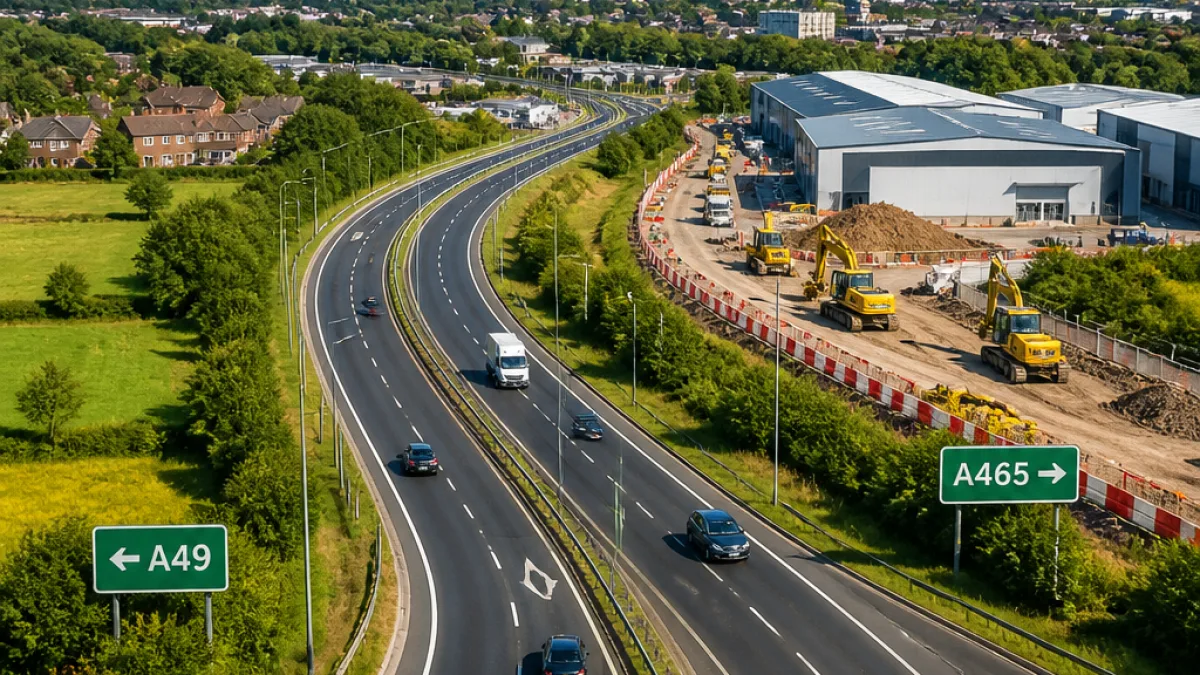
Herefordshire Council has published a 30-page business case for a new road intended to carry traffic south of the city between the A49 and A465, saying the scheme would provide an alternative route and significantly ease bottlenecks on existing streets.
The document, prepared externally by infrastructure consultancy AECOM and released ahead of the start of construction, forecasts average daily traffic falling by between 15% and 25% on Walnut Tree Avenue and the A465. A more modest reduction of around 7% is predicted for Holme Lacy Road. The council says drivers would also see faster journeys to the Herefordshire Enterprise Zone, where about 3,500 people are employed.
"One of the reasons we have produced a detailed business case is to demonstrate that the scheme represents good value for money."
The council has earmarked approximately £45m for the project. The business case anticipates an average reduction of roughly six-and-a-half minutes on trips between the city centre and the industrial areas around Rotherwas and the Enterprise Zone.
Local benefits and likely impacts
For commuters and local businesses the proposed bypass is presented as a measure to improve journey-time reliability and reduce the frequent hold-ups that affect key radial routes. The business case explicitly identifies improved reliability for bus services among the scheme’s advantages, which could matter for those who rely on public transport to reach employment, education and services.
Transport improvements may also have wider economic implications. By shortening travel times to the Enterprise Zone, where thousands work, the route could influence commuting patterns and the attractiveness of the area for firms considering expansion. The council has stressed the need to show that the public investment provides value for money before construction begins.
- Projected traffic reductions: 15–25% on Walnut Tree Avenue and the A465; about 7% on Holme Lacy Road.
- Anticipated journey time saving: ~6.5 minutes between the city centre/A465 and the Enterprise Zone.
- Funding set aside: ~£45 million.
Questions for residents and road users
While the council’s figures focus on traffic flow and time savings, residents are likely to want reassurance on environmental effects, noise, active travel provision for pedestrians and cyclists, and the potential for induced traffic — where new roads encourage more car journeys overall. The published business case provides the numerical forecast and economic rationale but detailed design and planning consultations will be the forums to examine those local concerns.
Stakeholders in Hereford have in recent years debated the balance between improving road capacity and supporting sustainable travel. Some households may welcome quicker commutes and more reliable buses, while others will look for guarantees on measures to protect residential areas and the rural landscape south of the city.
What happens next
With the business case now public, the council has signalled it will proceed towards work starting on the route. Further documentation and planning submissions will set out the technical design and mitigation measures. As the scheme moves from proposal to reality, residents and businesses in Hereford can expect consultation opportunities and more detailed timetables from the council.
| Location | Projected traffic fall | Notes |
|---|---|---|
| Walnut Tree Avenue | 15–25% | Regular hold-ups cited in council analysis |
| A465 | 15–25% | Main arterial into south Hereford |
| Holme Lacy Road | ~7% | Smaller projected reduction |
The council’s published paper aims to demonstrate that investment will deliver quantifiable improvements for road users and local employers. As the plans progress, the detail of environmental assessments, construction timetables and public consultation will shape how the bypass is delivered and experienced by the people of Hereford.