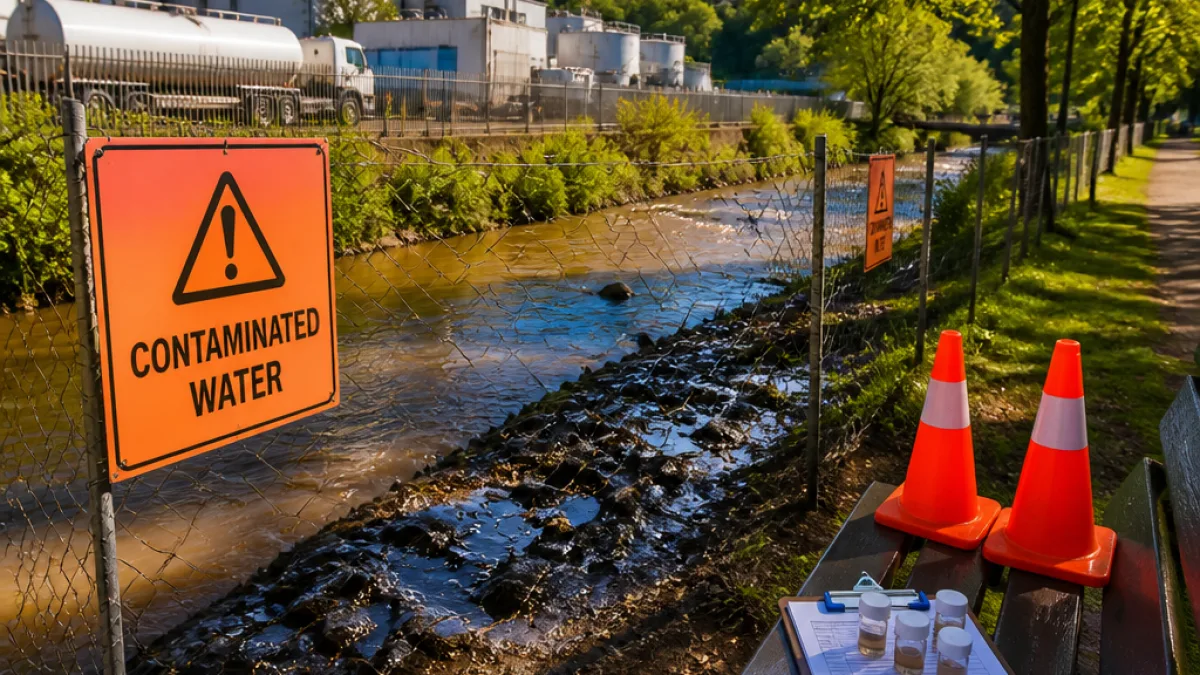
A court has imposed a series of interim requirements on Brenntag Mid‑South, Inc. after state testing detected black water and several toxic chemicals leaking from the company’s East Durham facility into a stream that runs through Burton Park and on to Third Fork Creek, which drains to Jordan Lake, the city’s drinking water source.
The order, secured by the North Carolina Attorney General’s office and the North Carolina Department of Environmental Quality, is not a final judgment in the lawsuit the state filed in June. Instead, it aims to prevent further discharges while legal proceedings continue and to force the company to set out how it will track, investigate and stop pollution.
What the court order requires
Under the timetable set by the court, Brenntag must deliver two key reports to state regulators. By 17 August the company is to explain how the leaks occurred and what they may mean for human health. A second, more detailed plan is due by 1 September, describing measures to stop future leaks.
- Submit initial incident report to the N.C. Department of Environmental Quality by 17 August.
- Provide a comprehensive prevention and remediation plan by 1 September.
- Reimburse the city of Durham for the costs of signs warning of contamination along Third Fork Creek.
- Begin maintenance of an existing construction fence in Burton Park that blocks access to the contaminated stretch of stream.
The state’s lawsuit, filed in June, alleges that Brenntag had been illegally releasing pollutants from its East Durham facility. Recent testing cited in the suit reportedly found black water and multiple toxic chemicals in the affected stream.
“Protecting the health of our community and the integrity of Durham’s waterways is one of our top priorities,” Durham Mayor Leonardo Williams said. “City staff have been diligently working for several years to address contamination linked to the Brenntag site, and we will continue taking action to safeguard our waterways.”
Local impact and the wider water system
Third Fork Creek is part of the watershed that leads into Jordan Lake — a significant reservoir and a source of drinking water for Durham and other communities. The presence of contaminants in a feeder stream raises concerns about potential downstream effects even as investigations continue to determine the scale and severity of the pollution.
The city has already taken steps to limit public exposure: signage warning residents of contamination along Third Fork Creek remains in place, and a construction fence in Burton Park has been used to block access to the affected stretch of water. The court order requires Brenntag to reimburse the city for the costs of those signs and to begin maintaining the fence.
Regulatory and legal context
State authorities say many of the actions now required by the court were matters they had previously asked the company to undertake. The order functions as a temporary enforcement measure while the litigation proceeds: it is intended to stop further releases and ensure there is a plan for remediation and prevention, but it does not resolve the underlying legal claims.
The N.C. Department of Environmental Quality will receive the reports required under the order and will be in a position to assess the company’s proposed steps. Those reports are due on tight timescales — 17 August and 1 September — which signals the urgency with which regulators and the city are treating the matter.
For residents, the immediate concerns are clear: continued monitoring of water quality, assurance that drinking water sources remain protected, and visible action to prevent further contamination of local green spaces such as Burton Park. The court-mandated reports should provide more detail on how Brenntag proposes to identify the causes of the leaks and to prevent a recurrence.
As the case moves through the courts, Durham’s civic leaders and state regulators will be watching the company’s compliance with the order closely. The required reimbursements and fence maintenance are among the practical steps intended to limit risk to the public while the legal process plays out.
| What | Deadline |
|---|---|
| Initial incident and health impact report to DEQ | 17 August |
| Detailed prevention and clean‑up plan | 1 September |
The court order represents a step towards accountability, but it leaves open the broader questions about how widespread contamination might be and what long‑term remediation will be required. Durham’s waterways and its residents will be waiting for the company’s reports and for regulators’ assessments of those submissions.